Sign in

John Greenwood

@jagreenwood.bsky.social
1.1K followers 365 following 47 posts

Vision scientist in Experimental Psychology, University College London. Foreigner. Father. Posting perception, neuroscience, music & I guess reposted memes. He/him. Lab website: eccentricvision.com

PostsRepliesMedia
Reposted by John Greenwood
Steve Fleming @smfleming.bsky.social · 13h
Excited to be launching our new PhD program in Minds and Machines at UCL with co-Directors Tali Sharot and @nadinedijkstra.bsky.social To apply, find out more here: www.ucl.ac.uk/brain-scienc... Our launch event is on Nov 10th, with a cracking lineup of speakers: luma.com/cikzcth0
lnkd.in
LinkedIn
This link will take you to a page that’s not on LinkedIn
16434
Reposted by John Greenwood
worm @rfksbrainworm.bsky.social · 02/10/2026
If you ever wondered why visible light is those particular wavelengths, it's because life evolved to see in the narrow range where water is transparent
Diagram of absorption of emf by water. There's a gap right that dips in the 500 nm range
10260491693
Reposted by John Greenwood
Derek Arnold @visnerd.bsky.social · 12/09/2026
This is our summary of where we think the field of Aphantasia research stands. Congenital aphantasia: what we (think we) know, what we thought we knew but were mistaken about, and what we don't know. www.sciencedirect.com/science/arti...
sciencedirect.com
Congenital aphantasia: what we (think we) know, what we thought we knew but were mistaken about, and what we don't know
Congenital Aphantasia initially described a lifelong inability to visualise. But it is now understood to manifest as imaginative inabilities that can …
63613
Reposted by John Greenwood
Haus of Decline @hausofdecline.bsky.social · 12/09/2026
I feel that certain forms of art are relatively insultated from the threat of AI. It will create a bifurcated market, where people who engage with art primarily as a distraction will bow to the machine, whereas people that use art for its emotional value will pay a premium for human made stuff.
241408117
Reposted by John Greenwood
Pascal Mamassian @mamassian.bsky.social · 09/07/2026
How meaningful is it to search for the minimal exposure duration of a stimulus to understand visual perception? With Mark Wexler, we wrote a commentary on the article of Lanfranco et al., Nat. Commun., 2024: www.nature.com/articles/s41...
nature.com
The meaningfulness of searching for minimal exposure duration to understand visual perception - Nature Communications
Nature Communications - The meaningfulness of searching for minimal exposure duration to understand visual perception
1237
Reposted by John Greenwood
Dr. Scandal Piñata @dr-g.myatproto.social · 03/07/2026
It’s astounding how much the functioning of universities depends on a significant fraction of faculty being workaholic people pleasers with poor boundaries and ADHD
031479
Reposted by John Greenwood
Paul Byrne @theplanetaryguy.com · 25/06/2026
1) Open this image up 2) Find the small, blue feature in the very middle Congratulations, you've spotted the Perseverance rover on Mars, photographed from orbit! 3) Trace the rover tracks as they wend their way across the surface
A complex landscape of buttes, hills, hummocks, and sand dunes, in tones of gold and teal. In the middle, a small, beetle-blue feature. Around it, faint parallel tracks.
411150388
Reposted by John Greenwood
Michael Okun @michael-okun.bsky.social · 10/06/2026
I’ve officially resigned as Associate Editor for Frontiers in Systems Neuroscience. It used to be a reputable journal, but became a case study in how forced automation destroys academic integrity. 👇
5435861430
Reposted by John Greenwood
#NeuroDegeneration preprints @prepub-neurodegen.bsky.social · 21/05/2026
Incomplete letter recognition is limited by cortical and not optical factors: Simulating the visual deficits of dementia in healthy adults #NeuroDegeneration 🧪🧠 www.biorxiv.org/content/10.64898/20…
001
Reposted by John Greenwood
Dr Reshanne Reeder @kerblooee.bsky.social · 09/05/2026
Paper now published in Neuroscience of Consciousness and led by @chkhaidze.bsky.social: From dots to faces: individual differences in visual imagery capacity predict the content of Ganzflicker-induced hallucinations academic.oup.com/nc/article/2...
academic.oup.com
From dots to faces: individual differences in visual imagery capacity predict the content of Ganzflicker-induced hallucinations
Abstract. A rapidly alternating red and black display known as Ganzflicker induces visual hallucinations that reflect the generative capacity of the visual
0215
Reposted by John Greenwood
bganschow.bsky.social @bganschow.bsky.social · 06/05/2026
The complete psilocybin mushroom has compounds the enrich the experience. These are missing in the refined "clinical" psilocybin. But even in its clinical form it’s a delight to the human brain…like a toy of light…quite enriching. www.sciencealert.com/a-single-dos...
sciencealert.com
A Single Dose of Psilocybin Induces Lasting Brain Changes, New Study Suggests
Just one insightful psychedelic trip can have a profound impact on a person, and a new study goes some way to explaining why.
052
Reposted by John Greenwood
Petter Törnberg @pettertornberg.com · 23/04/2026
Social media is no longer social. Most of it is passive viewing of videos and pictures from people we've never met. But we're still studying social media like it's 2010. We've entered the post-social media era — and research needs to catch up. osf.io/preprints/so... preprint w/ Richard Rogers
392982945
Reposted by John Greenwood
A.R. Moxon @juliusgoat.bsky.social · 09/04/2026
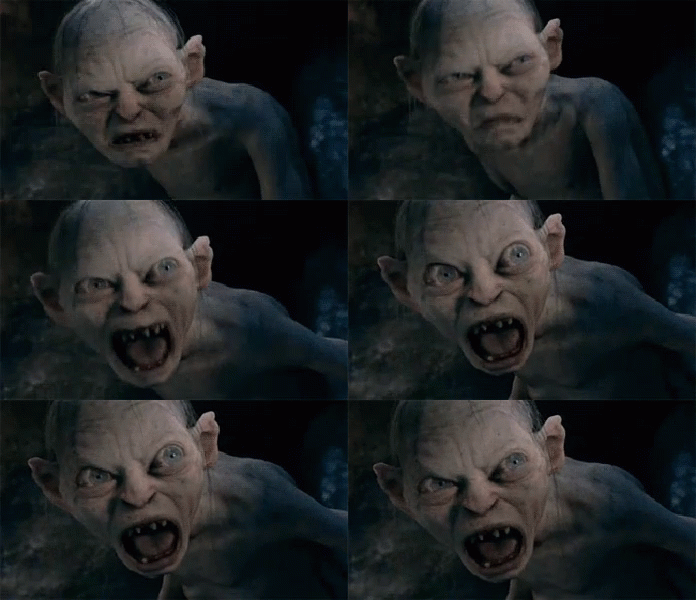
Social media apps as Lord of the Rings characters, a thread: Twitter: Twitter is Gollum. Began as a normal halfling. Overexposure to evil left it thin and stretched and bitter.
media.tenor.com
a close up of a gollum from the lord of the rings with a very angry look on his face
Alt: a close up of a gollum from the lord of the rings with a very angry look on his face
4236761210
Reposted by John Greenwood
Katie Mack @astrokatie.com · 03/04/2026
More context on this #Artemis II image: * This is the night side, lit by moonlight. You can see city lights in Spain & Portugal, & a sliver of day at lower right * The Sun is entirely behind Earth, which makes it a kind of solar eclipse, but w/ Earth doing the eclipsing instead of the Moon: ☀️🌍🚀🌕
A full disc image of Earth, as seen from the Orion Crew Module. The planet is a pale blue, swirling with white clouds and glowing slightly lighter blue in place from reflected light. At lower left, a large brown landmass is Africa, with Spain and Portugal with twinkling lights where the planet curves. At top right, auroras glow in a thin green glow, just barely separated from the planet's surface. Earth is set against the black of space (pic: NASA/R.Wiseman)
231130433679
Reposted by John Greenwood
Zach Weinersmith @zachweinersmith.bsky.social · 02/04/2026
Hey geeks! We're ordering extra blank mugs for the upcoming Mother's Day, but if you want one of our statistical parent mugs, please get your order in. smbc-store.myshopify.com/products/goo...
419223
Reposted by John Greenwood
Dennis B. Hooper @dennisbhooper.bsky.social · 12/02/2026
please enjoy these classic Moon Tweets™
Molly Lambert
@mollylambert
I respect the moon's unwillingness to be photographed on a phone
12:31 PM • 12/12/19 • Twitter Web App
59.5K Retweets 294K LikesLance St. Laurent @LanceStLaurent
When you see this blatant anti-moon propaganda, consider the source
The Sun
@TheSun • Jan 18, 2019
'Super blood wolf moon' may trigger end of the world this weekend
thesun.co.uk/news/8223896/s.
8:32 PM • Jan 20, 2019 • Twitter for iPhone
49.9K Retweets
493 Quote Tweets
238.7K LikesPaul Ford v @ftrain
When the moon hits your knees And you mispronounce trees
Sycamore
5:14 AM • 2/27/18 • Twitter for Android
13.6K Retweets 37.3K Likesdustin Couch
@Dustinkcouch
nasa employee: oh hey u guys are back early
astronaut: moon's haunted
nasa employee: what?
astronaut: *loading a pistol and getting back on the rocket-ship* moon's haunted
10:18 PM - 29 Oct 2018
6663501768
Reposted by John Greenwood
ECVP 2026 @ecvp.bsky.social · 27/03/2026
📅 Early bird registration for European Conference on Visual Perception closes 7 April. Join the vision science community in Bournemouth this August and secure your place at a reduced rate. 🔗 Register: www.eventbrite.co.uk/e/ecvp-2026-... #ECVP2026 #VisionScience
eventbrite.co.uk
ECVP 2026 European Conference on Visual Perception
ECVP 2026, 48th European Conference on Visual Perception, 23-27 August, Bournemouth, UK
025
Reposted by John Greenwood
Nadine Dijkstra @nadinedijkstra.bsky.social · 27/03/2026
Check out this new cross-journal special Collection on Visual Imagery at Nature Communications, Communications Psychology and Scientific Reports: www.nature.com/collections/...! Get submitting! @natcomms.nature.com, @commspsychol.nature.com
nature.com
Visual Imagery
Editors invite manuscripts that highlight recent developments in the mechanisms, functions and experience of visual mental imagery. Topics include, but are ...
0126
Reposted by John Greenwood
Kamila Maria Jozwik @kamilajozwik.bsky.social · 23/03/2026
postdoc and PhD positions in visual cognitive computational neuroscience in my lab at the University of Cambridge kamilajozwik.com/join_lab.html
kamilajozwik.com
Kamila Jozwik - Join lab
12712
Reposted by John Greenwood
Andrea Benucci @andrea-benucci.bsky.social · 20/03/2026
How psychedelics push your brain to dream while awake – new study theconversation.com/how-psychede...
theconversation.com
How psychedelics push your brain to dream while awake – new study
How psychedelics induce intense visuals.
0113
Reposted by John Greenwood
Helen Czerski @helenczerski.bsky.social · 14/03/2026
Ever wondered why you can see underwater bubbles: invisible air in invisible water? It's because light bends slightly at the boundary between air & water, so light coming from behind the bubble is diverted away from your eye. The resulting dark line shows you the bubble must be there. Beautiful!
561902286
Reposted by John Greenwood
Jean-François Bonnefon @jfbonnefon.bsky.social · 11/03/2026
I like how typos in manuscripts are no longer considered evidence of sloppiness, and have turned instead into luxury signals of hand-crafted writing by a human master wordsmith who keeps to the traditional ways
412526
Reposted by John Greenwood
Nika Adamian @nikaadamian.bsky.social · 12/03/2026
OK vision friends, who's ready to break this tool 😜 www.keithcirkel.co.uk/whats-my-jnd/
keithcirkel.co.uk
What's My JND?
Find your Just Noticeable Difference in colour perception. How small a colour difference can you actually see?
634
Reposted by John Greenwood
Pascal Mamassian @mamassian.bsky.social · 12/03/2026
A new Department of Cognitive Science is being created at Bocconi University in Milan, Italy. Here is the call for a cluster hire (for around 10 faculty) in all areas of cognitive science, at both junior and senior levels: www.unibocconi.it/en/faculty-a... Deadline: May 4th, 2026
unibocconi.it
Open Rank Faculty Cluster Hire Search for the New Department of Cognitive Science at Bocconi - Bocconi University
3150119
Reposted by John Greenwood
Aidan Horner @aidanhorner.bsky.social · 11/03/2026
Exciting news! The @yorkpsychology.bsky.social are recruiting 3 new ART (research and teaching) lecturers! One role will be prioritised for cognitive, affective and/or social neuroscience. #neuroskyence #cognition #psychscisky #neurojobs
jobs.york.ac.uk
Jobs - The University of York
16459
Reposted by John Greenwood
Will Harrison @willjharrison.bsky.social · 09/03/2026
I'm looking for a skilled PhD student who doesn't want to work too hard but still do great science: unisc-cp.enquire.cloud/round/RND-00...
Screenshot of job ad:
How do Bayesian brains acquire priors?
APPLICATIONS CLOSE
20/4/2026 11:55 PM


Summary of the Project
This project explores how the brain constructs perceptual experience from visual input, focusing on the role of Bayesian models in perception. A key challenge in vision science is understanding how humans interpret complex scenes from the limited information available in retinal images. Modern theories suggest that perception involves probabilistic inference, where the brain integrates sensory signals with prior expectations to make sense of the world. However, the origins and nature of these expectations remain poorly understood. This research aims to advance our understanding of perceptual experience by examining how structured patterns in visual input can inform models of perception. The work spans computational modelling and experimental approaches to uncover principles that explain how visual systems interpret properties such as shape, material, and lighting from images. By addressing fundamental questions about perception, this project will contribute to psychology, neuroscience, and artificial intelligence, offering insights into how biological and artificial systems can learn to interpret complex environments.
02111
Reposted by John Greenwood
Ondrej Zika @ondrejzika.bsky.social · 04/03/2026
Come join us in Dublin: Assistant Professor/Lecturer in Neuroscience position available at UCD! Let me know if you have any questions :) full advert here: lnkd.in/dW_uFuab
087
Reposted by John Greenwood
Hugo Spiers @hugospiers.bsky.social · 04/03/2026
Re-visiting cognitive reserve: The importance of multiple brain measures "‘cognitive reserve’ broadly refers to better-than-expected cognitive abilities in old age, presumed to reflect environmental/lifestyle factors earlier in life." Nice review from Rik Henson: journals.sagepub.com/doi/full/10....
journals.sagepub.com
Sage Journals: Discover world-class research
Subscription and open access journals from Sage, the world's leading independent academic publisher.
0112
Reposted by John Greenwood
Pascal Mamassian @mamassian.bsky.social · 24/09/2025
A nice shift in perceived colour between central and peripheral vision. The fixated disc looks purple while the others look blue. The effect presumably comes from the absence of S-cones in the fovea. From Hinnerk Schulz-Hildebrandt: arxiv.org/pdf/2509.115...
An array of 9 purple discs on a blue background. Figure from Hinnerk Schulz-Hildebrandt.
32764295
Reposted by John Greenwood
John Greenwood @jagreenwood.bsky.social · 23/02/2026
Why do children struggle to recognise objects in cluttered scenes more than adults? Our new paper looks at the development of visual acuity and crowding across childhood, and the way the visual system fine tunes our ability to see detail: www.nature.com/articles/s41...
23617
Reposted by John Greenwood
Ryan Moulton @moultano.bsky.social · 26/02/2026
Millenials got the last childhood before social media, the last dating before the apps, and the last white collar careers before AI. If you think the boomer resentment is bad, lots worse coming.
39815
Reposted by John Greenwood
Dan McQuillan @danmcquillan.bsky.social · 25/02/2026
Good👏to👏see👏UK👏research👏funding👏 keeping👏a👏critical👏and👏rigorous👏academic distance👏from👏AI👏hype👏and 👏AI-pilled👏government 👏policy www.ukri.org/publications...
ukri.org
UKRI AI Research and Innovation Strategic Framework
093
Reposted by John Greenwood
Micah G. Allen @micahgallen.com · 25/02/2026
@francescafardo.bsky.social, Camilla E. Krænge & colleagues on evidence accumulation in temperature perception. Distinct roles for spatial summation and lateral inhibition. Really nice work, great collab: www.sciencedirect.com/science/arti...
062
Reposted by John Greenwood
Quark Bee @quarkbee.bsky.social · 25/02/2026
Ghislaine Maxwell's father made a fucktonne of money off academic publishing. He owned Pergamon Press, profiting off decades of dizzying growth and profit margins before selling to Elsevier for 100s of millions and falling off his yacht. I think this should be way more common knowledge than it is.
26525
Reposted by John Greenwood
Joe Hanson @drjoehanson.bsky.social · 28/10/2025
When people learn with ChatGPT instead of following their own searches, they end up knowing less, caring less, and producing worse advice, even when the facts are the same. Friction is an essential ingredient for learning! Convenience makes us shallow. academic.oup.com/pnasnexus/ar...
academic.oup.com
Experimental evidence of the effects of large language models versus web search on depth of learning
Abstract. The effects of using large language models (LLMs) versus traditional web search on depth of learning are explored. A theory is proposed that when
201329609
Reposted by John Greenwood
RoordaLab @roordalab.bsky.social · 24/02/2026
Vision Science makes the front page of NYT!! featuring work from @neurofishh.bsky.social and @denilsson.bsky.social with comments from Berkeley's own @karthikshekhar.bsky.social #visionscience www.nytimes.com/2026/02/23/s...
nytimes.com
The Rise of Eyes Began With Just One
04319
John Greenwood @jagreenwood.bsky.social · 23/02/2026
Why do children struggle to recognise objects in cluttered scenes more than adults? Our new paper looks at the development of visual acuity and crowding across childhood, and the way the visual system fine tunes our ability to see detail: www.nature.com/articles/s41...
23617
Reposted by John Greenwood
Titus von der Malsburg @tmalsburg.bsky.social · 10/02/2026
We compared the TRACKPixx3 eye-tracker against the EyeLink 1000 Plus. Across 8 tasks, accuracy was similar. One key difference: TPx3 aggressively smooths sample data, which may affect sub-fixation phenomena and fixation onsets. Check the paper for the full results. osf.io/preprints/ps...
Schematic representation of the sequence of tasks in the benchmark.
172
Reposted by John Greenwood
Emi @kayamalie.bsky.social · 09/02/2026
Whale evolution makes me uncomfortable
A diagram of the evolution of whales, from land dwelling mammals to the ocean giants we know today.
46792281312
Reposted by John Greenwood
SueYeon Chung @sueyeonchung.bsky.social · 10/02/2026
Our paper is out in @natneuro.nature.com! www.nature.com/articles/s41... We develop a geometric theory of how neural populations support generalization across many tasks. @zuckermanbrain.bsky.social @flatironinstitute.org @kempnerinstitute.bsky.social 1/14
7278101
Reposted by John Greenwood
Ben Collins @bencollins.bsky.social · 06/02/2026
Once again, it turns out “fully autonomous” means “a guy in the Philippines.”
futurism.com
It Turns Out Waymos Are Being Controlled by Workers in the Philippines
During a Congressional hearing, Waymo's chief safety officer, Mauricio Peña, was grilled over the company's reliance on overseas workers.
620221406714
Reposted by John Greenwood
Biyu Jade He @biyuhe.bsky.social · 04/02/2026
Ever wondered how the Dalmatian Dog effect works? The human brain can quickly learn from a single experience and generalize it to related experiences — an impressive feat so far not matched by AI. Our new paper in @natcomms.nature.com reveals how this works. www.nature.com/articles/s41...
28433
Reposted by John Greenwood
Nicole Rust @nicolecrust.bsky.social · 21/01/2026
Let's talk about "grumpy lab person". Many labs have them. With an eye to keeping science at its most rigorous, they cross the line into criticism that's too harsh. They are the ones who risk killing your scientific spirit. They are reviewer 2. /1
Grumpy from Disney's Snow White and the 7 dwarves.
77219
Reposted by John Greenwood
Dr Reshanne Reeder @kerblooee.bsky.social · 09/01/2026
Welcome to the world of Ganzflicker... in comic form!? Comic by the fabulous daltonkaygreta@gmail.com, Instagram: @Mr.dog.art A MassArt initiative led by @hudrewthis.bsky.social Hallucinations are often feared and unwanted... But what if we could induce them, so we can better understand them?
Narration:
Hallucinations are complex phenomena occurring involuntarily to individuals with a mental disorder. They are often feared and unwanted. 

Narration:
 But what if they can be controlled? What if we could intentionally induce them in a secure way, so we can better understand them?

Narration:
In order for an experimentally induced hallucination to form, the mind must be presented with something specific that is visually very different from what it is accustomed to seeing.

Narration:
Sensory deprivation: The lack of stimuli (specifically visual). Participants engaging in this method of hallucination induction can be completely blindfolded or left in a pitch black environment. Either way, their mind must not be exposed to light.

Narration:
Ganzfeld: A uniformly colored, luminary visual field (e.g. a clear blue sky or a singular color on a screen). Exposure to ganzfeld can induce slight visual hallucinations. 
(Figure laying on the grass, facing a clear blue sky.)

Narration:
Sensory deprivation can be an unreliable method for the intention of experiencing induced hallucinations. Visuals aren’t always guaranteed, and it can take hours or even days for imagery to start showing up. 
(Figure sitting on the ground, blindfolded. Cobwebs are on the figure, signifying a long time has passed. A little spider is next to the figure.)

Narration:
Ganzfeld is also not very reliable. Though most individuals experience visuals, they are not very complex. Most experience colors and simple geometric patterns after a while.
(Side view of a head, a cloud forming from their head that contains simple geometric shapes.)

Narration:
But is there a way to induce complex and vivid hallucinations almost immediately and comfortably? There sure is!
(Two figures, shoulders up, next to each other. Exclamation marks next to one, and a question mark next to the other. They are both looking at the text bubble.)
174
Reposted by John Greenwood
Fernanda Ribeiro @felenitaribeiro.bsky.social · 01/12/2025
Investigating individual-specific topographic organization has traditionally been a resource-intensive and time-consuming process. But what if we could map visual cortex organization in thousands of brains? Here we offer the community with a toolbox that can do just that! tinyurl.com/deepretinotopy
48540
Reposted by John Greenwood
Women in Neuroscience UK @womeninneurouk.bsky.social · 25/11/2025
Brenda Milner showed the world that memory isn’t one thing — the hippocampus supports our life stories, while other circuits let us keep learning skills. Her research on patient H.M. built the foundation of cognitive neuroscience. #WomenInScience #MemoryResearch #NeuroHistory
05820
Reposted by John Greenwood
Sam Schwarzkopf @sampendu.bsky.social · 23/11/2025
It is our great honour to announce the APCV Keynote at #epc-apcv-2026: Prof. Hakwan Lau from the Institute for Basic Science in Korea! The call for member-initiated symposia & abstracts is now open: visualneuroscience.auckland.ac.nz/epc-apcv-2026 #psychscisky #visionscience #neuroskyence
1258
Reposted by John Greenwood
Marco Aqil @marcoaqil.bsky.social · 23/11/2025
Our new paper is out in Nature Communications! nature.com/articles/s41... We combined psychophysics, 7T fMRI, and computational modeling of vision with placebo, 5mg, and 10mg psilocybin, in the same group of participants, to clarify the computational mechanisms of psychedelics. 🧵
26623