Sign in

John Nyakatura

@johnnyakatura.bsky.social
459 followers 771 following 34 posts

Biologist at Humboldt University, Berlin... Zoology, Functional Morphology, Comparative Anatomy, Biomechanics, Evolutionary Biology, etc. Follow this profile for any news from our lab.

PostsRepliesMedia
Reposted by John Nyakatura
German Society for Mammalian Biology @mammalbiology.bsky.social · 17/09/2026
The Annual Meeting 2026 draws to a close and we’re looking back on an inspiring week! 🐾 Thank you to all speakers, presenters, participants and everyone who made this 100th anniversary meeting so special! 🎉 @mfnberlin.bsky.social #DGS2026 #Mammalogy #MammalianBiology
0136
Reposted by John Nyakatura
Human Frontier Science Program @hfspo.bsky.social · 05/08/2026
Between presentations and conversations, participants at the HFSP Frontier Workshop are exploring how fossils, AI, robotics and computational science can advance our understanding of evolution. #HFSP #HFSPFrontierWorkshop #Evolution #AI #sts 🧪
033
Reposted by John Nyakatura
Lene Liebe Delsett @leneliebedelsett.bsky.social · 05/08/2026
Thank you for inviting me to speak and for three very inspiring days at the @hfspo.bsky.social #HFSPFrontierWorkshop in London!
051
John Nyakatura @johnnyakatura.bsky.social · 22/07/2026
That was fun. @aperegrination.bsky.social please join us as often as you like. I am also looking forward to push our FEA project further ahead 🤩
050
Reposted by John Nyakatura
Pauline Provini @paulineprovini.bsky.social · 09/07/2026
@johnnyakatura.bsky.social presents how #XROMM scientific rotoscoping allows us to compare kinematics across species and even infer fossils movements @europexn.bsky.social #SEBconference
032
Reposted by John Nyakatura
Dr Alessio Veneziano @aveneziano.bsky.social · 09/06/2026
Finally out! Trabecular structure in tamarins changes depending on their leaping distance! A collaboration with U. Nguyen, @fabioalfieri2.bsky.social, A. Licht and @johnnyakatura.bsky.social, using my #R package "indianabones". (1/2) #primates #BioAnth #bones #science 🧪🐒🦴🏺 doi.org/10.1002/ajpa...
Visualisation of the result of the 3D node density computation on the proximal epiphysis of tamarins (detail of Figure 2 of the linked paper). A: anatomical section shown in B, C and D; B: 3D visualisation of the section; C: section in 2D showing the trabecular structure; density of trabecular nodes in 3D, shown as a colourmap.
192
Reposted by John Nyakatura
Fabio Alfieri @fabioalfieri2.bsky.social · 09/06/2026
New paper out! 🦴🐒 In the trabecular bone of tamarin limbs, we found that beyond non-locomotor factors, leaping distance leaves a signal! Thanks to @aveneziano.bsky.social, and colleagues from the lab led by @johnnyakatura.bsky.social Open Access on American Journal of Biological Anthropology
0124
John Nyakatura @johnnyakatura.bsky.social · 09/06/2026
Finally out. More of our work on tamarins 🤩. Whole‐Epiphysis Trabecular Bone in Tamarin Limbs Suggests Effects of Leaping Distance Alongside Non‐Biomechanical Factors - Nguyen et al. - 2026 - American Journal of Biological Anthropology - onlinelibrary.wiley.com/doi/10.1002/...
onlinelibrary.wiley.com
Whole‐Epiphysis Trabecular Bone in Tamarin Limbs Suggests Effects of Leaping Distance Alongside Non‐Biomechanical Factors
Objectives Beyond non-biomechanical factors, the trabecular architecture of long bone epiphyses variably underlies functional adaptations to locomotor behavior. A recent study, characterizing tamari.....
083
Reposted by John Nyakatura
Armita R. Manafzadeh @armanafzadeh.bsky.social · 13/05/2026
Our work on mammalian hallucal grasping, led by Irene Montañez-Rivera during her time in the @johnnyakatura.bsky.social group, is out now in iScience. A true team effort; thanks to the whole crew for inviting me to contribute a small piece! www.cell.com/iscience/ful...
1138
John Nyakatura @johnnyakatura.bsky.social · 12/05/2026
Very proud of the first paper of the PhD project of Adrian Scheidt.
171
John Nyakatura @johnnyakatura.bsky.social · 13/04/2026
2 PhD Opportunities! 🤩 We are recruiting two highly motivated PhD students to join an ambitious project advancing Robotic Paleontology—a rapidly emerging field that fuses paleontology, biomechanics, simulation, and robotics. nyakaturalab.com/news/ Please share!!
nyakaturalab.com
Nyakatura-Lab for Comparative Zoology | News
See what’s been happening in the Nyakatura Lab. News: discover our latest publications, recent events, and research highlights.
01723
Reposted by John Nyakatura
Fabio Alfieri @fabioalfieri2.bsky.social · 07/03/2026
I’m very happy to share that our work on bone inner structure of Madagascar’s subfossil sloth- and koala-lemurs is finally out 🦴🐒 on @zoojlinnsoc.bsky.social A big thank you to co-authors @julsam.bsky.social Carla Argilés Esturgó and Damiano Marchi! academic.oup.com/zoolinnean/a... 1/6
academic.oup.com
The locomotor behaviour of subfossil Malagasy sloth-lemurs (Strepsirrhini: Indriidae) and koala-lemurs (Strepsirrhini: Megaladapidae): new insights from limb trabecular bone
Abstract. The locomotion of Malagasy Quaternary subfossil lemurs, including palaeopropithecines (‘sloth-lemurs’) and megaladapids (‘koala-lemurs’), has bee
5117
John Nyakatura @johnnyakatura.bsky.social · 08/03/2026
Cool new insights into some weird fossil mammals from Madagascar 😎 locomotor behaviour of subfossil Malagasy sloth-lemurs (Strepsirrhini: Indriidae) and koala-lemurs (Strepsirrhini: Megaladapidae): new insights from limb trabecular bone url: academic.oup.com/zoolinnean/a...
academic.oup.com
The locomotor behaviour of subfossil Malagasy sloth-lemurs (Strepsirrhini: Indriidae) and koala-lemurs (Strepsirrhini: Megaladapidae): new insights from limb trabecular bone
Abstract. The locomotion of Malagasy Quaternary subfossil lemurs, including palaeopropithecines (‘sloth-lemurs’) and megaladapids (‘koala-lemurs’), has bee
051
Reposted by John Nyakatura
Biodiversity Pics @biodiversitypix.bsky.social · 23/02/2026
🛡 Natural history of the animal kingdom for the use of young people Brighton: E. & J.B. Young and Co., 1889. [Source]
Historical illustration titled "Toothless Animals and Duck-Bill" from 1889, featuring five animals in a natural landscape. A bristly armadillo (Dasypus setosus) is depicted near the center on grassy terrain, showing its distinct armored, segmented shell and short legs. Surrounding it are a great ant-eater with black and white fur and a long snout, a duck-bill platypus near water, a scaly ant-eater with brown overlapping scales, and a three-toed sloth with a baby clinging to its back in a tree. The scene blends detailed animal features with rocky cliffs, grass, and a water body in the background.
0288
Reposted by John Nyakatura
Dr. Headbutt 🌈🧪 @nicoleackermans.com · 19/02/2026
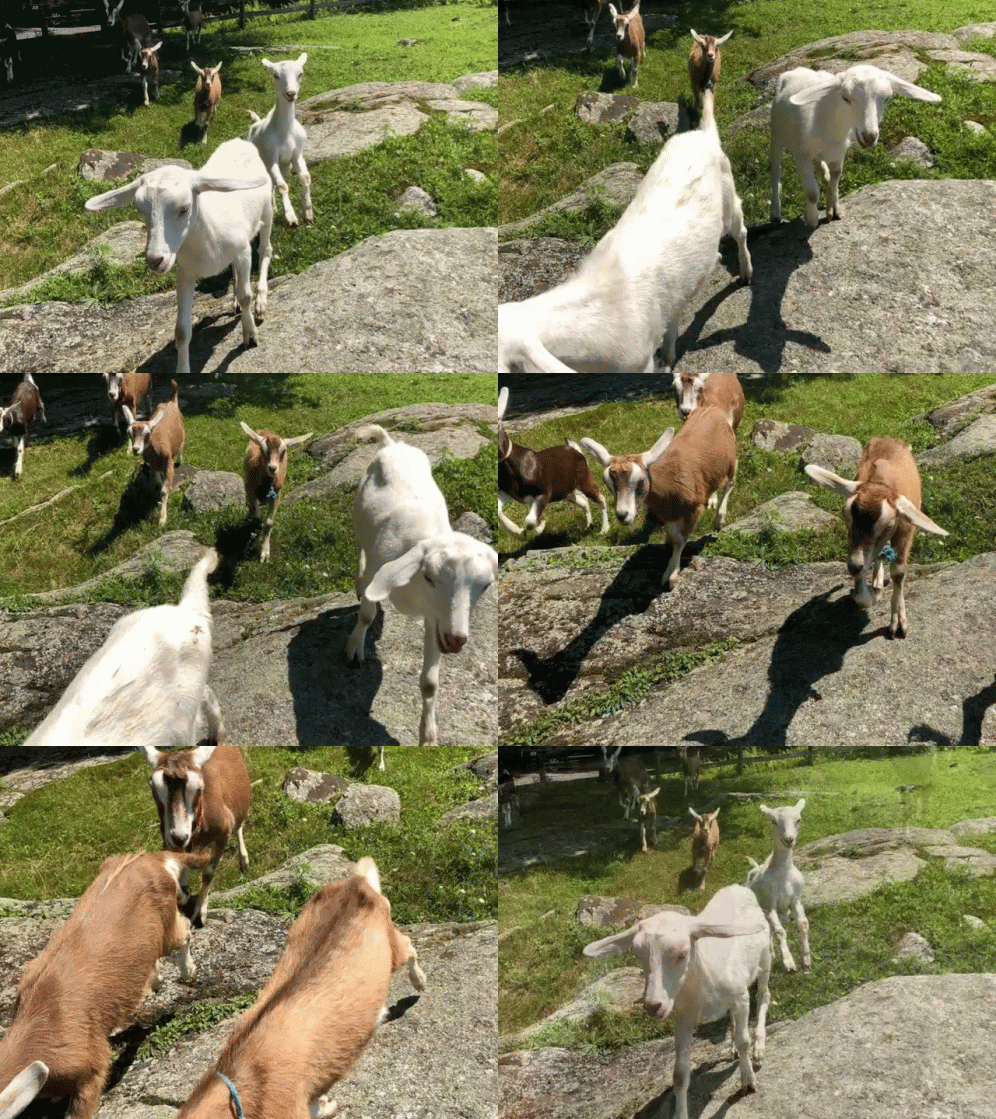
I don't think that the reviewers asking me for higher animal numbers really understand how many 40 goats are. Do you know the CHAOS that comes with dealing with 40 GOATS in an experimental setting! Mice people cannot comprehend. 3 goats alone ate a tarp, a clock, and 2 expensive accelerometers!
media.tenor.com
a group of goats standing in a grassy field looking at the camera
Alt: a group of goats running towards the camera
914520
Reposted by John Nyakatura
Science X / Phys.org @sciencex.bsky.social · 17/02/2026
Comparisons of climbing behaviors in arboreal mammals indicate that adaptations for vertical descent, including upright postures, played a key role in early primate evolution. doi.org/hbppbb
phys.org
Climbing behaviors of tree-dwelling mammals unlock insights on early primate evolution
Researchers have shed new light on the features that enable tree-dwelling mammals to move effectively through their environments, providing insights into the evolution of the distinct upright postures seen in primates.
032
John Nyakatura @johnnyakatura.bsky.social · 17/02/2026
Our paper, based on a uniquely large dataset of vertical descent behaviours in arboreal mammals, is published in @elife.bsky.social. The findings offer fresh perspectives on reconstructing postures in early primates. You can find the accompanying press release here: elifesciences.org/for-the-pres...
elifesciences.org
Climbing behaviours of tree-dwelling critters unlock insights on early primate evolution
Researchers have published the first comparative analysis of downward climbing behaviours across a broad range of small mammal species, with insights into the evolution of primates’ arboreal upright p...
0105
Reposted by John Nyakatura
Thomas R. Holtz, Jr. @arctomet.bsky.social · 08/02/2026
Scaling of internal joint distance in the elbow of small‐ to medium‐sized mammals: Implications for range of motion analyses - Scheidt - Journal of Anatomy - Wiley Online Library onlinelibrary.wiley.com/doi/10.1111/...
onlinelibrary.wiley.com
Scaling of internal joint distance in the elbow of small‐ to medium‐sized mammals: Implications for range of motion analyses
We investigated the internal joint distances (IJDs) of the humero-ulnar and humero-radial joint, within a sample of 15 small- to medium-sized mammals and report isometric results. We also found that ...
0124
Reposted by John Nyakatura
Alberta Claw @albertonykus.bsky.social · 11/02/2026
Biomechanical and energetic considerations indicate that the giant extinct seabird Pelagornis could not feed like a skimmer: royalsocietypublishing.org/rsos/article... 🪶🧪 (📷Hellyer-Price et al.)
Graph showing the estimated metabolic costs of different seabirds (including the extinct Pelagornis) flying with their bill partly submerged underwater. Points above a dashed line indicate that this behavior is energetically unlikely.
04410
Reposted by John Nyakatura
Dr. Headbutt 🌈🧪 @nicoleackermans.com · 11/02/2026
After teaching my motor control lecture, I was pleasantly surprised to run into some Muybridge originals at the Birmingham Museum of art (for free)! Before his photos in 1878, we didn't know how horses galloped because it was too fast to capture, which is why they look so odd in old paintings! 🧪
Muybridge series of pictures of a bird in flightMuybridge series of pictures of an elephant walkingMuybridge series of pictures of a horse jumping
2226
John Nyakatura @johnnyakatura.bsky.social · 11/02/2026
Our latest paper is just out 🤩! If you enjoy functional morphology and comparative biomechanics, Adrian's work on the internal joint spacing and its implications for modelling range of motion in the joints of mammals, will be something for you. Cheers! onlinelibrary.wiley.com/doi/10.1111/...
onlinelibrary.wiley.com
Scaling of internal joint distance in the elbow of small‐ to medium‐sized mammals: Implications for range of motion analyses
We investigated the internal joint distances (IJDs) of the humero-ulnar and humero-radial joint, within a sample of 15 small- to medium-sized mammals and report isometric results. We also found that ...
086
John Nyakatura @johnnyakatura.bsky.social · 01/12/2025
More info on our recent paper in this interview in Science... Why does biology keep building things out of tiles? | Science | AAAS www.science.org/content/arti...
science.org
Why does biology keep building things out of tiles?
Science talks with two scientists about finding the beauty in nature’s mosaics
022
John Nyakatura @johnnyakatura.bsky.social · 13/11/2025
Thrilled our multi-year work on biological tilings is out in @pnasnexus.org! From virus shells to dinosaurs, seeds to fish scales—tilings are everywhere in biology. Explore the paper and our interactive catalogue (link following in next post): doi.org/10.1093/pnas...
doi.org
Tiled material systems: Exploring biodiversity and multifunctionality of a universal and structural motif
Abstract. Humans are drawn to patterns and hierarchies in nature, mimicking them particularly in decoration and architecture. Natural patterns, however, ar
161
Reposted by John Nyakatura
DZG 2025 Berlin @dzg2025berlin.bsky.social · 31/07/2025
🚨 Final Call! Don't miss your last chance to submit a poster abstract for the Annual Meeting of the German Zoological Society 🦎🐦🧬 Contribute your research, connect with colleagues — and be part of it! Submission closes tomorrow. Be there or be square!
142
Reposted by John Nyakatura
Journal of Zoology @jzoology.bsky.social · 09/04/2025
Journal of Zoology is now on Bluesky! Follow us to discover what we've published recently in our scientific journal covering all areas of #zoology - and find out more about us at zslpublications.onlinelibrary.wiley.com/journal/1469... @zslscience.bsky.social
13619
Reposted by John Nyakatura
Mayerl Lab @mayerllab.bsky.social · 11/07/2025
Our paper reviewing the neurophysiology of swallowing just came out! We detail 70 years of progress towards understanding neuromotor functioning in feeding, and highlight several emerging technologies for the future Check it out at the link below - journals.physiology.org/doi/full/10....
0104
Reposted by John Nyakatura
DZG 2025 Berlin @dzg2025berlin.bsky.social · 22/06/2025
Abstracts due today! Join us in Berlin to explore the full spectrum of zoological research. Expect excellent speakers, an unforgettable evening beneath iconic dinosaur exhibits, engaging city excursions, satellite symposia etc.. Limited slots remain for talks and posters—submit yours now. #DZG2025
061
John Nyakatura @johnnyakatura.bsky.social · 16/06/2025
Whoop whoop!
020
Reposted by John Nyakatura
Kate Marvel @drkatemarvel.bsky.social · 16/06/2025
Today's the day! www.nypl.org/events/progr...
nypl.org
Kate Marvel & Friends: Feeling Climate Change
The climate scientist is joined by a group of special guests to share insights, data, and stories that reflect how it feels to live in a changing world.
39016
Reposted by John Nyakatura
DZG 2025 Berlin @dzg2025berlin.bsky.social · 10/06/2025
Gentle reminder: #DZG2025 in Berlin! The extended Early Bird registration is ending soon. Nab the reduced rate NOW and join us in Berlin. 🤩 dzg-meeting.de
086
Reposted by John Nyakatura
DZG Neurobiology @dzg-neurobiology.bsky.social · 06/06/2025
We are lucky to have Merly Vogt (Helmholtz Diabetes Center, Munich) and @beetzjerome.bsky.social (Uni Wuerzburg) as speakers for the neurobiology section 🤗
065
John Nyakatura @johnnyakatura.bsky.social · 06/06/2025
Wow! Happy to see that the subject groups invited such high-profile speakers as "headliners" for their sections.
030
John Nyakatura @johnnyakatura.bsky.social · 04/06/2025
Make sure to nab the reduced fee! #DZG2025 in Berlin
020
Reposted by John Nyakatura
University Museum of Zoology, Cambridge @zoologymuseum.bsky.social · 04/06/2025
📢WE'RE HIRING📢Could you be our new Senior Collections Lead? Would you enjoy working with one of the UK's most important natural history collections? Apply by 22 June to look after our amazing Collections Management, Care & Conservation team. @camunivmuseums.bsky.social www.jobs.cam.ac.uk/job/51272/
Lower gallery of the Museum of Zoology
01917
Reposted by John Nyakatura
Prof. Christine Böhmer @vertevo.bsky.social · 02/06/2025
Ever wondered how the shape of the genital bone in male Harbour #seals develops throughout #ontogeny? Berghäuser, Wölfer, Böhmer @vertevo.bsky.social & @johnnyakatura.bsky.social @jzoology.bsky.social 2025 Morphology & development of the baculum in harbour seals P. vitulina doi.org/10.1111/jzo....
032
Reposted by John Nyakatura
DZG 2025 Berlin @dzg2025berlin.bsky.social · 27/05/2025
Why join #DZG2025 in Berlin? Reason #4: A wonderful public lecture (open to everyone without registration). dzg-meeting.de #share #like
021
Reposted by John Nyakatura
DZG 2025 Berlin @dzg2025berlin.bsky.social · 27/05/2025
Why join #DZG2025 in Berlin? Reason #3: Insightful excursions to diverse (biologically relevant) places in Berlin. Check out our website! E.g., the Ihnestraße Memorial dzg-meeting.de #share #like
011
Reposted by John Nyakatura
Javi Ibarrondo @jibarrondo.bsky.social · 22/05/2025
Bird feeders have caused a dramatic evolution of California hummingbirds | Science | AAAS www.science.org/content/arti... 🧪
science.org
Bird feeders have caused a dramatic evolution of California hummingbirds
Beaks have grown longer and larger, and ranges have expanded to follow the feeders
1439185
Reposted by John Nyakatura
Sam Price @evovert.bsky.social · 23/05/2025
New paper alert! @keifferwilliams.bsky.social has spent many years refining the application of complexity measures to highly variable 🐟🦷 he explains how you can do it in his first chapter of his PhD in @sicbjournals.bsky.social
0176
Reposted by John Nyakatura
DZG 2025 Berlin @dzg2025berlin.bsky.social · 22/05/2025
Why join #DZG2025 in Berlin? Reason #2: Ice-Breaker event in the @mfnberlin.bsky.social spectacular dinosaur hall! For example… #share #like dzg-meeting.de
172
Reposted by John Nyakatura
Lauren Sumner-Rooney @laurensr.bsky.social · 14/05/2025
Come and work with us for a few months on a standalone project! Up to £3,000 (c. 3560 EUR) available for students or postdocs to visit a new lab like ours 👀 Deadline 6th June, but get in touch with me ASAP to discuss your ideas and interests!
075
Reposted by John Nyakatura
DZG 2025 Berlin @dzg2025berlin.bsky.social · 18/05/2025
Why join #DZG2025 in Berlin? Reason #1: Outstanding plenary speakers! For example… #share #like dzg-meeting.de www.uni-kiel.de/de/forschung...
031
Reposted by John Nyakatura
DZG 2025 Berlin @dzg2025berlin.bsky.social · 18/05/2025
Why join #DZG2025 in Berlin? Reason #1: Outstanding plenary speakers! For example… #share #like dzg-meeting.de www.nwg-info.de/de/council/e...
052
Reposted by John Nyakatura
DZG 2025 Berlin @dzg2025berlin.bsky.social · 17/05/2025
Registration NOW OPEN. Join us in Berlin! #DZG2025
099
Reposted by John Nyakatura
DZG 2025 Berlin @dzg2025berlin.bsky.social · 17/05/2025
Why join #DZG2025 in Berlin? Reason #1: Outstanding plenary speakers! For example… #share #like dzg-meeting.de abl.cnbch.uw.edu.pl/people/marta...
041
Reposted by John Nyakatura
DZG 2025 Berlin @dzg2025berlin.bsky.social · 17/05/2025
Why join #DZG2025 in Berlin? Reason #1: Outstanding plenary speakers! For example… #share #like dzg-meeting.de www.museumfuernaturkunde.berlin/en/museum/to...
031
Reposted by John Nyakatura
DZG 2025 Berlin @dzg2025berlin.bsky.social · 16/05/2025
Why join #DZG2025? Reason #1: Outstanding plenary speakers! For example… #share #like (bio.kuleuven.be/faculty/0000...)
033
Reposted by John Nyakatura
Tom Astle @tjalamont.bsky.social · 16/05/2025
🐙🌿 Friday Spiday: A beautiful jumping spider, a male Habronattus americanus. This guy's flamboyant coloration (plus some dance moves) is how he impresses a mate. These spiders are only a few mm. long, and not especially colorful from above, so are easy to overlook. I found him last weekend--
A macro photo of a colorful jumping spider, with a blue face, bright red fuzzy palps, more red on the underside of the forelegs, and orange and dark brown striped legs, facing the camera on pale orange sand.
720922
Reposted by John Nyakatura
Prosanta Chakrabarty @prosanta.bsky.social · 15/05/2025
Phylogenomic and Population Genomic Analyses of Ultraconserved Elements Reveal Deep Coalescence and Introgression Shaped Diversification Patterns in Lamprologine Cichlids of the Congo River @fishnandoalda.bsky.social et al. (including me!) 2025 Systematic Biology academic.oup.com/sysbio/advan...
a) Graphical representation of the major hybridization events inferred between
species of CR Lamprologus based on the two main phylogenomic hypotheses using DSuite
(MSC: species tree and ML: maximum likelihood). Numbers next to arrows show the f-branch
statistic values. b) Estimated ages (Mean tMRCA ± 95% HPD) for the nodes in the 
Lamprologus clade based on the fossil-calibrated timetree constructed in BEAST2. Numbers1403
with an asterisk indicate different relationships in the MSC and ML trees. Node OUT represents
the tMRCA between the CR Lamprologus clade and all LT lamprologines in the outgroup
2278
Reposted by John Nyakatura
Global Center for Species Survival @protectspecies.bsky.social · 16/05/2025
From @nature.com, “Global hotspots of butterfly diversity are threatened in a warming world.” 🌍🧪 www.nature.com/articles/s41...
nature.com
Global hotspots of butterfly diversity are threatened in a warming world - Nature Ecology & Evolution
Butterflies are a large, functionally important and charismatic invertebrate group. Here, the authors characterize global macroecological patterns of butterflies and project shifts in their bioclimati...
12913