Sign in

Johannes Herpell

@herpell.bsky.social
337 followers 226 following 16 posts

Microbes | Plants | Ecology | Climbing | Cycling | Surfing Postdoc @mpipz.bsky.social with @hacquardst.bsky.social | Views are my own

PostsRepliesMedia
Johannes Herpell @herpell.bsky.social · 05/05/2026
A side project that got out of hand—in the best way 🚀 New paper is out: www.nature.com/articles/s41... We sequenced the first Clusia genomes to understand something subtle but fundamental: 👉 CAM is a drought adaptive mechanism in plants - how do different physiotypes of CAM evolve? A 🧵 👇 1/14
nature.com
Clusia genomes shed light on the evolution and diversity of crassulacean acid metabolism physiotypes - Nature Communications
Clusia species exhibit diverse photosynthetic physiotypes. The authors present genome assemblies for C. major (weak CAM), C. minor s.l. (facultative CAM), and C. rosea (strong CAM), and speculate that...
242
Reposted by Johannes Herpell
Marc Somssich @somssich.bsky.social · 21/08/2025
Great to see this really cool story (see quoted post) published in @newphyt.bsky.social! nph.onlinelibrary.wiley.com/doi/full/10.... Congratulations @laravdijck.bsky.social, @parkergroup.bsky.social! Plant-Scopoletin-Fungal Endophyte-Iron #PlantScience #Coumarin #PlantImmunity #PlantNutrition
nph.onlinelibrary.wiley.com
Cooperation between a root fungal endophyte and host‐derived coumarin scopoletin mediates Arabidopsis iron nutrition
Iron acquisition is a critical challenge for plants, especially in iron-deficient soils. Recent research underscores the importance of root-exuded coumarins in modulating the root microbiome communi...
01710
Reposted by Johannes Herpell
Tatsuya Nobori @tatsuyanobori.bsky.social · 13/08/2025
How can we better understand the plant immune system? In my new @cp-cellhostmicrobe.bsky.social piece, I propose “immune cell states” as a framework for uniting molecular and cellular perspectives. www.cell.com/cell-host-mi...
38039
Reposted by Johannes Herpell
ᐯIᑕTOᖇ ᑎIᘔET, ᗰᗪ @nizet.bsky.social · 18/04/2025
Fascinating innate immune evasion strategy in SCIENCE #glycotime 𝘗𝘴𝘦𝘶𝘥𝘰𝘮𝘰𝘯𝘢𝘴 𝘴𝘺𝘳𝘪𝘯𝘨𝘢𝘦 makes GLYCOSIRIN, a novel iminosugar that blocks plant glycosidases from degrading bacterial flagellin—hiding pathogens from plant immune sensors. New cryo-EM insights reveal exactly how this stealthy trick works
science.org
Bacterial pathogen deploys the iminosugar glycosyrin to manipulate plant glycobiology
The extracellular space (apoplast) in plants is a key battleground during microbial infections. To avoid recognition, the bacterial model phytopathogen Pseudomonas syringae pv. tomato DC3000 produces ...
02912
Reposted by Johannes Herpell
Nature @nature.com · 17/04/2025
Nature research paper: Low overlap of transcription factor DNA binding and regulatory targets go.nature.com/4jedGUz
go.nature.com
Low overlap of transcription factor DNA binding and regulatory targets - Nature
A near-complete survey of transcription factor activities in Saccharomyces cerevisiae reveals that most transcription factors have both activator and repressor activities and limited overlap between their binding sites on DNA and regulation of nearby genes.
0246
Johannes Herpell @herpell.bsky.social · 11/04/2025
Would you like to study metabolite-based microbe-microbe or plant-microbe interactions but do not have the tools to? @chesneau-g.bsky.social came up with a simple solution with great potential! Check out our new publication in @naturecomms.bsky.social and Guillaume’s 🧵 below for details👇
131
Reposted by Johannes Herpell
Max Planck Institute for Plant Breeding Research @mpipz.bsky.social · 10/04/2025
📣Paper Alert! 📣New publication out by @hacquardst.bsky.social and his team on the development of MetaFlowTrain – a new tool to study metabolic exchange and interactions within microbial communities @naturecomms.bsky.social 👏🥳Congratulations! 👉https://bit.ly/44jnM1H www.nature.com/articles/s41...
nature.com
MetaFlowTrain: a highly parallelized and modular fluidic system for studying exometabolite-mediated inter-organismal interactions - Nature Communications
Metabolic interactions shape ecosystems but remain hard to study. Here, authors present MetaFlowTrain, a modular, low-cost fluidic system controlling metabolic fluxes between microbes, and show its va...
2115
Reposted by Johannes Herpell
Stéphane Hacquard @hacquardst.bsky.social · 10/04/2025
We present MetaFlowTrain, an easy-to-build, highly parallelized, and cost-effective fluidic system for studying microbial exometabolites and their roles in modulating microbe–microbe–host interactions. Kudos to @chesneau-g.bsky.social @mpipz.bsky.social Give it a try: www.nature.com/articles/s41...
76433
Reposted by Johannes Herpell
Christie Wilcox @nerdychristie.bsky.social · 28/03/2025
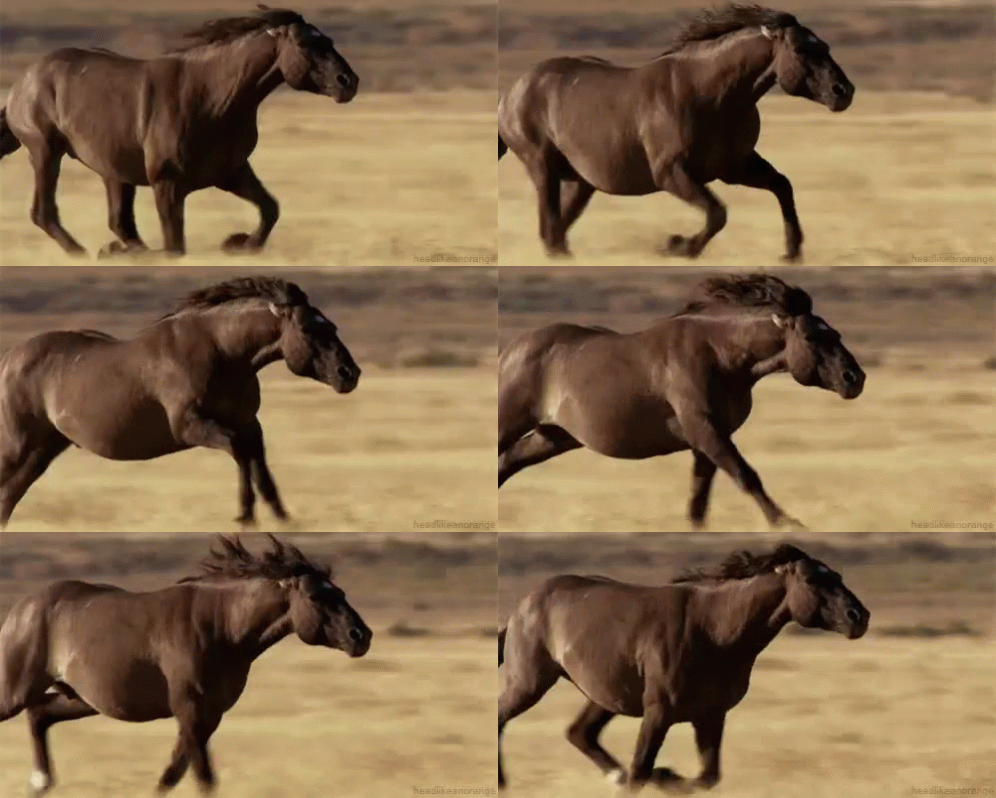
How did horses become so athletic? In part, a mutation that should have cut a key protein short instead makes it more sensitive to the stress of exercise. That and more of the best from @science.org and science in this edition of #ScienceAdviser: www.science.org/content/arti... 🧪🐴
media.tenor.com
a brown horse is running across a dry grass field .
ALT: a brown horse is running across a dry grass field .
18215
Reposted by Johannes Herpell
Tonni Andersen @tonnigrubeandersen.bsky.social · 21/03/2025
Finally! Im so excited to present to culmination of many years of work from the fantastic Defeng Shen and some great collaborators. For details, I have made a digested thread below, but if you are more interested feel free to reach out (and read the paper of course). www.science.org/doi/10.1126/...
science.org
Apoplastic barriers are essential for nodule formation and nitrogen fixation in Lotus japonicus
Establishment of the apoplastic root barrier known as the Casparian strip occurs early in root development. In legumes, this area overlaps with nitrogen-fixing nodule formation, which raises the possi...
49224105
Reposted by Johannes Herpell
Max Planck Institute for Plant Breeding Research @mpipz.bsky.social · 21/03/2025
📣Paper Alert! New publication @science.org by the group of @tonnigrubeandersen.bsky.social @mpipz.bsky.social, colleagues @ucph.bsky.social & others on the Casparian strip and its role in metabolic trade between plants & bacteria. 👏Learn more 👉https://bit.ly/4bJe4Yd www.science.org/doi/10.1126/...
science.org
Apoplastic barriers are essential for nodule formation and nitrogen fixation in Lotus japonicus
Establishment of the apoplastic root barrier known as the Casparian strip occurs early in root development. In legumes, this area overlaps with nitrogen-fixing nodule formation, which raises the possi...
0259
Reposted by Johannes Herpell
Christine Faulkner @pdchristine.bsky.social · 11/03/2025
We're looking for a postdoc to join the lab to work on cell-to-cell communication via the apoplast. Candidate must be brave, as they will have to lead us (me) away from the plasmodesmata-lands we've inhabited for so long! www.jic.ac.uk/vacancies/po...
jic.ac.uk
Postdoctoral Researcher (Faulkner Group) | John Innes Centre
An exciting opportunity has arisen for a Postdoctoral Researcher to join the Faulkner Group at the John Innes Centre, working on cutting-edge science in the field of Cell & Developmental Biology.
47487
Reposted by Johannes Herpell
Basler Lab @basler-lab.bsky.social · 05/03/2025
Poke bacteria with a sharp needle and they poke back in just a few seconds! Congratulations to Mitchell (and others) for this analysis of Pseudomonas #T6SS assembly in response to membrane damage! Collaboration with Rod Lim's lab @biozentrum.unibas.ch www.science.org/doi/10.1126/...
2166
Reposted by Johannes Herpell
Freda Kreier (she/her) @fredakreier.bsky.social · 05/03/2025
🧪 Homo erectus crafted specialized tools out of the bones of elephants and hippos. Read all about it in my latest for Nature. #scicom #paleo www.nature.com/articles/d41...
nature.com
Ancient humans used bone tools one million years earlier than thought
Objects discovered in Tanzania and dated to 1.5 million years ago help to rewrite human ancestors’ use of carved bone implements.
03911
Reposted by Johannes Herpell
Ari Pekka Mähönen @apmahonen.bsky.social · 05/03/2025
Wow, cAMP production appears to be the key for activating canonical auxin signalling, not AUX/IAA degradation! Also annoying - I need to revise quite a many teaching slides to update auxin signalling 😀 www.nature.com/articles/s41...
nature.com
TIR1-produced cAMP as a second messenger in transcriptional auxin signalling - Nature
cAMP produced by the TIR1/AFB receptors of the main endogenous developmental plant hormone auxin acts as a true second messenger, revising the established paradigm of transcriptional auxin signalling.
36633
Reposted by Johannes Herpell
Matthias Benoit @mattbnt.bsky.social · 05/03/2025
🚨New paper published in @nature.com! Using pan-genetics across the Solanum genus🍅🥔🍆we reveal why gene duplications🧬are major contingencies in crop engineering. My postdoc work in the Lippman lab @CSHL, collab. with @katiejenike.bsky.social @mikeschatz.bsky.social chatz.bsky.social and many others!
nature.com
Solanum pan-genetics reveals paralogues as contingencies in crop engineering - Nature
Gene duplication and subsequent paralogue diversification are major obstacles to genotype-to-phenotype predictability.
18196106
Reposted by Johannes Herpell
pfeilmeier.bsky.social @pfeilmeier.bsky.social · 24/02/2025
📌Vacancy at the University of Amsterdam! Join us at the Green Life Sciences with three open positions by my colleagues. 🌱🌻 1/3 PhD position on "Microbial Host Preference in Plant Stress Resilience" in the group of Dr. Kathrin Wippel: werkenbij.uva.nl/en/vacancies...
werkenbij.uva.nl
Vacancy — PhD Candidate Microbial Host Preference in Plant Stress Resilience
Are you an early-career researcher with a passion for plant science? Would you like to apply your enthusiasm to a highly relevant project in the field of plant-microbiome interactions? Then we have th...
11523
Reposted by Johannes Herpell
Ka Wai Ma @kawaima.bsky.social · 20/02/2025
Congratulations to Jana Ordon and all coauthors!!! Our new study is published in @natureplants.bsky.social "Conserved immunomodulation and variation in host association by Xanthomonadales commensals in Arabidopsis root microbiota" (0/n) rdcu.be/eauzt
rdcu.be
Conserved immunomodulation and variation in host association by Xanthomonadales commensals in Arabidopsis root microbiota
Nature Plants - The authors show that immunosuppression is highly conserved in the bacterial order Xanthomonadales. This feature, which preceded their specialization as host-adapted pathogens,...
82211
Reposted by Johannes Herpell
Finkemeier Lab @ifink-lab.bsky.social · 18/02/2025
Please read here about our collaborative work with Ag Kudla @uni-muenster.de on the phosphocode of these two Calcium-dependent kinases. With the power of MS-based functional #proteomics www.science.org/doi/10.1126/...
science.org
A bi-kinase module sensitizes and potentiates plant immune signaling
Mutual activation of a Ca2+ sensing bi-kinase module potentiates NADPH oxidase activation to facilitate systemic immunity.
0128
Reposted by Johannes Herpell
Paloma Durán @paduba.bsky.social · 17/02/2025
Happy to share this viewpoint, written together with @fabriceroux7.bsky.social and Fabienne Vailleau @lipme-toulouse.bsky.social nph.onlinelibrary.wiley.com/doi/10.1111/... 1/4
nph.onlinelibrary.wiley.com
Building microbial synthetic communities: get inspired by the design of synthetic plant communities
In the last decade, the generation of host-associated microbial culture collections has allowed the fine disentangling of complex relationships between commensal microbes and their hosts, and within-...
33722
Reposted by Johannes Herpell
Chloé Beaulieu @chloe-beaulieu.bsky.social · 17/02/2025
I’m super happy to have a great part of my PhD work (under the wonderful supervision of C. Libourel @pierremarcdelaux.bsky.social & @maximebonhomme.bsky.social) now out in @naturegenet.bsky.social ! Here’s a little thread (1/18) www.nature.com/articles/s41...
nature.com
The Marchantia polymorpha pangenome reveals ancient mechanisms of plant adaptation to the environment - Nature Genetics
Pangenome analyses of 133 wild accessions of the model bryophyte Marchantia polymorpha identify adaptive features and provide insights into the mechanisms of plant adaptation to the terrestrial enviro...
310248
Reposted by Johannes Herpell
Roeland Berendsen @rlberendsen.bsky.social · 17/02/2025
We continue to build the Plant Microbiome Starter Pack. Please let us know if you or others are missing! go.bsky.app/QG4wCyf
153016
Reposted by Johannes Herpell
bactodeath.bsky.social @bactodeath.bsky.social · 12/02/2025
Have a look at our new story on how Bacterial Cellulose works miracles in plant wound healing by activating regeneration via concurrent activation of ROS, defense and cytokinin signalling. In collaboration with @cbgpmadrid.bsky.social @icmabcsic.bsky.social www.science.org/doi/10.1126/...
science.org
Exogenous bacterial cellulose induces plant tissue regeneration through the regulation of cytokinin and defense networks
Bacterial cellulose application concurrently targets cytokinin- and ROS-associated defense responses to induce plant regeneration.
11510
Reposted by Johannes Herpell
Max Planck Institute for Plant Breeding Research @mpipz.bsky.social · 13/02/2025
🔊Paper Alert - New publication out @nature.com by the Parker Lab @mpipz.bsky.social and colleagues at Westlake University on the fine tuning of plant immunity regulation 🌿🪴Congratulations 👏 👏 Learn more here 👉 bit.ly/3WZjrfw #plantsci #immunity www.nature.com/articles/s41...
nature.com
Balanced plant helper NLR activation by a modified host protein complex - Nature
In Arabidopsis, mechanisms for NRG1A activation by recognition of a modified host EDS1–SAG101 complex, and NRG1A inhibition by NRG1C through sequestration of activated EDS1–SAG101, show activation and...
0113
Reposted by Johannes Herpell
Tatsuya Nobori @tatsuyanobori.bsky.social · 17/01/2025
Evolution of interorganismal strigolactone biosynthesis in seed plants www.science.org/doi/10.1126/...
science.org
Evolution of interorganismal strigolactone biosynthesis in seed plants
Strigolactones (SLs) are methylbutenolide molecules derived from β-carotene through an intermediate carlactonoic acid (CLA). Canonical SLs act as signals to microbes and plants, whereas noncanonical S...
081
Reposted by Johannes Herpell
A. Murat Eren (Meren) @merenbey.bsky.social · 17/01/2025
I'm very happy to report that Matt Schechter's PhD work is now online as a pre-print: "Ribosomal protein phylogeography offers quantitative insights into the efficacy of genome-resolved surveys of microbial communities", www.biorxiv.org/content/10.1... Here's a little 🧵 about it.
13520
Reposted by Johannes Herpell
Evan Bardot (he/him) @ebardot.bsky.social · 13/01/2025
Inspired by @mads100tist.bsky.social I'm going to do threads on parts of the publishing process we often get asked about. These will be from my perspective @naturecomms.bsky.social and based on my own opinions, so keep your salt handy.
22512
Reposted by Johannes Herpell
Ed Hawkins @edhawkins.org · 12/01/2025
The data is in. 2024 was the warmest year on record, and probably in the whole of human history – about 1.6°C warmer than the pre-industrial period. More than 1 billion individual thermometer measurements have been condensed into a single vital number. theconversation.com/my-new-dark-...
theconversation.com
My new dark red climate stripe for 2024 shows it’s the hottest year yet
These ‘warming stripes’, adopted around the world as a symbol of climate awareness, action and ambition, now include another dark red stripe for 2024.
4364196
Reposted by Johannes Herpell
Izzy Jayasinghe @ijayas.bsky.social · 10/01/2025
Such a game changing set of innovations to be able to fully 3D print these microscopes. Think about all the cool science that this unlocks, especially beyond the traditional style of microscopy 🧪
36718
Reposted by Johannes Herpell
Nature Reviews Microbiology @natrevmicro.nature.com · 10/01/2025
#weekendreading 🔬 Non-adapted bacterial infection suppresses plant reproduction in Science Advances #microsky www.science.org/doi/10.1126/...
science.org
Non-adapted bacterial infection suppresses plant reproduction
Non-adapted bacterial infection represses nonhost plant’s reproduction rather than induces disease.
001
Reposted by Johannes Herpell
Science Magazine @science.org · 09/01/2025
The protein GAME15 is the missing link in the pathway that Solanum plants like potatoes use to make molecules for pest defense, a new Science study finds. The results pave the way for innovative applications in agriculture and biotechnology.
scim.ag
A cellulose synthase–like protein governs the biosynthesis of Solanum alkaloids
Decades of research on the infamous antinutritional steroidal glycoalkaloids (SGAs) in Solanaceae plants have provided deep insights into their metabolism and roles. However, engineering SGAs in heterologous hosts has remained a challenge. We discovered...
03110
Reposted by Johannes Herpell
Science Magazine @science.org · 08/01/2025
"[My adviser] told me that instead of focusing on finding a dream job, I should think about what I am good at and what makes me happy at least 80% of the time. This advice surprised me at first, but it ended up being exactly what I needed to hear." scim.ag/3DHtLCc
scim.ag
To choose a career, I needed to do more than ‘follow my dream’
Practical advice helped this international scientist figure out her post-Ph.D. direction
011624
Reposted by Johannes Herpell
Tatsuya Nobori @tatsuyanobori.bsky.social · 08/01/2025
New year, new paper! Now published in @nature.com. We identified and characterised diverse immune cell states in plants under pathogen attack. My postdoc work in the Ecker lab at @salkinstitute.bsky.social. A thread (0/n) #PlantScience www.nature.com/articles/s41...
23253129
Reposted by Johannes Herpell
Nature Microbiology @natmicrobiol.nature.com · 08/01/2025
OUT NOW - Streptomyces secretes a siderophore that sensitizes competitor bacteria to phage infection www.nature.com/articles/s41...
nature.com
Streptomyces secretes a siderophore that sensitizes competitor bacteria to phage infection - Nature Microbiology
A secondary metabolite sensitizes competitor Bacillus subtilis to a wide panel of lytic phages by sequestering iron and preventing the activation of Spo0A.
511545
Reposted by Johannes Herpell
Soil Biogeochemistry @ UNIL @keiluweitlab.bsky.social · 08/01/2025
🚨We are filling a 5-year postdoc/junior lecturer position in Soil Biogeochemistry at the University of Lausanne. Fully-funded, independent, cutting-edge research on microbe-mineral-organic matter interactions, #climate, and #soils. Deadline: Jan 30. Start: Sept 2025. Info👇
12932
Reposted by Johannes Herpell
Ben Engel @cellarchlab.com · 06/01/2025
Towards community-driven visual proteomics! Excited to finally share this large-scale curated & annotated dataset of 1829 high-quality #cryoET tomograms of the little green alga that just keeps giving— Chlamydomonas! 🧪🧶🧬🌾🌊🌍 Preprint📜: www.biorxiv.org/content/10.1... A short thread🧵👇
7338128
Reposted by Johannes Herpell
raphmercier.bsky.social @raphmercier.bsky.social · 06/01/2025
We are still waiting for applications to join us as a group leader in the department of Chromosome Biology! Apply until the first of Feb.
media.tenor.com
a man wearing a suit and tie is standing in a field of yellow flowers
ALT: a man wearing a suit and tie is standing in a field of yellow flowers
11735
Reposted by Johannes Herpell
Sebastian Soyk @sebastiansoyk.bsky.social · 04/01/2025
Very happy to see our work on deleterious mutations in #tomato published in @naturegenet.bsky.social 🧬🌱🍅! We identify deleterious mutations that were enriched during #domestication and apply #CRISPR to repair a mutation in cultivated tomato. #genetics #plantscience www.nature.com/articles/s41...
nature.com
Repairing a deleterious domestication variant in a floral regulator gene of tomato by base editing - Nature Genetics
A deleterious mutation in the tomato transcription factor SSP2 was enriched during domestication. Repairing the deleterious mutation in cultivated tomato by base editing leads to compact growth and ea...
711752
Reposted by Johannes Herpell
Ákos T Kovács @evolvedbiofilm.bsky.social · 02/01/2025
Join the MicroClock team and work on the discovery of the Bacillus subtilis circadian clock components: #PostDocPosition in Leiden 🇳🇱 via the @microclockerc.bsky.social #ERCSyG project Deadline: 17 January www.universiteitleiden.nl/vacatures/20... please share with your network🙏
01723
Reposted by Johannes Herpell
Journal of Experimental Botany @jxbotany.bsky.social · 18/12/2024
**𝗪𝗘'𝗥𝗘 𝗥𝗘𝗖𝗥𝗨𝗜𝗧𝗜𝗡𝗚** JXB is looking for an assistant editor to join our friendly team based in Lancaster, UK. Come and work for a society-owned journal and support the #plantscience community. 🧪 More info: bit.ly/JXBAE24 @sebiology.bsky.social @cristobaluauy.bsky.social @giffordlab.bsky.social
Cartoon drawing of a researcher sat in a chair working on a laptop
02634
Reposted by Johannes Herpell
Meenu Singla-Rastogi @msr20.bsky.social · 03/01/2025
What a great start to the year 2025. Just published online is our PNAS paper - Diverse plant RNAs coat Arabidopsis leaves and are distinct from apoplastic RNAs www.pnas.org/doi/10.1073/... @pbaldrich.bsky.social @meghahs28.bsky.social @inneslab.bsky.social
pnas.org
Diverse plant RNAs coat Arabidopsis leaves and are distinct from apoplastic RNAs | PNAS
Transgenic expression of a double-stranded RNA in plants can induce silencing of homologous mRNAs in fungal pathogens. Although such host-induced g...
24117
Reposted by Johannes Herpell
Roger Innes @inneslab.bsky.social · 03/01/2025
Very happy to start the new year with publication of our new work on leaf surface RNA. Plant leaves secrete diverse RNAs that are surprisingly stable on their surfaces. Next question to answer: What do they do? www.pnas.org/doi/epub/10....
Protocol for isolating RNA from the surfaces and apoplastic spaces of plant leaves.
210948
Reposted by Johannes Herpell
Science Magazine @science.org · 03/01/2025
A new study finds ants best humans at tests of collective intelligence. Learn more: scim.ag/4h2K0ID
26506166
Reposted by Johannes Herpell
Roeland Berendsen @rlberendsen.bsky.social · 28/12/2024
www.nature.com/articles/s41... 🌱🚜 Excited to see our paper in @naturemicrobiol.bsky.social ! Amazing effort by @y-song.bsky.social in collaboration with TU Delft (Neil Budko, Elisa Atza) and the Dutch potato breeding industry to harness the power of the microbiome! 🥔🔬@utrechtpmi.bsky.social
nature.com
Seed tuber microbiome can predict growth potential of potato varieties - Nature Microbiology
Time-resolved drone imaging of potato crop development and seed tuber microbiome data can be used to predict potato vigour, or growth potential, in next-season crops in trial fields.
37441
Reposted by Johannes Herpell
Tatsuya Nobori @tatsuyanobori.bsky.social · 03/01/2025
Bacteria use exogenous peptidoglycan as a danger signal to trigger biofilm formation www.nature.com/articles/s41...
nature.com
Bacteria use exogenous peptidoglycan as a danger signal to trigger biofilm formation - Nature Microbiology
Peptidoglycan released by neighbouring kin or non-kin cell lysis induces physiological changes that protect from a range of stresses, including phage predation.
083