Sign in

Benjy Barnett

@benjyb.bsky.social
573 followers 558 following 59 posts

Post doc in the Uncertainty Lab at Birkbeck University. Consciousness + everything that might mean.

PostsRepliesMedia
Reposted by Benjy Barnett
Aeon Magazine @aeon.co · 27/07/2026
Despite its imposing stature and importance to ecosystems, the northern cassowary of New Guinea is rarely seen in the wild. This short film documents the ornithologist Yoki Hadiprakarsa and wildlife photographer Tim Laman’s eight-month search for the elusive bird
buff.ly
Scientists and locals unite to film a large, elusive New Guinean bird | Aeon Videos
Join the search for the elusive cassowary, a big bird that plays an outsized role in maintaining its rainforest home
0106
Reposted by Benjy Barnett
David Barner @drbarner.bsky.social · 17/03/2026
Here's a link to the now published paper on how children acquire the meaning of the word "zero" with @yuyanfei31.bsky.social www.sciencedirect.com/science/arti...
sciencedirect.com
Training “Zero” in preschoolers: Fast referential learning, slow relational integration
Children's understanding of the number word “zero” typically lags behind positive numbers. According to stage theories, they first interpret “zero” as…
0131
Reposted by Benjy Barnett
Aaron Kaltenmaier @akalt.bsky.social · 06/03/2026
Excited to share that our MEG project is now out in Current Biology! We show how visual content codes relate to motor oscillations in telling time. Huge thanks to Quirin Gehmacher, Peter Kok, Matt Davis and Clare Press (bsky links below).🧵 authors.elsevier.com/sd/article/S...
authors.elsevier.com
ScienceDirect.com | Science, health and medical journals, full text articles and books.
13715
Reposted by Benjy Barnett
Daniel Yon @danieljamesyon.bsky.social · 27/02/2026
Check out Benjy’s new paper, the first from his postdoc in the lab! 👁️ 🧠 It reveals how our inferences about what’s present and absent in the external world are calibrated by perceiving w/ others. And we come to detect what our partners can. Thread below 👇 @benjyb.bsky.social @leverhulme.ac.uk
1121
Benjy Barnett @benjyb.bsky.social · 27/02/2026
your paper looks really cool Christian! I've been thinking about how our results might relate to perceptual development, so I look forward to reading it properly :)
000
Benjy Barnett @benjyb.bsky.social · 27/02/2026
and tagging the great @danieljamesyon.bsky.social as it didn't seem to work in my initial post!
010
Benjy Barnett @benjyb.bsky.social · 27/02/2026
In the preprint, we lay out a number of potentially exciting implications these results may have for topics as broad as models of consciousness, cultural anthropology of sensory experiences, and social cognition 🧠
130
Benjy Barnett @benjyb.bsky.social · 27/02/2026
We also show that ‘matching’ behaviour is amplified by the social framing of the task, with significantly weaker matching found in a non-social task.
Matching effects were significantly weaker in a non-social version of the task.
130
Benjy Barnett @benjyb.bsky.social · 27/02/2026
Critically, this effect persisted once participants performed the task alone again – suggesting the impact of joint decision making percolated into participants’ private cognition, and was not merely tied to the explicit reporting of awareness to another agent.
120
Benjy Barnett @benjyb.bsky.social · 27/02/2026
Across multiple experiments, we show that participants ‘match’ their awareness reports to their partner – such that those with liberal partners become more liberal and those with conservative partners become more conservative.
Plots showing the effect of 'threshold matching', where participants match their threshold for detecting the presence of targets to their partner.
120
Benjy Barnett @benjyb.bsky.social · 27/02/2026
The partners were programmed to have either a higher or lower threshold for reporting the presence of a target than participants.
Description of methodology showing the creation of partners with specifically liberal or conservative biases to reporting the presence of targets
110
Benjy Barnett @benjyb.bsky.social · 27/02/2026
To probe this, we asked participants to do a simple perceptual detection task on their own, with a partner, and then on their own again.
Illustration of task paradigm, showing a detection task performed individually, followed by joint with a partner, before being done alone again.
110
Benjy Barnett @benjyb.bsky.social · 27/02/2026
But as of yet, it's unknown whether our social interactions can influence perhaps the most fundamental of all perceptual judgements: did I see anything at all? In other words, can social interactions influence what we report becoming aware of in the first place?
media.tenor.com
spongebob squarepants is smiling and looking at the camera while standing on a beach .
ALT: spongebob squarepants is smiling and looking at the camera while standing on a beach .
120
Benjy Barnett @benjyb.bsky.social · 27/02/2026
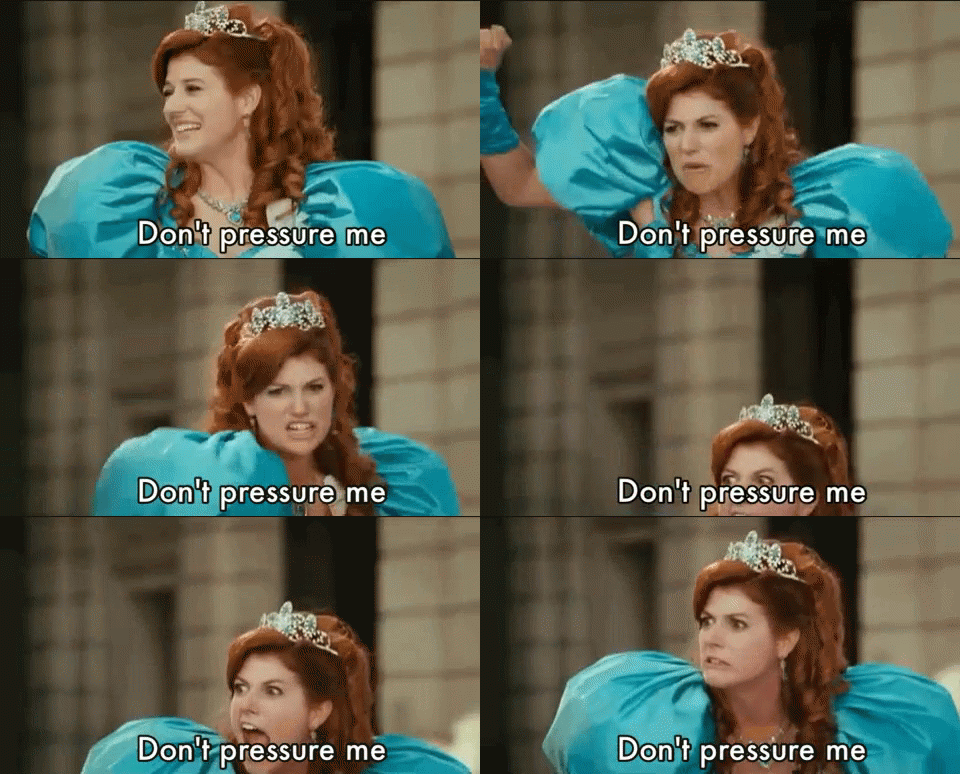
Over the last half-century, psychologists have suggested social pressure can influence how we describe the way our percepts look. For example, is this line longer than that line, is this patch greener than that patch?
media.tenor.com
a woman in a blue dress with a tiara on her head is smiling and says `` don 't pressure me '' .
ALT: a woman in a blue dress with a tiara on her head is smiling and says `` don 't pressure me '' .
110
Benjy Barnett @benjyb.bsky.social · 27/02/2026
Do our social interactions influence what we become aware of? In our❗new preprint❗@danieljamesyon.bsky.social and I delve into this question: asking whether joint decision making in a detection task can bias awareness reports. osf.io/preprints/ps... 🧵
osf.io
OSF
1248
Reposted by Benjy Barnett
Krisztina Jedlovszky @kjedlovszky.bsky.social · 11/02/2026
Happy to have the preprint of my work in @philcorlett.bsky.social's lab out 🎊 read below to see how experienced volatility influences social hallucinations in paranoid perception
174
Reposted by Benjy Barnett
Caitlin Gilbert @caitlingilbert.bsky.social · 28/01/2026
In response to announcement that he will be a new CBS contributor, Andrew Huberman tweeted “I’ve always gone issue-by-issue on health & science, spoken to experts w/a range of takes & presented where I see the center of (data) mass pointed. I’ll do the same with @CBSNews”. In Sept he posted this:
Screenshot of tweet from Huberman that reads: “The other is that dog breeds w/different shaped heads are predictive of their demeanor and intelligence. And while I don’t! believe in Phrenology I now do pay some attention to how the shapes of peoples heads relates to their intellect and steadiness, or lack thereof.”
50272471832
Reposted by Benjy Barnett
Nadine Dijkstra @nadinedijkstra.bsky.social · 20/01/2026
So excited to see this lovely paper with @benjyb.bsky.social, @matanmazor.bsky.social and @giuliacabbai.bsky.social published in @nconsc.bsky.social! academic.oup.com/nc/article/2...
academic.oup.com
Vivid imagery is reported faster than weak imagery
Abstract. Visual imagery and external perception rely on similar representations. However, whether the same processes underpin the subjective appraisal of
04013
Benjy Barnett @benjyb.bsky.social · 19/01/2026
Out now in @nconsc.bsky.social 🧠😶‍🌫️ academic.oup.com/nc/article/2...
academic.oup.com
Vivid imagery is reported faster than weak imagery
Abstract. Visual imagery and external perception rely on similar representations. However, whether the same processes underpin the subjective appraisal of
0163
Reposted by Benjy Barnett
Daniel Yon @danieljamesyon.bsky.social · 16/12/2025
I've got a fully-funded PhD studentship open at @birkbeckpsychology.bsky.social, investigating social learning about metacognition & awareness, w/ behavioural studies & neuroimaging (fMRI) - thanks to @leverhulme.ac.uk More details here: www.jobs.ac.uk/job/DPV831/p... #cogsci #neuroskyence
jobs.ac.uk
PhD Studentship: Social Learning of Metacognition and Awareness at Birkbeck, University of London
jobs.ac.uk now advertising a PhD Studentship: Social Learning of Metacognition and Awareness Visit jobs.ac.uk to apply and to browse more PhD opportunities.
24554
Reposted by Benjy Barnett
Nadine Dijkstra @nadinedijkstra.bsky.social · 27/11/2025
I am very excited to share our new preprint, spearheaded by the brilliant @lunahuestegge.bsky.social, w/ @peterkok.bsky.social and others: ‘An attempt to push mental imagery over the reality threshold using non-invasive brain stimulation’ doi.org/10.31234/osf...
doi.org
OSF
33613
Reposted by Benjy Barnett
Rutger Bregman @rutgerbregman.com · 25/11/2025
I wish I didn’t have to share this. But the BBC has decided to censor my first Reith Lecture. They deleted the line in which I describe Donald Trump as “the most openly corrupt president in American history.” /1
337100445078
Reposted by Benjy Barnett
Maia Armstrong @maiajuliet.bsky.social · 11/11/2025
super excited to say that the first paper from my PhD has been published in Neuroscience and Biobehavioral Reviews 🧠!! “I could have done otherwise”: the neural bases of counterfactual representations -> doi.org/10.1016/j.ne...
doi.org
Redirecting
1123
Reposted by Benjy Barnett
Marcel S. Kehl @mskehl.bsky.social · 27/10/2025
🚨Preprint: Semantic Tuning of Single Neurons in the Human Medial Temporal Lobe 1/8: How do human neurons encode meaning? In this work, led by Katharina Karkowski, we recorded hundreds of human MTL neurons to study semantic coding in the human brain: doi.org/10.1101/2025...
doi.org
Semantic Tuning of Single Neurons in the Human Medial Temporal Lobe
The Medial Temporal Lobe (MTL) is key to human cognition, supporting memory, emotional processing, navigation, and semantic coding. Rare direct human MTL recordings revealed concept cells, which were ...
38239
Reposted by Benjy Barnett
Peter Kok @peterkok.bsky.social · 21/10/2025
@dotproduct.bsky.social's first first author paper is finally out in @sfnjournals.bsky.social! Her findings show that content-specific predictions fluctuate with alpha frequencies, suggesting a more specific role for alpha oscillations than we may have thought. With @jhaarsma.bsky.social. 🧠🟦 🧠🤖
jneurosci.org
Contents of visual predictions oscillate at alpha frequencies
Predictions of future events have a major impact on how we process sensory signals. However, it remains unclear how the brain keeps predictions online in anticipation of future inputs. Here, we combin...
711243
Reposted by Benjy Barnett
Philip Ball @philipcball.bsky.social · 26/09/2025
And as for writing, don't get me started. Most often, the process of writing is not a laborious business of transcription, but a process of thinking itself. I'm not about to outsource my thinking to a machine.
113726
Reposted by Benjy Barnett
George Monbiot @georgemonbiot.bsky.social · 28/07/2025
I know there's a risk of amplifying the fascist horror show, but I think we need to be aware of just how far things are going, especially as this man is a Republican candidate for governor of California. All the old safeguards are being deliberately torn down, and the unspeakable normalised.
A post on X by Kyle Langford, with a composite photo showing him standing outside the gates of Auschwitz, and the caption: "My zero unemployment plan", with an emoji of factory chimneys.
2522502927
Reposted by Benjy Barnett
flowerville @flowerville.bsky.social · 27/07/2025
Albert Camus to René Char (1957) Camus-Char: Correspondence 1946-1959
17621
Benjy Barnett @benjyb.bsky.social · 25/07/2025
There is still so much we don’t know about the brain’s ability to deal with absence, and we hope this study goes some way towards revealing the different ways we are able to represent ‘nothing.’
youtube.com
Générique (Bande originale du film "Ascenseur pour l'échafaud")
YouTube video by Miles Davis - Topic
050
Benjy Barnett @benjyb.bsky.social · 25/07/2025
These findings help extend previous distinctions between perception and cognition to the case of absences and, at least in adult humans, suggest that abstract concepts of absence are not rooted in more primitive representations of sensory absence.
130
Benjy Barnett @benjyb.bsky.social · 25/07/2025
Moreover, this was in spite of low-level visual similarities between perceptual and non-symbolic absences, which could otherwise drive spurious generalisation between the two domains.
130
Benjy Barnett @benjyb.bsky.social · 25/07/2025
We built on these results to study how numerical and perceptual absences related to each other – finding surprisingly strong evidence for distinct neural representations of different types of absence.
161
Benjy Barnett @benjyb.bsky.social · 25/07/2025
First of all, we replicated our previous findings that representations of absence are shared across both symbolic and non-symbolic numerical tasks.
cell.com
Symbolic and non-symbolic representations of numerical zero in the human brain
Barnett and Fleming show how non-symbolic and symbolic representations of zero are represented at the start of a neural number line and generalize across notational format. These representations are l...
131
Benjy Barnett @benjyb.bsky.social · 25/07/2025
To characterise the brain’s representation of various absences, we had participants perform three different tasks in the MEG scanner, each involving absence from a different domain: perceptual, non-symbolic numerosity, and symbolic number.
120
Benjy Barnett @benjyb.bsky.social · 25/07/2025
Likewise, how we are able to conceptualise absence – e.g., as the number zero – is not straightforward either. How did we create something out of nothing?
120
Benjy Barnett @benjyb.bsky.social · 25/07/2025
But how the brain deals with absences is not currently known. Sensory systems are typically geared to detect the presence of objects in our environment, so how we are able to perceive absences is not a straightforward question.
120
Benjy Barnett @benjyb.bsky.social · 25/07/2025
What do the music of Miles Davis, the paintings of Edward Hopper, and the equations of Isaac Newton have in common? They all rely – in different ways – on absences.
151
Benjy Barnett @benjyb.bsky.social · 25/07/2025
A ✨bittersweet✨ moment – after 5 years at UCL, my final first-author project with @smfleming.bsky.social is ready to read as a preprint! 🥲
2318
Reposted by Benjy Barnett
Jason da Silva Castanheira @jasondasilvac.bsky.social · 24/07/2025
Very proud to share this one🥹! We show that personalized signatures of brain activity are heritable and relate to the expression of specific genes. That means my brain-fingerprint is very similar to my twin brother's! #ResearchIsMeSearch🧠 🧬 ♊️
science.org
Genetic foundations of interindividual neurophysiological variability
Individual brain activity profiles are shaped by lifelong genetic influences.
13815
Reposted by Benjy Barnett
Nadine Dijkstra @nadinedijkstra.bsky.social · 23/07/2025
After five years of confused staring at Greek letters, it is my absolute pleasure to finally share our (with @smfleming.bsky.social) computational model of mental imagery and reality monitoring: Perceptual Reality Monitoring as Higher-Order inference on Sensory Precision ✨ osf.io/preprints/ps...
osf.io
OSF
413036
Reposted by Benjy Barnett
Jianghao Liu @jianghaoliu.bsky.social · 23/07/2025
Is vivid imagery reported faster than weak imagery? YES. There is an inverse correlation between subjective vividness and RTs in imagery tasks (N=117). doi.org/10.1016/j.co...
2297
Reposted by Benjy Barnett
Giulia Cabbai @giuliacabbai.bsky.social · 23/07/2025
Always late to the party, but really excited to share this new preprint led by @benjyb.bsky.social where we find an intriguing link between vividness ratings and reaction times!🧠💭
091
Reposted by Benjy Barnett
Matan Mazor @matanmazor.bsky.social · 23/07/2025
Confidence in absence as confidence in counterfactual visibility: a CogSci proceedings paper with star MSc student Maya Schipper, is now out on PsyArXiv: osf.io/preprints/ps... 🧵👇
35618
Benjy Barnett @benjyb.bsky.social · 22/07/2025
Hey Will, thanks for the tip. We checked again and everything looks ok to us. The data/code are up on OSF though so feel free to take a look and email me if you find anything!
050
Benjy Barnett @benjyb.bsky.social · 21/07/2025
#neuroskyence #PsychSciSky
010
Benjy Barnett @benjyb.bsky.social · 21/07/2025
All data and code for the paper can be found here: osf.io/g7tjh/. We would be very interested if other people found similar patterns in their data!
osf.io
RT x Vividness
Hosted on the Open Science Framework
150
Benjy Barnett @benjyb.bsky.social · 21/07/2025
We hope that by drawing attention to this effect, future models of imagery will start to tease apart the distinct contributions of imagery formation and evaluation to subjective reports of imagery, which is essential for the discussion around unconscious imagery.
131
Benjy Barnett @benjyb.bsky.social · 21/07/2025
We speculate as to whether our results point towards a shared process of evaluating subjective visual experiences across perception and imagery.
140
Benjy Barnett @benjyb.bsky.social · 21/07/2025
We show that individual differences in this perceptual RT asymmetry - as well as trait imagery vividness - predicts imagery RT asymmetry.
140
Benjy Barnett @benjyb.bsky.social · 21/07/2025
A similar effect has been widely reported in perceptual detection - where reporting not seeing a stimulus takes more time than reporting that you saw it.
120