Reposted by Prehistorica (Christian M.)Credentials, Dan @dancredentials.bsky.social · 01/06/2026HAPPY PRIDE!! (Those two radiodonts back there are gay) 0136
Prehistorica (Christian M.) @prehistorica.bsky.social · 01/06/2026A pair of Oreinorema bergstroemi, a small species of highly derived radiodont from the Chengjiang Biota of Cambrian China, examine the defences of the armoured lobopodian Onychodictyon ferox. 118067
Prehistorica (Christian M.) @prehistorica.bsky.social · 09/05/2026Canadaspis perfecta gathering to mate and moult in the Cambrian-age Burgess Shale. In layer -350 of the Walcott Quarry (Phyllopod Bed), Canadaspis gathered in such great concentrations that one slab of shale, roughly 1 square metre in area, was covered in over 700 individuals. 48729
Prehistorica (Christian M.) @prehistorica.bsky.social · 18/12/2025Buccaspinea cooperi, a hurdiid radiodont from the Cambrian of Utah, known for its large oral-cone mouth that makes up nearly a quarter of its body length. 510540
Prehistorica (Christian M.) @prehistorica.bsky.social · 06/11/2025Hallucigenia sparsa, a small lobopodian from the Cambrian-age Burgess Shale, climbing on a sponge. 625375
Prehistorica (Christian M.) @prehistorica.bsky.social · 09/10/2025Papiliomaris kluessendorfae, first reported in 1985 as the Waukesha "Butterfly Animal", was recently described as a strange bivalved arthropod with three pairs of large, feathery appendages. Some reports indicate it could reach up to 20cm wide. 413239
Prehistorica (Christian M.) @prehistorica.bsky.social · 22/08/2025Multiple lobopodian fossils from the Chengjiang Biota of Cambrian China, including a specimen of two Diania cactiformis, have been found stacked directly on top of each other. Perhaps a snapshot into the courtship and reproduction of these ancient arthropod ancestors? 24516
Reposted by Prehistorica (Christian M.)Peter Nickolaus @peternickolaus.bsky.social · 26/07/2025Results from the #paloestream from 26th July 2025. Depicted are from top left to down right: #Palaeocampa #Nektognathus #Wudingloong #Mirasaura Tags: #paleoart #prehistoric #prehistoriccreatures #paleozoic #prehistoricanimals #peternickolaus #paleopete #dinosaur 05615
Reposted by Prehistorica (Christian M.)Joschua Knüppe @joschuaknuppe.bsky.social · 26/07/2025Results from the Flocking #paleostream! Palaeocampa, Nektognathus, Wudingloong, Mirasaura 012242
Reposted by Prehistorica (Christian M.)nogain98 @rlatkdwls.bsky.social · 26/07/2025#Paleostream flocking! Nektognathus, Palaeocampa, Wudingloong(Sort by age). It is unclear if Wudingloong lived alongside quadrupedal sauropods 03810
Reposted by Prehistorica (Christian M.)Luther Wells @ultraluther.bsky.social · 26/07/2025Flocking! A Lobopodian was drawn! Palaeocampa, Nektognathus, Wudingloong, Mirasaura. #paleostream #paleoart #sciart #art 07017
Reposted by Prehistorica (Christian M.)David Clark @clarkeocrinus.bsky.social · 25/07/2025A really nice thread on a strange worm. #FossilFriday 0174
Reposted by Prehistorica (Christian M.)Communications Biology @commsbio.nature.com · 25/07/2025Palaeocampa anthrax, a fossil worm first described from Carboniferous rocks in 1865 as a caterpillar, is redescribed as a freshwater aysheaiid lobopodian with unique sclerite armature and probable chemical defences. @prehistorica.art www.nature.com/articles/s42...nature.comPalaeocampa anthrax, an armored freshwater lobopodian with chemical defenses from the Carboniferous - Communications BiologyPalaeocampa anthrax, a fossil worm first described from Carboniferous rocks in 1865 as a caterpillar, is redescribed as a freshwater aysheaiid lobopodian with a unique sclerite armature and probable c... 042
Reposted by Prehistorica (Christian M.)Giant Blue Anteater @kyre-fiskrof.bsky.social · 25/07/2025Basically, they're this big mama here, but having lived directly in fresh water with spikes like spiky-boi caterpillars, a head shield, and presumably no ability to shoot glue. They would definitely be fun to keep in an aquarium! 0103
Reposted by Prehistorica (Christian M.)Luis Collantes @luiscollantes.bsky.social · 24/07/2025Knecht et al. - Palaeocampa anthrax, an armored freshwater lobopodian with chemical defenses from the Carboniferous www.nature.com/articles/s42... 04210
Reposted by Prehistorica (Christian M.)たてぃとぅてと(B_Wither) @fossiltttttbw.bsky.social · 24/07/2025#paleoart In Carboniferous lake of Montceau-les-Mines, Platysella descusi is trying to bother Palaeocampa anthrax. Palaeocampa curls up and bristles up in defense. Two Palaeocaris secretanae and single Nyranerpeton montceauense are swimming nearby. 0126
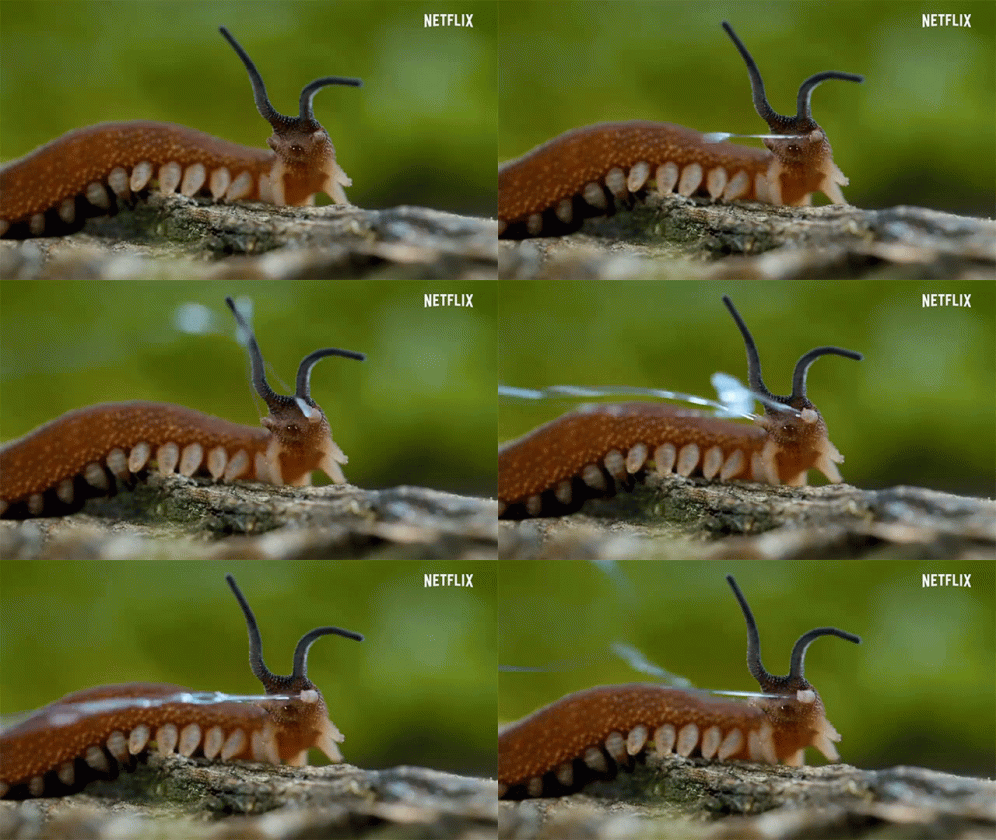
Reposted by Prehistorica (Christian M.)Neil Kelley @kelleypaleolab.bsky.social · 23/07/2025Great thread on a cool newly recognized toxic lobopodian from the famous Mazon Creek lagerstätte.media.tenor.coma close up of a slug with netflix written on the bottom rightAlt: Living velvet worm spraying a sticky liquid used to trap prey and deter predators. 1101
Reposted by Prehistorica (Christian M.)dactylioceras.bsky.social @dactylioceras.bsky.social · 23/07/2025Palaeocampa anthrax, an armored freshwater lobopodian with chemical defenses from the Carboniferous www.nature.com/articles/s42... Art by @prehistorica.art 094
Reposted by Prehistorica (Christian M.)Anthony (Tony) J. Martin @ichnologist.bsky.social · 23/07/2025🚨LOBOPODIAN ALERT!1!!!11!🚨 Palaeocampa – a fossil known since 1865 – redescribed & now interpreted as: geologically youngest of its kind (315-307 mya), lived in freshwater environments, & (most badass of all) had venomous spines. Great work by Richard Knect, @prehistorica.art, & colleagues. 🧪 0359
Reposted by Prehistorica (Christian M.)たてぃとぅてと(B_Wither) @fossiltttttbw.bsky.social · 23/07/2025某所で噂されていた研究が出版された・・・石炭紀の淡水葉足動物! phys.org/news/2025-07...phys.orgFossil once thought a caterpillar is now the oldest known nonmarine lobopodianIn a twist worthy of a detective novel, a long-misidentified fossil at Harvard's Museum of Comparative Zoology (MCZ) has emerged as a key discovery in early animal evolution. 0105
Prehistorica (Christian M.) @prehistorica.bsky.social · 23/07/2025Meet Palaeocampa anthrax, a newly discovered Carboniferous lobopodian, and 150 year old mystery fossil! Palaeocampa is an exceptional lobopodian - it lived in rivers and lakes, bristled with thousands of poisonous spines, and more. 🧵 Open access: nature.com/articles/s42... 318463
Prehistorica (Christian M.) @prehistorica.bsky.social · 05/06/2025A swarm of Isotelus maximus gathering to moult and reproduce, stalked in the distance by large nautiloid cephalopods. 110124
Prehistorica (Christian M.) @prehistorica.bsky.social · 18/05/2025Cretoperipatus burmiticus, an equatorial velvet worm from the Cretaceous period. 27315
Reposted by Prehistorica (Christian M.)The Palaeontological Association @thepalass.bsky.social · 06/05/2025Discussion in #PapersinPalaeontology: comment onlinelibrary.wiley.com/doi/full/10.... and reply onlinelibrary.wiley.com/doi/10.1002/... on Omnidens appendages and the origin of radiodont mouthparts 0126
Prehistorica (Christian M.) @prehistorica.bsky.social · 07/05/2025Pulmonoscorpius, a 70cm long scorpion from Carboniferous Scotland. A daytime predator, Pulmonoscorpius was equipped with large compound eyes on the sides of its head, and an enormous stinger. Here, it blends in with the forest, eating a lizard-like Westlothiana. 69023
Prehistorica (Christian M.) @prehistorica.bsky.social · 06/05/2025New Paper -> Comment on: Omnidens appendages and the origin of radiodont mouthparts Are there really 2 species of Omnidens? I comment on the organization of the mouth of this Cambrian apex predator, and argue there is only one species, Omnidens amplus. onlinelibrary.wiley.com/doi/epdf/10.... 37422
Prehistorica (Christian M.) @prehistorica.bsky.social · 29/03/2025Keurbos susanae, a newly described giant arthropod from the Ordovician-age Soom Shale of South Africa. 1328593
Prehistorica (Christian M.) @prehistorica.bsky.social · 14/03/2025For #FossilFriday, an enormous (>70cm) headshield from the colossal filter feeding radiodont Aegirocassis benmoulai (Ordovician of Morocco, Fezouata Formation) One of the most exciting fossils I've gotten in the mail, I think 05715
Prehistorica (Christian M.) @prehistorica.bsky.social · 05/02/2025The Herefordshire Biota, a diverse assemblage of animals from the Silurian-age rocks of the UK. Among the largest animals is Thanahita, a strange relative of Hallucigenia with soft papillae lining its back. 220065
Prehistorica (Christian M.) @prehistorica.bsky.social · 25/11/2024Arthropleura, the largest known arthropod to ever exist at an estimated 2.5 metres long, walks slowly along an ancient Carboniferous coastline looking for food. 371061250
Prehistorica (Christian M.) @prehistorica.bsky.social · 22/11/2024The Anji Biota, a diverse glass sponge reef roughly 1000 metres below the waves of Ordovician China, in the aftermath of Earth's second worst mass extinction event. Archopterus anjiensis, a small eurypterid, glides leisurely through. #paleoart #sciart 7420119
Prehistorica (Christian M.) @prehistorica.bsky.social · 17/11/2024Balcoracania dailyi, exploring the intertidal reaches of a shallow inland sea during the middle Cambrian. As an adult, this trilobite could have over 100 thoracic segments, more than any other known trilobite. 7437103
Reposted by Prehistorica (Christian M.)Fossiladder13 @fossilsdder13.bsky.social · 17/11/2024In the middle Cambrian of China, a young Amplectobelua narrowly escapes a Tauricornicaris (here restored as a Fuxianhuiid). #paleoart #paleontology #cambrian 0233
Reposted by Prehistorica (Christian M.)Farid Saleh | فريد صالح @taphozoan.bsky.social · 16/11/2024Imagine travelling back 470 million years to dive alongside the marine polar animals of that era. Reconstruction by @prehistorica.bsky.social. Work published earlier this year in collaboration with @lukaslaibl.bsky.social: www.nature.com/articles/s41... 🤿 🦐 16016
Reposted by Prehistorica (Christian M.)Caxela @caxela.bsky.social · 15/11/2024A Presence at the Shore of Hațeg Island... (February 2024) 7761184
Prehistorica (Christian M.) @prehistorica.bsky.social · 15/11/2024Isotelus, one of North America’s largest and most famous trilobites. Some specimens of Isotelus maximus have been noted to preserve distinct spots of pigmentation on the shell, giving us a hint at its in-life colouration and patterning. #FossilFriday 0336
Prehistorica (Christian M.) @prehistorica.bsky.social · 13/11/2024The Fezouata Biota, a collection of exceptionally preserved rocks from the Ordovician of Morocco. The largest, the radiodont Aegirocassis benmoulai, grew to over 2 metres in length. This piece was one of the most time consuming I’ve ever done, and includes roughly 50 different animal species. 413140
Prehistorica (Christian M.) @prehistorica.bsky.social · 03/11/2024Shucaris ankylosskelos, a recently described radiodont from the Chengjiang Biota, hunting an Erratus sperare. Shucaris was a mid-sized (~30cm) radiodont of questionable taxonomic placement. It had unique, crook-shaped appendages, and gnathobases behind the mouth to cut up prey. 312334
Prehistorica (Christian M.) @prehistorica.bsky.social · 14/10/2023“… the thought of a megalodon, rushing up and grabbing a whale, the way that white sharks grab seals here, and the amount of blood, and the thrashing…” (Thanks to @evoincarnate.bsky.social for the base model) 05113
Prehistorica (Christian M.) @prehistorica.bsky.social · 28/09/2023Slimonia acuminata, a large eurypterid from the Silurian of Lesmahagow, Scotland. It lacked the long grabbing chelicera characteristic of more famous pterygotioids, instead using its three walking limbs to catch prey. 14512
Prehistorica (Christian M.) @prehistorica.bsky.social · 24/09/2023Now that it’s got varnish I’m actually not sure about giving it away just yet 0131
Prehistorica (Christian M.) @prehistorica.bsky.social · 24/09/2023Prepared and repaired a decent little Trimerus from the Rochester Shale. With a bit of paint touch up, it made for a nice piece. Also, what I thought was a Trimerus, but is actually a big chunk of cephalopod shell. 090
Prehistorica (Christian M.) @prehistorica.bsky.social · 21/09/2023Earlier in the week it seems I managed to find the first ever soft bodied fossil from the relatively famous Rochester Shale, the place I get all my Trimerus fossils. To me, it looks like some kind of worm moult (maybe Palaeoscolecid?). Don’t really know what to do with it tbh 0101
Prehistorica (Christian M.) @prehistorica.bsky.social · 20/09/2023Trimerus delphinocephalus, a giant trilobite from the Silurian-age Rochester Shale, hiding under some rocks. 05418