Sign in

Damian Koevoet

@dkoevoet.bsky.social
263 followers 326 following 49 posts

Postdoc | Visual Attention & Memory | Donders Institute, Radboud University (NL)

PostsRepliesMedia
Reposted by Damian Koevoet
Maëlle Lerebourg @maellelerebourg.bsky.social · 26/08/2026
Good morning @ecvp.bsky.social! ☕If you are wondering how imagery and perception interact and compete, and how to quantify these competitive interactions in visual cortex with fMRI,🧠please drop by the poster session this afternoon and chat with me about my newest study (with @peelen.bsky.social)
1265
Reposted by Damian Koevoet
Marlene Cohen @marlenecohen.bsky.social · 07/07/2026
Now out at PNAS - congratulations to Ramanujan Srinath and the team! Ram's ability and willingness to connect all these data, models, and ideas has changed my thinking/interpretation of many findings. I suspect I will keep learning from this study for a long time. www.pnas.org/doi/10.1073/...
pnas.org
The structure of correlated variability reflects task-relevant information in sensory neurons | PNAS
Shared trial-to-trial variability across sensory neurons is reliably reduced when perceptual performance improves, yet this variability is low dime...
13815
Reposted by Damian Koevoet
Marco Gandolfo @marco-gandolfo.bsky.social · 03/07/2026
New preprint ! 🎺 👇 We show that objects can facilitate scene recognition irrespectively to their semantical link to the scenes. TMS to Object-selective LOC eliminated such facilitation! Congratulations to Aaron for his first paper coming from a chunky master thesis project!
04518
Reposted by Damian Koevoet
Joost de Jong @joost-de-jong.bsky.social · 29/06/2026
How do we keep up with the pace of our surroundings? Previously, we’ve shown that working memory encoding speeds up when you expect limited encoding time. How does the brain accomplish this? In new work, we found that the brain uses an accelerated neural code⚡🧠: www.biorxiv.org/content/10.6... (1/6)
biorxiv.org
Neural acceleration drives adaptations in working memory encoding speed
Humans and non-human animals adaptively boost their encoding speed when they expect limited sensory exposure time, so that they can capture essential information before it is gone. However, it is uncl...
1124
Damian Koevoet @dkoevoet.bsky.social · 10/06/2026
I became a dr. last week! Thanks to everyone who made it an amazing day - I had a blast.
6211
Reposted by Damian Koevoet
Christoph Strauch @cstrauch.bsky.social · 27/05/2026
New preprint (doi.org/10.64898/202...) shows that where you look next is an economic decision. Saccades trade off effort-costs (measured via pupil) against monetary rewards. 1) By default, participants have strong saccade direction preferences (e.g., cardinal over diagonal, up over down) (1/4)
Left: participants prefer cardinals and upward directions without receiving rewards. Center: after titrating rewards throughout the experiment, downward and cardinal directions provide less reward, i.e., participants are willing to saccade there even though they gain little in comparison. Right: This titration of rewards offsets the internal saccade costs, leading to uniform preference across directions
13412
Damian Koevoet @dkoevoet.bsky.social · 27/05/2026
Reward and intrinsic effort-costs drive saccade selection 👀. But what happens when these factors compete? Our newest preprint shows that saccade selection follows principles of economic decision-making:
090
Damian Koevoet @dkoevoet.bsky.social · 26/05/2026
We often fail to pay attention to what's important for extended periods of time. What's going on in the brain when we're failing to pay attention? In a new preprint, we show that frontal potentials (fP3) track visual and auditory attentional lapses. doi.org/10.64898/202... #neuroscience
biorxiv.org
1110
Reposted by Damian Koevoet
Rick den Otter @rickdott.bsky.social · 21/05/2026
New paper out: Trial-level sequence modeling reveals hidden dynamics of dual-task interference. We decoded, at the trial level, the sequence of cognitive operations people take when multitasking. We found that how cognitive operations interleaved across tasks predicted RT and accuracy!
journals.plos.org
Trial-level sequence modeling reveals hidden dynamics of dual-task interference
Author summary In our daily lives, we are often required to juggle multiple tasks at once, for example when operating an in-car device while driving. While multitasking is increasingly common, researc...
093
Reposted by Damian Koevoet
Alex J. Hoogerbrugge @ajhoogerbrugge.bsky.social · 19/05/2026
Investigations into whether we can search for multiple targets in a simultaneous fashion have led to mixed findings. In this new PsychScience article, we report that people CAN search concurrently, but don't always DO so... 🧵 journals.sagepub.com/doi/10.1177/...
Results figure, showing that, when instructed, participants can either search sequentially or concurrently for multiple items
1239
Damian Koevoet @dkoevoet.bsky.social · 05/05/2026
Past experiences shape current selection. But when and how strong are past and present targets represented in the brain? In our newest paper, we show that past and present search targets are concurrently represented in the brain. Out now in @plosbiology.org doi.org/10.1371/jour... #neuroscience
doi.org
Past and present goals are represented concurrently during visual search
Past experience and our current goals guide what information to focus on. But how and when does the brain represent the past and the present? This new study shows that the brain represents the past an...
16121
Reposted by Damian Koevoet
Maëlle Lerebourg @maellelerebourg.bsky.social · 04/05/2026
What do we look for when searching for objects in our daily-life environments? Very happy that I can now share this review, together with @suryagayet.bsky.social , @predictivebrain.bsky.social and @peelen.bsky.social🥳 A brief thread below!
24815
Reposted by Damian Koevoet
Surya Gayet @suryagayet.bsky.social · 04/05/2026
New paper alert: very proud to share our review published in Trends in Cognitive Sciences, spearheaded by @maellelerebourg.bsky.social, and together with @peelen.bsky.social and @predictivebrain.bsky.social, about goal-directed search in real-world environments. See below for a thread/tldr!
0255
Damian Koevoet @dkoevoet.bsky.social · 31/03/2026
Do you want to measure pupil size while participants move their eyes around 👀? We offer a straightforward solution to gaze-induced distortions on pupil size measurements in our newest paper!
0113
Reposted by Damian Koevoet
Journal of Cognitive Neuroscience (JoCN) @jocn.bsky.social · 25/03/2026
direct.mit.edu/jocn/article...
direct.mit.edu
Dissociating Spatial Attention and Working Memory Storage with Pupillometry
Abstract. Extant work establishes a close relationship between spatial attention and working memory (WM) storage. Indeed, spatial representations of memorized items emerge spontaneously, even when…
193
Reposted by Damian Koevoet
Christoph Strauch @cstrauch.bsky.social · 07/03/2026
We show that synesthesia is sensory and automatic in nature: the pupil scales with the brightness of experienced synesthetic colors. doi.org/10.7554/eLif... Now in its new dress @elife.bsky.social (convincing & valuable in round 1). If anyone wants to pick up the method, happy to share & explain!
doi.org
49229
Reposted by Damian Koevoet
Veera Ruuskanen @veerahelmisofia.bsky.social · 24/02/2026
Hey bluesky 👋 really excited about this one! 👀
0141
Reposted by Damian Koevoet
Surya Gayet @suryagayet.bsky.social · 28/01/2026
My first TEDx talk just came out. It's always fun to talk about your own research area to the general audience, and its even more fun when you are lucky enough to be supported by such a platform. Happy to hear your thoughts :-) youtu.be/UyUclyHx8d8?...
youtu.be
How reality is simulated by your brain | Surgya Gayet | TEDxEindhoven
YouTube video by TEDx Talks
2429
Damian Koevoet @dkoevoet.bsky.social · 26/11/2025
Our commentary @stigchel.bsky.social on Ruth Rosenholtz' Visual Attention in Crisis paper is now available: doi.org/10.1017/S014... We argue that effort must be considered when aiming to quantify capacity limits or a task's complexity.
doi.org
Putting effort into task complexity | Behavioral and Brain Sciences | Cambridge Core
Putting effort into task complexity - Volume 48
194
Reposted by Damian Koevoet
Surya Gayet @suryagayet.bsky.social · 24/11/2025
Celebration time 🥳 @liangyouzhang.bsky.social publishes the 1st empirical paper of his PhD! We show that numerosity adaptation (a seemingly high-level stim property) suppresses neural responses in early visual cortex; these adaptation FX increase as we progress thru the visual processing hierarchy.
093
Damian Koevoet @dkoevoet.bsky.social · 24/11/2025
This paper is now published in Journal of Neuroscience! www.jneurosci.org/content/earl...
jneurosci.org
Population-Level Activity Dissociates Preparatory Overt from Covert Attention
The neural signatures of preparing overt eye movements and directing covert spatial attention overlap as they recruit the same brain areas. Yet, these neural signatures are dissociable at the single-c...
091
Reposted by Damian Koevoet
Kabir Arora @arora-borealis.bsky.social · 29/10/2025
Planning on running a RIFT study? In a new manuscript, we put together the RIFT know-how accumulated over the years by multiple labs (@lindadrijvers.bsky.social, @schota.bsky.social, @eelkespaak.bsky.social, with Cecília Hustá and others). Preprint: osf.io/preprints/ps...
osf.io
OSF
1228
Damian Koevoet @dkoevoet.bsky.social · 24/10/2025
Filled with a bunch of extra analyses, this is now accepted in The Journal of Neuroscience @sfn.org! You can have a sneak peak here: www.biorxiv.org/content/10.1...
biorxiv.org
Population-Level Activity Dissociates Preparatory Overt from Covert Attention
The neural signatures of preparing overt eye movements and directing covert spatial attention overlap as they recruit the same brain areas. Yet, these neural signatures are dissociable at the single-c...
1142
Reposted by Damian Koevoet
Eelke Spaak @eelkespaak.bsky.social · 22/10/2025
🧠 Regularization, Action, and Attractors in the Dynamical “Bayesian” Brain direct.mit.edu/jocn/article... (still uncorrected proofs, but they should post the corrected one soon--also OA is forthcoming, for now PDF at brainandexperience.org/pdf/10.1162-...)
direct.mit.edu
Regularization, Action, and Attractors in the Dynamical “Bayesian” Brain
Abstract. The idea that the brain is a probabilistic (Bayesian) inference machine, continuously trying to figure out the hidden causes of its inputs, has become very influential in cognitive (neuro)sc...
22912
Damian Koevoet @dkoevoet.bsky.social · 14/10/2025
Spatial attention and working memory are popularly thought to be tightly coupled. Yet, distinct neural activity tracks attentional breadth and WM load. In a new paper @jocn.bsky.social, we show that pupil size independently tracks breadth and load. doi.org/10.1162/JOCN...
13615
Reposted by Damian Koevoet
Matthieu Chidharom @matthieu-mx.bsky.social · 28/09/2025
1/ Why are we so easily distracted? 🧠 In our new EEG preprint w/ Henry Jones, @monicarosenb.bsky.social and @edvogel.bsky.social we show that distractibility is associated w/ reduced neural connectivity — and can be predicted from EEG with ~80% accuracy using machine learning.
16226
Reposted by Damian Koevoet
Darius Suplica @dsuplica.bsky.social · 04/09/2025
Very excited to announce my first paper is out in @currentbiology.bsky.social! Using EEG, we identify an item-based measure of storage in working memory that generalizes across auditory and visual items. authors.elsevier.com/a/1ljFF3QW8S... #PsychSciSky #neuroskyence #workingmemory
authors.elsevier.com
1167
Reposted by Damian Koevoet
Chris Paffen @chrispaffen.bsky.social · 02/07/2025
Surely you know about eye dominance. You probably don’t know it’s not a unitary phenomenon: in this paper I show that sensory eye dominance varies over the visual field. In the Discussion I propose an explanation for why this variation might exist. Curious? Read it here: doi.org/10.1167/jov....
Sensory eye dominance varies over the horizontal axis of the visual field: left eye dominance for the right visual field; right eye dominance for the left visual field.
163
Damian Koevoet @dkoevoet.bsky.social · 30/06/2025
Had a blast at last week's symposium! Inspiring to hear all the talks about EEG and attention. I presented on the neural correlates of saccade preparation and covert spatial attention. Check out the preprint here: doi.org/10.1101/2025...
160
Reposted by Damian Koevoet
theeuweslab.bsky.social @theeuweslab.bsky.social · 30/06/2025
Last week's symposium titled "Advances in the Encephalographic Study of Attention" was a great success! Held in the KNAW building in Amsterdam and sponsored by the NWO, many of (Europe's) leading attention researchers assembled to discuss the latest advances in attention research using M/EEG.
4257
Reposted by Damian Koevoet
Gabriel Weindel @gweindel.bsky.social · 26/06/2025
In this new preprint, in review @elife.bsky.social, we show what processing steps make up the reaction time using single trial #EEG modelling in a contrast #decision task. In this 🧵 I'm telling the story behind it as I think it is quite interesting and I can't write it like this in the paper...
23011
Reposted by Damian Koevoet
Alex J. Hoogerbrugge @ajhoogerbrugge.bsky.social · 18/06/2025
Thrilled to share that I successfully defended my PhD dissertation on Monday June 16th! The dissertation is available here: doi.org/10.33540/2960
3162
Reposted by Damian Koevoet
Chong Zhao @zhaochong.bsky.social · 18/06/2025
New paper out at Journal of Memory and Language! We knew that individual differences in working memory predict source memory, but did it predict simple item recognition memory (that relied on less attention resources than source memory)? Our answer is: YES! (with @edvogel.bsky.social ) 1/5
193
Damian Koevoet @dkoevoet.bsky.social · 12/06/2025
Now published in Attention, Perception & Psychophysics @psychonomicsociety.bsky.social Open Access link: doi.org/10.3758/s134...
link.springer.com
Reappearing sensory input guides visual working memory prioritization - Attention, Perception, & Psychophysics
Adaptive behavior necessitates the prioritization of the most relevant information in the environment (external) and in memory (internal). Internal prioritization is known to guide the selection of ex...
0148
Reposted by Damian Koevoet
theeuweslab.bsky.social @theeuweslab.bsky.social · 04/06/2025
Thanks to the support of the Dutch Research Council (NWO) and @knaw-nl.bsky.social , we're thrilled to announce the international symposium "Advances in the Encephalographic study of Attention"! 🧠🔍 📅 Date: June 25th & 26th 📍 Location: Trippenhuis, Amsterdam
298
Reposted by Damian Koevoet
Chris Paffen @chrispaffen.bsky.social · 04/06/2025
Sensory sensitivity We study how people react to sensory input like lights and sounds. You can help by completing a short online questionnaire. You can also sign up for an optional 3-hour lab session in Utrecht (€12/ hour) involving EEG and hearing tests. Take the survey here: tinyurl.com/457z89ta
021
Reposted by Damian Koevoet
Andre Sahakian @andresahakian.bsky.social · 29/05/2025
Long overdue! Didn't promote this one amid twitter/X chaos. But nearing the end of my PhD, I want to do this project justice and post it here: Is visual working memory used differently when errors are penalized? Out already 1+ year ago in JEP:LMC: research-portal.uu.nl/ws/files/258... 🧵 (1/3)
media.tenor.com
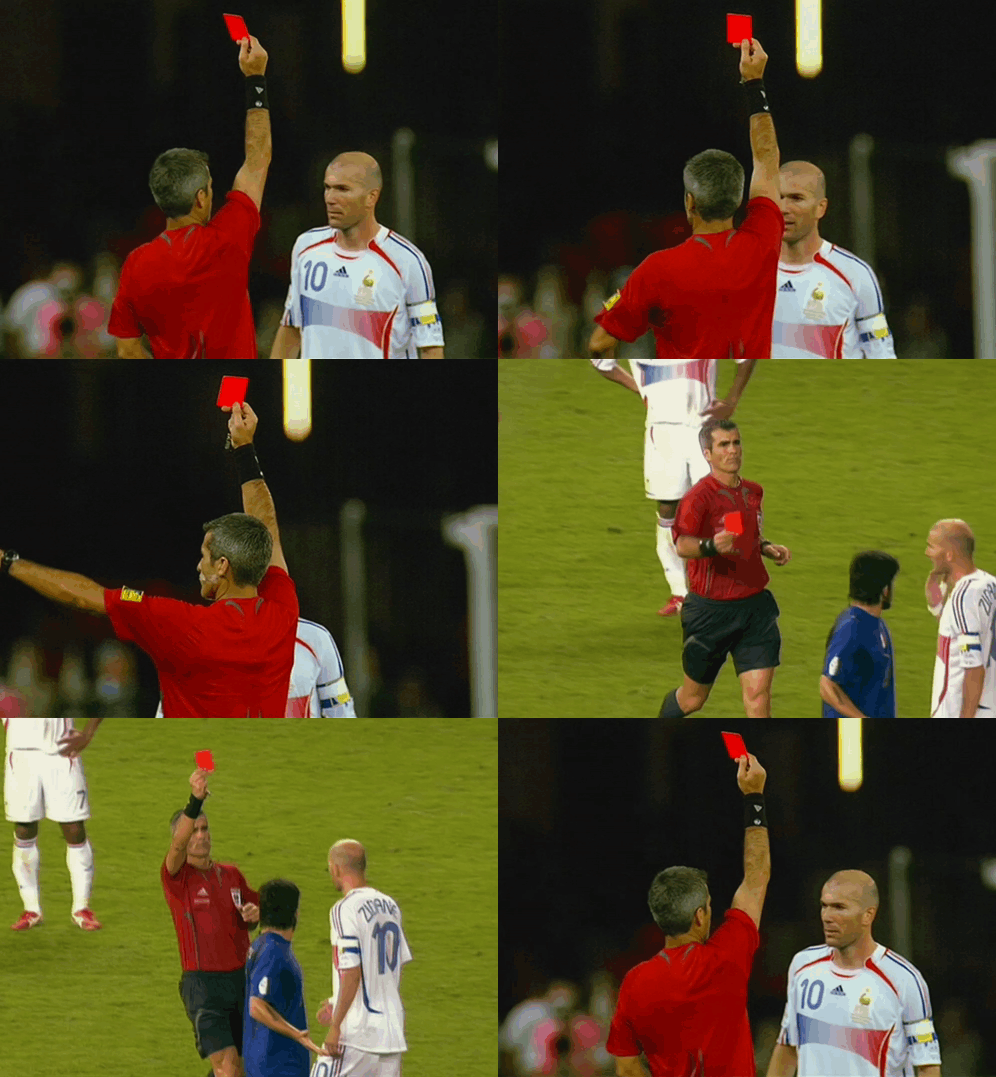
a soccer player with the number 10 on his jersey is being shown a red card
ALT: a soccer player with the number 10 on his jersey is being shown a red card
1111
Reposted by Damian Koevoet
Surya Gayet @suryagayet.bsky.social · 19/05/2025
Good morning #VSS2025, if you care for a chat about the role of attention in binding object features (during perceptual encoding and memory maintenance), drop by my poster now (8:30-12:30) in the pavilion (422). Hope to see you there!
3143
Reposted by Damian Koevoet
AttentionLab Utrecht University @attentionlab.bsky.social · 18/05/2025
@vssmtg.bsky.social presentations today! R2, 15:00 @chrispaffen.bsky.social: Functional processing asymmetries between nasal and temporal hemifields during interocular conflict R1, 17:15 @dkoevoet.bsky.social: Sharper Spatially-Tuned Neural Activity in Preparatory Overt than in Covert Attention
184
Damian Koevoet @dkoevoet.bsky.social · 17/05/2025
Attending @vssmtg.bsky.social? Come check out my talk on EEG decoding of preparatory overt and covert attention! Tomorrow in the Attention: Neural Mechanisms session at 17:15. You can check out the preprint in the meantime:
163
Damian Koevoet @dkoevoet.bsky.social · 16/05/2025
We previously showed that affordable eye movements are preferred over costly ones. What happens when salience comes into play? In our new paper, we show that even when salience attracts gaze, costs remain a driver of saccade selection. OA paper here: doi.org/10.3758/s134...
194
Damian Koevoet @dkoevoet.bsky.social · 13/05/2025
Preparing overt eye movements and directing covert attention are neurally coupled. Yet, this coupling breaks down at the single-cell level. What about populations of neurons? We show: EEG decoding dissociates preparatory overt from covert attention at the population level: doi.org/10.1101/2025...
2189
Reposted by Damian Koevoet
Alex J. Hoogerbrugge @ajhoogerbrugge.bsky.social · 07/05/2025
Thrilled to share that, as of May 1st, I have started as a postdoc at The University of Manchester! I will investigate looked-but-failed-to-see (LBFTS) errors in visual search, under the expert guidance of Johan Hulleman and Jeremy Wolfe. Watch this space!
1152
Reposted by Damian Koevoet
eLife @elife.bsky.social · 24/04/2025
Where a person will look next can be predicted based on how much it costs the brain to move the eyes in that direction.
buff.ly
A move you can afford
Where a person will look next can be predicted based on how much it costs the brain to move the eyes in that direction.
072
Reposted by Damian Koevoet
luzixu.bsky.social @luzixu.bsky.social · 23/04/2025
If you're interested in this article, here's the link: trebuchet.public.springernature.app/get_content/... Thanks to my supervisors @suryagayet.bsky.social @chrispaffen.bsky.social and @Stefan Van der Stigchel for their support!🎉
trebuchet.public.springernature.app
1114
Damian Koevoet @dkoevoet.bsky.social · 08/04/2025
In our latest paper @elife.bsky.social we show that we choose to move our eyes based on effort minimization. Put simply, we prefer affordable over more costly eye movements. eLife's digest: elifesciences.org/digests/9776... The paper: elifesciences.org/articles/97760 #VisionScience
elifesciences.org
1134
Reposted by Damian Koevoet
Christoph Strauch @cstrauch.bsky.social · 07/04/2025
We show that eye-movements are selected based on effort minimization - finally final in @elife.bsky.social eLife's digest: elifesciences.org/digests/9776... & the 'convincing & important' paper: elifesciences.org/articles/97760 I consider this my coolest ever project! #VisionScience #Neuroscience
elifesciences.org
A move you can afford
Where a person will look next can be predicted based on how much it costs the brain to move the eyes in that direction.
48226
Reposted by Damian Koevoet
Alex J. Hoogerbrugge @ajhoogerbrugge.bsky.social · 28/03/2025
New preprint! We present two very large eye tracking datasets of museum visitors (4-81 y.o.!) who freeviewed (n=1248) or searched for a +/x (n=2827) in a single feature-rich image. We invite you to (re)use the dataset and provide suggestions for future versions 📋 osf.io/preprints/os...
Heat map of gaze locations overlaid on top of a feature-rich collage image. There is a seascape with a kitesurfer, mermaid, turtle, and more.
2226
Reposted by Damian Koevoet
Christoph Strauch @cstrauch.bsky.social · 21/03/2025
Out in Psychophysiology (OA): Typically, pupillometry struggles with complex stimuli. We introduced a method to study covert attention allocation in complex video stimuli - effects of top-down attention, bottom-up attention, and pseudoneglect could all be recovered. doi.org/10.1111/psyp.70036
doi.org
<em>Psychophysiology</em> | SPR Journal | Wiley Online Library
Previous studies have shown that the pupillary light response (PLR) can physiologically index covert attention, but only with highly simplistic stimuli. With a newly introduced technique that models ....
2226