Sign in

Dr. Susanne Hoffmann

@susannehoffmann.bsky.social
1.2K followers 721 following 23 posts

Group leader @ MPI-BI, Germany, interested in Neuroethology~Naturalistic Neuroscience~Vocal Communication~Echolocation~Sensory+Motor Systems~🐦~🦇

PostsRepliesMedia
Reposted by Dr. Susanne Hoffmann
Ashkaan K. Fahimipour @akfbio.bsky.social · 05/08/2026
I'd be grateful if you could circulate to good students: I'm recruiting PhD students for Fall '27 in the areas of species interactions and animal behavior. Ad here - jobs.rwfm.tamu.edu/view-job/?id...
02840
Reposted by Dr. Susanne Hoffmann
Max Farnworth @maxfarnworth.bsky.social · 31/08/2026
🚨 I AM HIRING a 3-year postdoc & 4-year PhD student 🚨 [PLEASE SHARE WIDELY] My Emmy Noether @dfg.de funded Neural Circuit & Systems Evolution lab (🌟) at the @unimainz.bsky.socialÍ wants to start existing. So..., what do we need? WELL... we need you! APPLY UNTIL 21 SEPTEMBER.
static.klipy.com
ALT:
15765
Reposted by Dr. Susanne Hoffmann
Shivani Hariharan @shivanihari.bsky.social · 19/08/2026
Very excited to see our preprint out! 🦇 We show that bats time their echolocation calls to brief dips in rhythmic noise, helping them avoid acoustic jamming. Check it out!
0114
Reposted by Dr. Susanne Hoffmann
Migration Ecology Group @migecol.bsky.social · 12/08/2026
Free PhD positions!!! Cluster of Excellence NaviSense -> Sensory Basis, Mechanisms, and Impacts of Animal Navigation -> is looking for curious and motivated individuals from resource constrained countries to join NaviSense as Doctoral Researchers. #NaviSense #ornithology uol.de/en/job/docto...
02227
Reposted by Dr. Susanne Hoffmann
Mirjam Knörnschild @berlinbatlab.bsky.social · 18/08/2026
What would it take for AI to decode animal communication? In our new opinion piece, we argue that animal signals should not be understood only by how similar they sound, but by how the receiver perceives them. 🔗 doi.org/10.1016/j.cu...
03010
Reposted by Dr. Susanne Hoffmann
Bahl Lab @bahllab.bsky.social · 17/08/2026
🚨 4 new positions for postdoctoral research available at our @zukunftskolleg.bsky.social in beautiful Konstanz! If you are interested in exploring collective behaviour at the interface of theory and experiment, then consider applying! ⚠️ Deadline October 12 stellen.uni-konstanz.de/jobposting/4...
stellen.uni-konstanz.de
Four 2-year Postdoctoral Fellowships at the Zukunftskolleg
Application Deadline: 12 October 2026, 11:00 am (CET)
01727
Reposted by Dr. Susanne Hoffmann
SFB 1372 @sfb1372.bsky.social · 18/08/2026
NaviSense, the Cluster of Excellence on Animal Navigation at the University of Oldenburg, is looking for motivated doctoral researchers to join their interdisciplinary team! Find more details here: 🔗 uol.de/job1191en #DoctoralResearcher #AnimalNavigation #Oldenburg
01223
Reposted by Dr. Susanne Hoffmann
Harris Kaplan @harriskaplan.bsky.social · 14/08/2026
I'm thrilled to announce the opening of the Kaplan lab at the University of Virginia @uvabio.bsky.social ! We are a neuroscience lab aiming to define circuits underlying naturalistic behaviors in infants and adults. We're actively recruiting students and postdocs. Learn more at kaplan-lab.org.
96917
Dr. Susanne Hoffmann @susannehoffmann.bsky.social · 02/08/2026
On my way back home, full of new knowledge and project ideas. Thank you @neuroethology.org for once again a wonderful meeting. See you all in Taiwan in 2028.
1151
Reposted by Dr. Susanne Hoffmann
Jacob Lab @jacob-lab.bsky.social · 29/06/2026
Researchers with strong backgrounds in machine learning and AI, and a passion for advancing implantable neurotechnology, are also encouraged to apply. 📆 Application deadline: 15 Sept 2026 Please repost to help us reach the best candidates!
021
Reposted by Dr. Susanne Hoffmann
LyrebirdLab @lyrebirdlab.bsky.social · 04/06/2026
Funded #PhD scholarship: Vocal mimicry in toothbilled bowerbirds @westsyduhie.bsky.social with @animalecolab.bsky.social @drbackhouse.bsky.social @pec-exeter.bsky.social Closes: 31 July 2026 More info tinyurl.com/2axjy7pn
Lithograph of the Tooth-billed Bowerbird
01520
Reposted by Dr. Susanne Hoffmann
The Transmitter @thetransmitter.bsky.social · 24/06/2026
NEW! Explore @thetransmitter.bsky.social’s newest tool, Neuro Funding Finder. Discover grants, fellowships and funding opportunities for neuroscience research at all career stages. Find your next funding source and apply, all in one place: thetransmitter.org/neuroscience... #neuroskyence
04331
Reposted by Dr. Susanne Hoffmann
Kaja Wierucka @kajawierucka.bsky.social · 19/06/2026
Our new paper investigating the temporal dynamics of vocal accommodation in common marmosets is now published in Proceedings B! Read it here: royalsocietypublishing.org/rspb/article... @evocoggroup.bsky.social @nccrlanguage.bsky.social @primatenzentrum.bsky.social @royalsocietypublishing.org
royalsocietypublishing.org
Dynamic vocal learning in adult marmoset monkeys
Abstract. Socially mediated vocal plasticity, such as vocal accommodation, is an important mechanism for maintaining social cohesion and coordination in gr
02210
Reposted by Dr. Susanne Hoffmann
Maevatiana N. Ratsimbazafindranahaka @rmaevatiana.bsky.social · 16/06/2026
careers.universiteitleiden.nl/job/PhD-cand...
careers.universiteitleiden.nl
PhD candidate in Acoustic ecology of diving seabirds
068
Dr. Susanne Hoffmann @susannehoffmann.bsky.social · 13/06/2026
If you are in the Munich area in the beginning of July, you must go to this event! Highly recommended!!! Especially because Lisa Livancic, a fantastic student and science communicator in our research group, is speaking about acoustic communication in 🐦s.
082
Reposted by Dr. Susanne Hoffmann
Alena Lemazina @alenalem.bsky.social · 11/06/2026
🎉 Really happy to share that I, together with Carlos, PhD student at @danielavallentin.bsky.social group, have been elected as Chairs for the next Gordon Research Seminar (GRS) on Neural Mechanisms of Acoustic Communication! Stay tuned — more updates to come as we put the program together.
0183
Reposted by Dr. Susanne Hoffmann
animal prattle @animal-prattle.bsky.social · 11/06/2026
🥯🎤🐦 Does the song system in the songbird brain only care about song? How much does it interact with other areas? 🥯🎤🐦 Authors show society finches can be trained to modify song for food reward -> more proof the song system is not just a bad song detector! #neuroskyence #bioacoustics #prattle 💬
071
Reposted by Dr. Susanne Hoffmann
Journal of Experimental Biology @jexpbiol.bsky.social · 12/06/2026
Read the full research here doi.org/10.1242/jeb....
Screenshot of the PDF of the Research Article, Prenatal acoustic communication triggers adaptive vascular programming in the developing avian brain, by Prakrit Subba, Mylene M. Mariette, Katerina A. Palios, Michael G. Emmerson, Elisabetta Versace,
Katherine L. Buchanan, David F. Clayton and Julia M. George. The publishing information states © 2026. Published by The Company of Biologists | Journal of Experimental Biology (2026) 229, jeb252287. doi:10.1242/jeb.252287. The first sentence of the Abstract is: Developmental plasticity allows organisms to adjust their phenotypes to match environmental conditions, but how sensory cues program specific physiological systems remains poorly understood.
194
Dr. Susanne Hoffmann @susannehoffmann.bsky.social · 30/05/2026
Do you want to know if birds can use hair-like feathers as high-frequency sound receptors during echolocation? Join our team as PhD student or postdoc and find out! ⬇️ www.bi.mpg.de/2809383/job_...
Photo of a bird with large eyes sitting on a rock. The feathers are brown with white spots.
15935
Reposted by Dr. Susanne Hoffmann
Vivek Nityananda @viveknityananda.bsky.social · 18/05/2026
Know an amazing person in neuroethology who champions inclusivity and is a great mentor? Nominate them for this prize and let them know their efforts are important!
0810
Dr. Susanne Hoffmann @susannehoffmann.bsky.social · 18/05/2026
We are inviting applications of motivated pre-doctoral researchers to join an exciting, HFSP-funded projct. 🧪🐦 🧠 @mpiforbi.bsky.social @hfspo.bsky.social FindAPhD.com share.google/eCgiK7GdjoQD...
findaphd.com
PhD Programmes, Research Projects & Studentships in the UK & Europe
FindAPhD is a comprehensive guide to PhD studentships and postgraduate research degrees
043
Reposted by Dr. Susanne Hoffmann
Martin Bulla @martinbulla.bsky.social · 28/04/2026
Sunbirds don’t drink nectar like hummingbirds. They use intralingual suction: the tongue acts like a straw, moving nectar via pressure differences rather than capillarity. A clear case of biomechanical divergence despite ecological convergence. doi.org/10.1016/j.cu... @CurrentBiology #ornithology
112950
Reposted by Dr. Susanne Hoffmann
MPI for Biological Intelligence @mpiforbi.bsky.social · 20/04/2026
Exciting new research published in @currentbiology.bsky.social by our guest scientist and former group leader @jmrko.bsky.social. The study highlights insights from connectomics research in songbirds. „Tunneling neurons“ open new perspectives on how adult neural circuits may regenerate.
1117
Reposted by Dr. Susanne Hoffmann
Anna N Osiecka 🍉 @aosiecka.bsky.social · 17/04/2026
🔊 Research analyst for bioacoustics position open with The One and Only Susan Parks, Syracuse Uni: www.sujobopps.com/postings/112...
sujobopps.com
Research Analyst
The Bioacoustics and Behavioral Ecology Lab seeks a Research Analyst (RA) to support a diverse portfolio of research projects focused on the ecology and evolution of acoustic signaling and animal beha...
141
Reposted by Dr. Susanne Hoffmann
Pauline Provini @paulineprovini.bsky.social · 01/04/2026
🚨 Job alert! #PhD in #Biomechanics × #Neuroscience to study birdsong 🎵🐤 @mecadev.bsky.social and @neuropsi.bsky.social We are pre-selecting a candidate by April 15 to compete to InLife & IPV 2026 doctoral program (interview: May 20) 🔗 Full offer: sites.google.com/site/pauline... Please share!
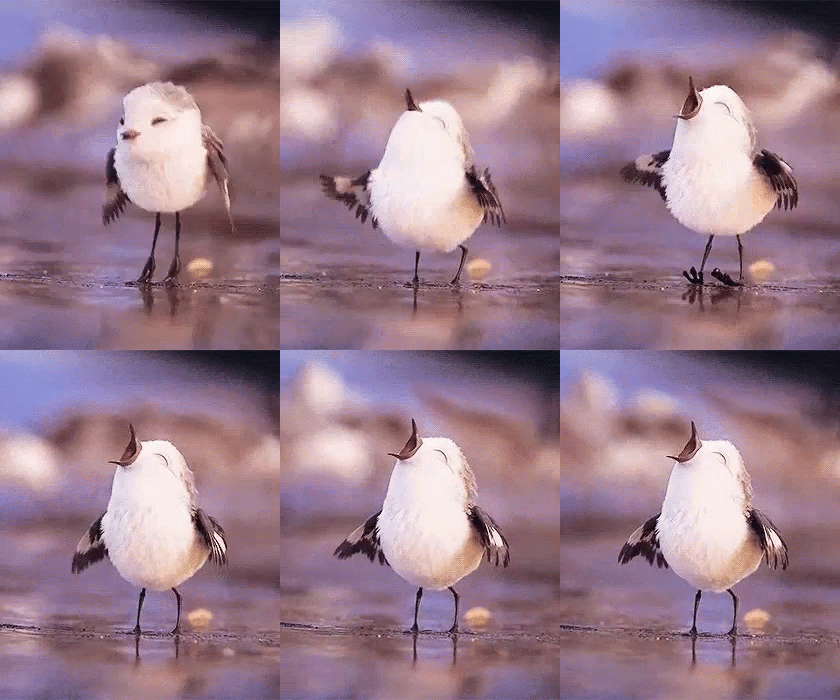
media.tenor.com
a small white bird is standing on one leg on a beach .
ALT: a small white bird is standing on one leg on a beach .
1914
Reposted by Dr. Susanne Hoffmann
Yuko Ulrich @yukoulrich.bsky.social · 10/04/2026
🎉New paper out from the lab, led by @baptistepiqueret.bsky.social: ant larvae chemically suppress the reproduction of their caregivers. bit.ly/4t8uZLG An example of how social interactions are regulated at the molecular level. The work was made possible by the unique environment @mpi-ce.bsky.social
pnas.org
06020
Reposted by Dr. Susanne Hoffmann
MPI for Biological Intelligence @mpiforbi.bsky.social · 10/04/2026
🐟+🐚 =🏠 Shell-dwelling cichlids are true underwater architects, instinctively transforming empty snail shells into protective nests. New research shows: They improve with practice, remember what they learned, and adapt to unusual conditions. 🔗 Press release: www.bi.mpg.de/news/2026-04...
12414
Reposted by Dr. Susanne Hoffmann
CIMeC_UniTrento @cimecunitrento.bsky.social · 07/04/2026
Applications are now OPEN for 13 PhD fellowships in the Doctoral Programme in Cognitive and Brain Sciences at CIMeC, University of Trento, Italy! 📅 Deadline: May 7, 2026 🧠 Research fields: brain, neuroscience, cognition, language, neuroimaging, vision and more. ℹ More info 🔗 phd.unitn.it/drcimec/
033
Reposted by Dr. Susanne Hoffmann
Andy Radford @andyradford.bsky.social · 27/03/2026
📢Fully-funded #PhD opportunity with us ❓Quantifying animal #movement patterns & behavioural #interactions in a changing world 👥Joint position in @bristolbiosci.bsky.social & #MacquarieUniversity 📆19th April deadline tinyurl.com/343acaev #maths #modelling #data #fieldwork #Australia 🙏PLEASE SHARE
Zebra finches in Australia; one of the study organisms for the PhDDwarf mongoose staring at a camera in South Africa; one of the PhD study organisms
080104
Reposted by Dr. Susanne Hoffmann
Sanele Nhlabatsi @sanele99.bsky.social · 01/04/2026
In parts of Africa, greater honeyguide birds guide people to bees’ nests. Honey for the people; in return, wax and brood for the bird: a perfect win-win. This 🧵 explores a remarkable, culturally sustained partnership between people of Eswatini and a wild bird. #BOU2026 #ornithology 1/7
The greater honeyguide bird on a honeycomb on a tree stump. Photo by Nigel DennisA Swati honey-hunter whistling on a hollow fruit to recruit a greater honeyguide. Photo by Jessica van der Wal
12911
Reposted by Dr. Susanne Hoffmann
Max-Planck-Gesellschaft @maxplanck.de · 02/04/2026
NeurodivergNet is a grassroots network founded by and for neurodivergent employees of the Max Planck Society. A place where people can connect & support one another, as well as a platform for collaboration on raising awareness and advocating for accessibility in the field of #neurodiversity.
neurodivergnet.net
Neurodivergnet | A network by and for neurodivergent scientists
A grassroots network created by and for neurodivergent scientists in academia.
12215
Reposted by Dr. Susanne Hoffmann
Max Planck Institute of Biochemistry @mpibiochem.bsky.social · 02/04/2026
We are looking for a new Vocational Training Manager for BioLab Technicians. The position will work for @mpiforbi.bsky.social as well as @mpibiochem.bsky.social. ❕ Apply until: April 29 ❕ www.linkedin.com/jobs/view/43... #hiring #jobalert #VocationalTraningManager #BioLab #Laboratory
012
Reposted by Dr. Susanne Hoffmann
Thejasvi Beleyur @beleyurthejasvi.bsky.social · 02/04/2026
Two Masters thesis position openings up on the lab website: activesensingcollectives.com/openings Especially interesting perhaps if you're into acoustics, graphical design, realtime visualisations, and algorithms. Please do spread the word and forward in your circles.
activesensingcollectives.com
Openings | Active Sensing Collectives
123
Reposted by Dr. Susanne Hoffmann
Journal of Avian Biology @avianbiology.bsky.social · 02/04/2026
New paper: Female superb lyrebirds show diverse vocal mimicry unrelated to age, but older females more often mimic predators, suggesting mimicry is fine-tuned for nest defence rather than sexual selection. ➡️ vist.ly/4x338 #ornithology #birds #mimicry #vocalisation #age
Female superb lyrebird. Photo: Wikimedia commonsFig. 4 from the article: Duration of element types with age. Ambiguous elements were significantly shorter in older females than younger females. By contrast, effects of age on conspecific and mimetic element length were not significant.Fig. 5 from the article: Mimicry of predator vocalisations and mimicry of non-predator vocalisations and their probability of occurrence.
0139
Reposted by Dr. Susanne Hoffmann
Nicholas Bellono @nbellono.bsky.social · 02/04/2026
Pablo Villar et al discover male octopus mating arms are sensory organs used to find females, navigate internally to the oviduct & deliver sperm. From behavior to structure, these findings offer a framework for how sensory systems shape reproduction & species barriers www.science.org/doi/10.1126/...
59331
Dr. Susanne Hoffmann @susannehoffmann.bsky.social · 03/04/2026
Had a lot of fun the last couple of days while filming with NHK (Japan Broadcasting Company). Thank you for covering our research!
160
Reposted by Dr. Susanne Hoffmann
Vivek Nityananda @viveknityananda.bsky.social · 03/02/2026
New #PhD on #bees (BeeHd?)! Despite the ad saying "UK Students only", a limited number of scholarships are available for international candidates. So please apply!
03439
Reposted by Dr. Susanne Hoffmann
Clemens Küpper @chorlnev.bsky.social · 01/04/2026
This work was led by freshly celebrated PhD Hanna Algora with vital contributions from @koivulakari.bsky.social @vmpakanen.bsky.social @jellybb.bsky.social, Kriszti Kupán and others
0144
Reposted by Dr. Susanne Hoffmann
Clemens Küpper @chorlnev.bsky.social · 01/04/2026
Nest failure in threatened #shorebirds has many reasons. Replacing eggs of vulnerable clutches with dummy eggs boosts nest survival of #Ruffs in grazed coastal meadows. New paper out 🎉 dx.doi.org/10.1002/ece3... in @ecol-evol.bsky.social #conservation #ornithology
1188
Reposted by Dr. Susanne Hoffmann
Jerome Beetz @beetzjerome.bsky.social · 20/02/2026
Have you ever asked yourself, how insect brains represent places? And whether insects do have place cells? Then move to Germany this summer and start your PhD in my lab. We conduct tetrode recordings from bumblebees that freely forage laboratory mazes. 🧠🐝#BeeSpace @erc.europa.eu @neuroethology.org
05037
Dr. Susanne Hoffmann @susannehoffmann.bsky.social · 27/03/2026
Very, very happy about receiving this grant!!! Thank you @hfspo.bsky.social for supporting us.
2121
Reposted by Dr. Susanne Hoffmann
MPI for Biological Intelligence @mpiforbi.bsky.social · 11/02/2026
Today, we celebrate the International Day of Women and Girls in Science! At our Institute, 60% of scientists are women, and each brings a unique perspective, curiosity, and voice to science. We are proud to introduce some of our female researchers and share their personal insights and motivation.
1153
Reposted by Dr. Susanne Hoffmann
MPI for Biological Intelligence @mpiforbi.bsky.social · 09/02/2026
1 lab. 2 days. 10 students. 🥼 🔬 🧪 Last week, we invited outstanding students from all over Bavaria who had qualified for the International Biology Olympiad. Our Maxlab was transformed into a hands-on biology training camp. This is what future scientists look like: thinking, experimenting, exploring.
1103
Reposted by Dr. Susanne Hoffmann
MPI for Biological Intelligence @mpiforbi.bsky.social · 04/02/2026
Who benefits from mating with multiple partners? Darwin suspected that in some cases, it may be the females rather than the males. A new long-term study on African coucals shows: when males provide all parental care, females can have more offspring by competing for and mating with multiple partners.
1156
Reposted by Dr. Susanne Hoffmann
Institute of Science and Technology Austria (ISTA) @istaresearch.bsky.social · 21/01/2026
Most of us are familiar with the nightingale's song, but did you know there's more to it than just a melody? Read more: doi.org/10.1016/j.cu... @danielavallentin.bsky.social @tpvogels.bsky.social @mpiforbi.bsky.social ​
0137
Reposted by Dr. Susanne Hoffmann
MPI for Biological Intelligence @mpiforbi.bsky.social · 27/10/2025
Two weeks left to apply for our graduate school IMPRS-BI and join us as a PhD student! Find out more: imprs-bi.mpg.de
0612
Reposted by Dr. Susanne Hoffmann
Nick Jourjine @nickjourjine.bsky.social · 22/07/2025
Very nice review of the neuroscience underlying bat #bioacoustics ⬇️
073
Reposted by Dr. Susanne Hoffmann
Alper Yelimlieş @alperyelimlies.bsky.social · 05/06/2025
Excited to share our new preprint! Unlike the North American yellow warblers, females in Galápagos commonly sing and duet with their paired partners. Here, we tested possible functions with a playback experiment: www.biorxiv.org/content/10.1...
 Illustration of female and male yellow warblers and their respective songs. On top, two duets are shown in spectrograms with male parts marked in red and female parts marked in yellow. On the left are three female songs and on the right are three different male songs. Illustrations are courtesy of Lena Gies.
49020
Reposted by Dr. Susanne Hoffmann
Nicholdav @nicholdav.bsky.social · 06/06/2025
🌧️📱 rain calls 📱🌧️ Cool study in @behavecol.bsky.social from Framond et al. (Brumm lab, @mpiforbi.bsky.social) of a poorly understood chaffinch call type Based on playbacks + field studies they conclude these are female-directed alarm calls academic.oup.com/beheco/artic... #prattle 💬 #bioacoustics
01911
Reposted by Dr. Susanne Hoffmann
Royal Society Publishing @royalsocietypublishing.org · 04/05/2025
The ontogeny of decision-making in an eavesdropping predator: royalsocietypublishing.org/doi/10.1098/... #ProcB #cognition #ethology
184