Sign in

Aadam

@aadam.dev
218 followers 482 following 24 posts

Ph.D. student @ IUI. Studying #MachineLearning, #NeuroSymbolicAI

PostsRepliesMedia
Aadam @aadam.dev · 11h
Found this video on my feed youtu.be/7Yy3nPDS0cs Perfect time as I wanted to get a refresher on how others have set up their systems and what I can learn from it to improve mine. I've been away from #Logseq for a while and have been using it mainly with LLM + CLI. Time to change that
youtu.be
Logseq Is Still Better Than Obsidian in 2026
YouTube video by ZeroShotOrDie
000
Reposted by Aadam
lichen.wiki @lichen.wiki · 26/09/2026
OMGGG you can now self-host lichen.wiki in a container !!!! (we also have a nix flake) wikis still live on people's PDSes, your instance sees the same wikis, nothing to migrate! you can put one wiki at the root of your own domain, or several (eg like one per language) guide here on tangled :
tangled.org
SELF-HOSTING.md at main · juprodh.me/lichen.wiki
🌿 Collaborative wiki on ATProto
0265
Reposted by Aadam
Quanta Magazine @quantamagazine.org · 26/09/2026
Lie groups underlie some of the most fundamental laws of physics. www.quantamagazine.org/what-are-lie…
1264
Reposted by Aadam
Sakana AI @sakanaai.bsky.social · 14/09/2026
Introducing PC-ALM: a local-learning alternative to backprop that trains 1000-layer neural nets using only local dynamics. Blog: pub.sakana.ai/pc-alm/
18714
Aadam @aadam.dev · 08/08/2026
Glad to see the future of efficient Linux Systems. www.jeffgeerling.com/blog/2026/ex...
jeffgeerling.com
I'm excited for Intel after testing the XPS 13
Shortly after Apple launched the budget MacBook Neo, Dell announced their response, a new low-end XPS 13. Matching the Neo's current pricing, it starts at $699, or $599 with an educational discount. T...
000
Reposted by Aadam
The Transmitter @thetransmitter.bsky.social · 08/07/2026
Explore @thetransmitter.bsky.social 's newest tool, Neuro Funding Finder. Discover grants, fellowships and funding opportunities for neuroscience research at all career stages, powered by @scientifyresearch.org. #neuroskyence thetransmitter.org/neuroscience...
thetransmitter.org
Neuroscience Grants Funding Finder
Discover grants, fellowships and funding opportunities for neuroscience research at all career stages.
03317
Aadam @aadam.dev · 04/07/2026
Really enjoying the seamless self-hosted sync for the Logseq DB version (set up with the help of Codex). Logseq nowadays acts as both my daily journal, and a place for LLM to write logs and context to. I'm loving the experience so far. Thank you Logseq team for developing and open-sourcing sync.
010
Aadam @aadam.dev · 03/07/2026
Remember watching some demo for Discourse Graphs by @joelchan86.bsky.social years ago, tried it a bit in Logseq, but it didn't stick. Got back into it today after watching some talks on Open Modular Science. Still, a lot to explore, what's @atproto.science, @semble.so , and @leaflet.pub etc.
480
Reposted by Aadam
Zed @zed.dev · 29/04/2026
Zed 1.0: Your last next editor.
412418
Reposted by Aadam
Mikkel Malmberg @mikker.dev · 24/02/2026
Finally recorded the Tuna introduction video www.youtube.com/watch?v=vkm...
youtube.com
Meet Tuna: a brand new, modern, modal launcher for macOS
Friends, I've been spending late nights building my very own, complete and perfect launcher for macOS. It's called Tuna.🌐 GET IT: https://tunaformac.com💬 D...
4384
Reposted by Aadam
Dan Goodman @neural-reckoning.org · 26/02/2026
London #neuroscience people you may like this. We're hosting a series of talks at Imperial & Crick on how to get experiment and theory working together better. Each session will have a talk around this and extended networking / group discussion on the questions raised. Plus, free food! 🤖🧠🧪
13813
Reposted by Aadam
Aadam @aadam.aadam.dev.ap.brid.gy · 24/02/2026
👋Hello World Welcome to my humble digital abode! In my first post on this newly minted Ghost blog, I aim to articulate my goals and motivations behind this blog, and make some resolutions for myself and some promises to you (my dear reader or future self). Before delving into my motivations […]
aadam.dev
Reclaiming my mind in the age of AI
👋 Hello World Welcome to my humble digital abode! In my first post on this newly minted Ghost blog, I aim to articulate my goals and motivations behind this blog, and make some resolutions for myself and some promises to you (my dear reader or future self). Before delving into my motivations, goals, and promises, let me first quickly introduce myself. My name is **Aadam** (yeah, that's my full name), and I'm currently doing a PhD in Computer Science. I won't say I'm quite an interesting fellow, but I do have some interests: 🤫 You can click on the highlighted text above to expand it further. There are some redeeming qualities to my character as well, but I'm not going to reveal all the goodies in our first meet-and-greet now, would I? You'll have to stick around (if intrigued) to find out more. # Why this Blog? To answer this question, I'll have to take you on a tangent and tell you a woeful story. Once upon a time there lived a starry-eyed boy, eager to learn and make his mark on the world. Inspired by sci-fi movies, and novels like I-Robot, he dreamed of creating truly intelligent machines one day. To realize his dream, he learned to code, enjoyed going through dense C++ manuals, and participated in several coding competitions representing his institution. Though with the passage of time, his interests shifted, his duties increased, and his priorities changed. Life happened. And more importantly, the world evolved. Suddenly, skills that were sought after and valued before were becoming obsolete. Even though AI wasn't truly intelligent yet, it became proficient enough to replace some of the skills that required intelligence before. Skills such as programming and writing, which required immense effort before, were being delegated to AI Agents. And more importantly, if you didn't use these new technologies, you'll get left behind. So, with time, he started relying on these technologies, and stopped developing and reinforcing his own skills in that particular domain. And slowly but surely, his skills atrophied. This is one of the main reasons behind the "Why" of this blog for me. I don't want my skills and my capabilities to fade away. I want to practice and improve my writing skills, in a carefree, safe, and personal environment, where I don't have to worry about meeting deadlines or quotas. I can polish my skills at my own pace, writing about what I want, and developing my own voice. There will surely be many errors (given that English isn't my first language), but that's fine. After all, you ~~only~~ mainly learn from your mistakes. I don't want to be entirely dependent on AI tools for writing and thinking. > “Once men turned their thinking over to machines in the hope that this would set them free. But that only permitted other men with machines to enslave them.” > > ― **Frank Herbert,**Dune I know that AI agents will be prevalent in the foreseeable future, and they are just tools (not actually intelligent beings for now 🤨), and we should use them to efficiently perform our tasks. They have their roles in writing, coding, brainstorming, re/searching, prototyping, and more, and can aid us in reaching our goals much more quickly and efficiently. I'm not against their usage. I regularly use them a lot to automate/skip mundane tasks. I just don't want to loose my own skills in the process. I have noticed this gradual skill decay personally and there have been some public reports on this as well. After the advent of calculator, it wasn't really necessary to memorize/practice complex calculations when you can simply get the answer quickly. That skill isn't required anymore. I wonder what skills will get obsolete after the Agentic AI era. So, the aim of this blog is quite selfish I'd say. I just want to develop my writing skills. I want to be able to confidently articulate my thoughts for a public audience. I really enjoyed the following quote by Brandon Sanderson (one of my favorite fantasy authors) in his recent talk where he discussed why he doesn't consider the AI generated output to be "Art". > Remember art is not just the story. It is not just the painting or the sculpture or whatever else you love to create. It's also the process of creation and what that process did to you. We make art because we can't help it. It's part of us. We understand what it is. We are drawn to it because we are of the same substance. We are the arts. > > Brandon Sanderson – We Are The Art | Brandon Sanderson’s Keynote Speech The basic idea is that "Art" isn't the end product (a generated poem, drawing, painting, novel), but the journey one took to get to that end product. And that's why I'm starting this blog. To go on a journey to rediscover myself and redevelop my skills. To share what I learn along the way. To revel in the joy of writing, living, and learning. # What to expect? 100% Human generated, error-prone prose. That's my only commitment to both myself and you, my dear reader. Again, if I use AI, then it would defeat the whole purpose of this blog. So, from brainstorming, to outlining, to writing, and finally editing, everything will be done by me and me alone. And this is a personal blog, so don't expect any adherence to a specific niche topic. I'll write about whatever topic catches my attention at that moment. I'm mainly interested in: Artificial Intelligence (Machine Learning, Deep Learning, Reinforcement Learning), Note-taking (Obsidian, Logseq, AnyType, Thymer, Tana), Programming (Julia, Go, Python), Fantasy Novels, Academic Life, and more. * * * So, if you want to get to know me more, learn about the journey I'm embarking on, and track my progress on this exciting path, stick around, introduce yourself in the comments, and follow along. If not, I still thank you for reading my incoherent thoughts and sticking till the end of this post. Looking forward to writing and sharing more, Insha'Allah.
021
Reposted by Aadam
Neuromatch @neuromatch.bsky.social · 10/02/2026
We’ve kicked off #Python for #ComputationalScience Week,...but it’s not too late to join! Come learn, practice, and build momentum! Catch up on #PythonWeek here: www.reddit.com/r/neuromatch...
Python for Computational Science Week, 7-15 Feb 2026

Start with what you know, end with what you need. 
Python Week makes it doable.
083
Reposted by Aadam
Hadi Vafaii @hadivafaii.bsky.social · 18/10/2025
RL Debates 2: Fritz "learning for the sake of learning" Sommer Fritz introduced an information-theoretic, first-principles approach to modeling exploration through the maximization of "predicted information gain." 📽️ Watch the full presentation here: www.youtube.com/watch?v=rlF-... 🧠🤖🧠📈
youtube.com
RL Debates 2: Fritz "learning for the sake of learning" Sommer
YouTube video by Sensorimotor AI
1115
Reposted by Aadam
Neuromatch @neuromatch.bsky.social · 16/10/2025
Neuromatch Academy 2026 is coming! ✅ Hands-on projects ✅ Global community ✅ Affordable fees Applications open Feb 2026. Learn more: neuromatch.io/courses/ Sign up for updates: neuromatch.io/mailing-list/ #ComputationalNeuroscience #DeepLearning #ClimateScience #NeuroAI #Neuroscience #AI
0129
Reposted by Aadam
Thousand Brains Project @thousandbrains.org · 10/10/2025
🚨 @vivianeclay.bsky.social and @cortical-canonical.bsky.social respond to “What's the Most Surprising Capability Monty Gains Through Sensorimotor Learning?” youtube.com/shorts/lUQkb... Read the paper: arxiv.org/abs/2507.04494 Read the plain language explainer: thousandbrains.org/thousand-bra...
youtube.com
✅ What's the Most Surprising Capability Monty Gains Through Sensorimotor Learning #sensorimotorai
YouTube video by Thousand Brains Project
032
Reposted by Aadam
Kris Jensen @kristorpjensen.bsky.social · 24/09/2025
I’m super excited to finally put my recent work with @behrenstimb.bsky.social on bioRxiv, where we develop a new mechanistic theory of how PFC structures adaptive behaviour using attractor dynamics in space and time! www.biorxiv.org/content/10.1...
922286
Reposted by Aadam
Neuromatch @neuromatch.bsky.social · 25/09/2025
Exciting news! 🎉 Our Computational Neuroscience course has been awarded NIH BRAIN Initiative funding! Students will get hands-on experience w real BRAIN Initiative datasets, helping them build computational skills that are essential for the future of neuroscience. www.linkedin.com/feed/update/...
17525
Reposted by Aadam
Hadi Vafaii @hadivafaii.bsky.social · 30/06/2025
“Perception as Inference” is a century-old idea that has inspired all major theories in neuroscience 🧠, including: ✅ Sparse Coding ✅ Predictive Coding ✅ Free Energy Principle & more! In my new blog post, I build the intuition behind this idea from ground up 👉[1/6]🧵 🧠🤖🧠📈
1245
Reposted by Aadam
Scott Hanselman 🌮 @scott.hanselman.com · 18/09/2025
Google Glass walked so Meta Ray Ban Glasses could also walk
1019116
Reposted by Aadam
Hadi Vafaii @hadivafaii.bsky.social · 17/09/2025
What drives behavior in living organisms? And how can we design artificial agents that learn interactively? 📢 To address these, the Sensorimotor AI Journal Club is launching the "RL Debate Series"👇 w/ @elisennesh.bsky.social, @noreward4u.bsky.social, @tommasosalvatori.bsky.social 🧵[1/5] 🧠🤖🧠📈
23710
Reposted by Aadam
Danzu @hdanzu.bsky.social · 07/09/2025
An overview of @logseq DB Task Management youtu.be/ITCcMFNSSmw?... with the new Schema and improved UX #logseq #TaskManagement #pkm #Productivity
youtu.be
Logseq DB - Task Management - Unfiltered and Unedited
YouTube video by H D
041
Reposted by Aadam
NeSy 2026 Conference @nesyconf.org · 05/09/2025
It is almost time to welcome you all in Santa Cruz! 🦕 We will start with an exciting and timely keynote by @guyvdb.bsky.social on "Symbolic Reasoning in the Age of Large Language Models" 👀 📆 Full conference schedule: 2025.nesyconf.org/schedule/
1185
Reposted by Aadam
Dan Goodman @neural-reckoning.org · 04/09/2025
Is anarchist science possible? As an experiment, we got together a large group of computational neuroscientists from around the world to work on a single project without top down direction. Read on to find out what happened. 🤖🧠🧪
Diagram of how the "collaborative modelling of the brain" (COMOB) project started. Starting material lead to group research or solo research, coming together in online workshops (monthly) in an iterative cycle, finishing with writing up together. The diagram is illustrated with colourful cartoon blob characters.
27528
Reposted by Aadam
Debbie Ridpath Ohi @debbieohi.com · 30/08/2025
Looking for more engagement on Bluesky? I've compiled tips with t he help of others in the community: publish.obsidian.md/debbieohi/bl... #BlueSkyTips
Comic strip of four colored stick-figure characters. In the first panel, green, pink, orange characters speak into megaphones. In the second panel, the green character looks frustrated while the others are silent as they look at him. In the third panel, the pink and orange characters chat with each other, while the green character says, “Bah, I give up. Not getting any engagement here.” In the last panel, the green character walks away as the pink and orange continue their conversation. Text at the bottom reads “@debbieohi.com.”
715536
Reposted by Aadam
Trinity Chung @trinityjchung.com · 27/05/2025
1/ What if we make robots that process touch the way our brains do? We found that Convolutional Recurrent Neural Networks (ConvRNNs) pass the NeuroAI Turing Test in currently available mouse somatosensory cortex data. New paper by @Yuchen @Nathan @anayebi.bsky.social and me!
Task-Optimized Convolutional Recurrent Networks Align with Tactile Processing in the Rodent Brain
1185
Reposted by Aadam
Obsidian @obsidian.md · 18/08/2025
Introducing Bases, a new core plugin that lets you turn any set of notes into a powerful database. Now available to everyone with Obsidian 1.9!
1442792
Reposted by Aadam
Emily Simons @emsimons.bsky.social · 18/07/2025
Join us on a (mathematical) journey to a shire - oops, HIGHER - standard and principled evaluation schema for our benchmark datasets. This is the reward of the RINGS framework. 📒 Blog: aidos.group/blog/rings/ 📃 Paper: doi.org/10.48550/arX... 👩‍💻 Code: github.com/aidos-lab/ri...
media.tenor.com
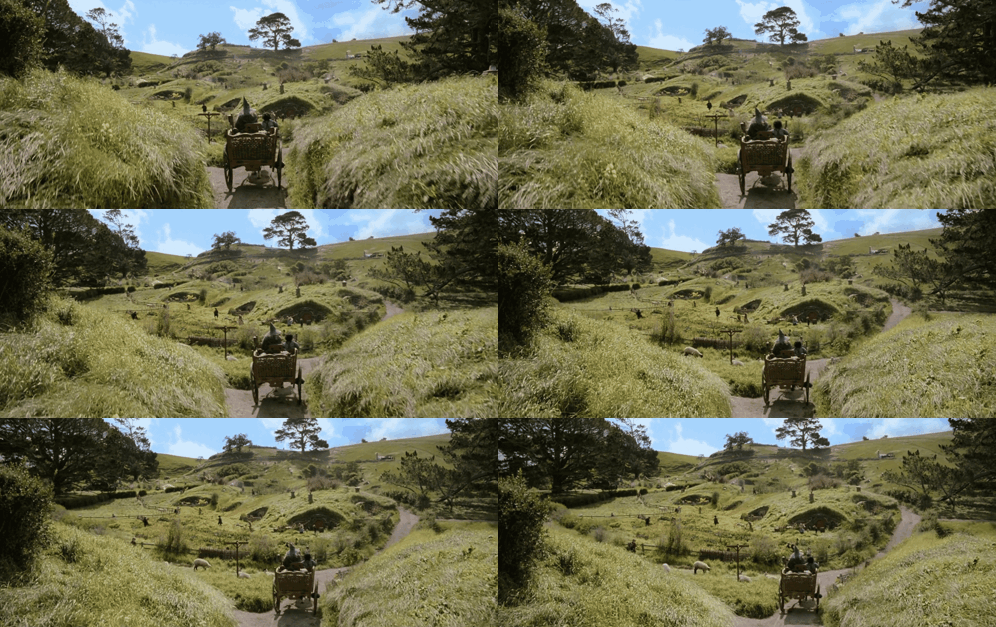
a horse drawn carriage going through a grassy area
ALT: a horse drawn carriage going through a grassy area
052
Reposted by Aadam
Blake Richards @tyrellturing.bsky.social · 11/07/2025
1/3) This may be a very important paper, it suggests that there are no prediction error encoding neurons in sensory areas of cortex: www.biorxiv.org/content/10.1... I personally am a big fan of the idea that cortical regions (allo and neo) are doing sequence prediction. But... 🧠📈 🧪
biorxiv.org
Sensory responses of visual cortical neurons are not prediction errors
Predictive coding is theorized to be a ubiquitous cortical process to explain sensory responses. It asserts that the brain continuously predicts sensory information and imposes those predictions on lo...
1321979
Reposted by Aadam
Thousand Brains Project @thousandbrains.org · 11/07/2025
1/ 🚨Another New Paper Drop! 🚨 “Hierarchy or Heterarchy? A Theory of Long-Range Connections for the Sensorimotor Brain” 👇 Dive into the full thread 🧵 arxiv.org/abs/2507.05888
184
Reposted by Aadam
Thousand Brains Project @thousandbrains.org · 10/07/2025
🔥 Want to understand how the neocortex builds intelligence? Artem Kirsanov made a great video on the Thousand Brains Theory, the foundation of everything we’re building at here Thousand Brains Project! 🎥 youtu.be/Dykkubb-Qus #Neuroscience #AI #ThousandBrains #Neocortex
youtu.be
A Fundamental Unit Of Intelligence
YouTube video by Artem Kirsanov
052
Reposted by Aadam
RL & Agents Reading Group @rl-agents-rg.bsky.social · 10/07/2025
Hello world! This is the RL & Agents Reading Group We organise regular meetings to discuss recent papers in Reinforcement Learning (RL), Multi-Agent RL and related areas (open-ended learning, LLM agents, robotics, etc). Meetings take place online and are open to everyone 😊
13712
Reposted by Aadam
Hadi Vafaii @hadivafaii.bsky.social · 09/07/2025
Announcing the new "Sensorimotor AI" Journal Club — please share/repost! w/ Kaylene Stocking, Tommaso Salvatori, and @elisennesh.bsky.social Sign up link: forms.gle/o5DXD4WMdhTg... More details below 🧵[1/5] 🧠🤖🧠📈
12412
Reposted by Aadam
Viviane Clay @vivianeclay.bsky.social · 08/07/2025
Super excited to share our new paper! We spent the past years building an alternative AI approach, and now we demonstrate a whole range of advantages. Robust object & pose detection, generalization, data and compute efficient training, continual learning, shape bias, intelligent policies, and more!🦾
042
Reposted by Aadam
Shubhendu Trivedi @shubhendu.bsky.social · 09/07/2025
Nice paper arxiv.org/abs/2506.01622
arxiv.org
General agents need world models
Are world models a necessary ingredient for flexible, goal-directed behaviour, or is model-free learning sufficient? We provide a formal answer to this question, showing that any agent capable of gene...
153
Reposted by Aadam
Blake Richards @tyrellturing.bsky.social · 09/07/2025
Together with @repromancer.bsky.social, I have been musing for a while that the exponentiated gradient algorithm we've advocated for comp neuro would work well with low-precision ANNs. This group got it working! arxiv.org/abs/2506.17768 May be a great way to reduce AI energy use!!! #MLSky 🧪
arxiv.org
Log-Normal Multiplicative Dynamics for Stable Low-Precision Training of Large Networks
Studies in neuroscience have shown that biological synapses follow a log-normal distribution whose transitioning can be explained by noisy multiplicative dynamics. Biological networks can function sta...
33913
Reposted by Aadam
Thousand Brains Project @thousandbrains.org · 09/07/2025
New paper dropped! “Hierarchy or Heterarchy? A Theory of Long-Range Connections for the Sensorimotor Brain” The Thousand Brains Theory explains the cortex’s non-hierarchical connections, and why they matter for building machine intelligence. Read it now: arxiv.org/abs/2507.05888
0133
Reposted by Aadam
Thousand Brains Project @thousandbrains.org · 08/07/2025
1/ This week, we’re releasing two milestone papers: one shows the amazing capabilities of thousand-brains systems and their benefits over deep learning, the other proposes a new theory of long-range connections in the neocortex. Years of work led to this.
1112
Aadam @aadam.dev · 28/06/2025
Such a timely find. I was just about to find some source to delve into the field HRL. I think this could be a good starting point.
020
Reposted by Aadam
Roger Creus Castanyer @roger-creus.bsky.social · 23/06/2025
🚨 Excited to share our new work: "Stable Gradients for Stable Learning at Scale in Deep Reinforcement Learning"! 📈 We propose gradient interventions that enable stable, scalable learning, unlocking significant performance gains across agents and environments! Details below 👇
1255
Reposted by Aadam
Sakana AI @sakanaai.bsky.social · 23/06/2025
Introducing Reinforcement-Learned Teachers (RLTs): Transforming how we teach LLMs to reason with reinforcement learning (RL). Blog: sakana.ai/rlt Paper: arxiv.org/abs/2506.08388 Code: github.com/SakanaAI/RLT We introduce a new way to teach LLMs how to reason by learning to teach, not solve.
2337
Reposted by Aadam
Leo Kozachkov @leokoz8.bsky.social · 28/05/2025
Big week for astrocyte research: 3 new Science papers link astrocytes to behavior. We're excited to add to the momentum with our new PNAS paper: a theory, grounded in biology, proposing astrocytes as key players in memory storage and recall. w/ JJ Slotine and @krotov.bsky.social (1/6)
13513
Reposted by Aadam
Sam McDougle @actlab.bsky.social · 02/06/2025
Thrilled to share the new paper from the lab out today in @nathumbehav.nature.com, led by the great @jetrach.bsky.social! "Mental graphs structure the storage and retrieval of visuomotor associations" www.nature.com/articles/s41...
nature.com
Mental graphs structure the storage and retrieval of visuomotor associations - Nature Human Behaviour
Trach and McDougle show that motor responses can form part of structured, graph-like memory representations.
28434
Reposted by Aadam
micha heilbron @mheilbron.bsky.social · 23/05/2025
New preprint, w/ @predictivebrain.bsky.social ! we've found that visual cortex, even when just viewing natural scenes, predicts *higher-level* visual features The aligns with developments in ML, but challenges some assumptions about early sensory cortex www.biorxiv.org/content/10.1...
biorxiv.org
Higher-level spatial prediction in natural vision across mouse visual cortex
Theories of predictive processing propose that sensory systems constantly predict incoming signals, based on spatial and temporal context. However, evidence for prediction in sensory cortex largely co...
28835
Reposted by Aadam
Tomer Ullman @tomerullman.bsky.social · 02/06/2025
Out now in TiCS, something i've been thinking about a lot: "Physics vs. graphics as an organizing dichotomy in cognition" (by Balaban & me) relevant for many people, related to imagination, intuitive physics, mental simulation, aphantasia, and more authors.elsevier.com/a/1lBaC4sIRv...
515148
Reposted by Aadam
Tim Vogels @tpvogels.bsky.social · 02/06/2025
We just pushed “Memory by a 1000 rules” onto bioRxiv, where we use clever #ML to find #plasticity quadruplets (EE, EI, IE, II) that learn basic stability in spiking nets. Why is it cool? We find 1000s!! of solutions, and they don’t just stabilise. They #memorise! www.biorxiv.org/content/10.1...
biorxiv.org
Memory by a thousand rules: Automated discovery of functional multi-type plasticity rules reveals variety & degeneracy at the heart of learning
Synaptic plasticity is the basis of learning and memory, but the link between synaptic changes and neural function remains elusive. Here, we used automated search algorithms to obtain thousands of str...
413747
Reposted by Aadam
Sakana AI @sakanaai.bsky.social · 26/05/2025
Following our Sudoku-based reasoning benchmark announcement, we've been evaluating the latest models to track improvements in their reasoning capabilities. Today, we’re launching the Sudoku-Bench Leaderboard: pub.sakana.ai/sudoku/ New technical report: arxiv.org/abs/2505.16135
1153
Reposted by Aadam
Adeel Razi @adeelrazi.bsky.social · 26/05/2025
🧵Training binary or spiking neural networks is hard. Gradients vanish, surrogates are noisy, batchnorm is brittle. We propose a Bayesian approach based on KL divergence minimization—and it works. Paper: arxiv.org/abs/2505.17962 Work by James Walker & Moein Khajehnejad @neuro-ai.bsky.social 1/6
arxiv.org
A Principled Bayesian Framework for Training Binary and Spiking Neural Networks
We propose a Bayesian framework for training binary and spiking neural networks that achieves state-of-the-art performance without normalisation layers. Unlike commonly used surrogate gradient methods...
33012
Reposted by Aadam
Friedemann Zenke @fzenke.bsky.social · 27/05/2025
1/6 Why does the brain maintain such precise excitatory-inhibitory balance? Our new preprint explores a provocative idea: Small, targeted deviations from this balance may serve a purpose: to encode local error signals for learning. www.biorxiv.org/content/10.1... led by @jrbch.bsky.social
518257
Reposted by Aadam
The Viking (Gunnar Blohm) @gunnarblohm.bsky.social · 27/05/2025
www.nature.com/articles/s41...
nature.com
Mastering diverse control tasks through world models - Nature
A general reinforcement-learning algorithm, called Dreamer, outperforms specialized expert algorithms across diverse tasks by learning a model of the environment and improving its behaviour by imagini...
1316