Sign in

Hannah Mechtenberg

@hannahmech.bsky.social
458 followers 547 following 76 posts

researcher studying brains, speech, how to talk about science, with some freelance graphic design on the side. she/her 🏳️‍🌈 hmechtenberg.wixsite.com/hrmech

PostsRepliesMedia
Reposted by Hannah Mechtenberg
Emily Myers @emilymyers.bsky.social · 13/10/2026
Lately out in Psychonomic Bulletin Review from Anne Marie Crinnion @jimmagnuson.bsky.social and me, an exploration of how listeners differ in their use of bottom-up (acoustic) and top-down (lexical-semantic) information. link.springer.com/article/10.3...
link.springer.com
Phonetic stability predicts individual differences in acoustic–phonetic cue weighting - Psychonomic Bulletin & Review
When processing speech, not every listener relies to the same degree on the various available types of information. It is unknown, however, whether differences in cue reliance reflect chronic or task-...
2237
Hannah Mechtenberg @hannahmech.bsky.social · 05/08/2026
8 years ago, I started a science magazine. There was a critical gap between speech science and non-experts, and I also wanted to provide writing and outreach instruction to undergrads. Check out our latest issue here, headed by Portia Washington: thespokenworddigest.substack.com
thespokenworddigest.substack.com
The Spoken Word | The Language and Brain Lab | Substack
Science digested by the Language and Brain Lab, where we cover topics in aphasia, speech and language science, and outreach. Available via print and podcast. Based at the University of Connecticut. Cl...
070
Hannah Mechtenberg @hannahmech.bsky.social · 11/06/2026
Thank you!!
010
Hannah Mechtenberg @hannahmech.bsky.social · 11/06/2026
What a whirlwind it's been! I came here in 2018 to work as a lab manager not knowing anything about speech or language and came away with more knowledge than I know what to do with (though, I still have a lot to learn)! Thank you to @emilymyers.bsky.social for your mentorship and the LAB Lab!
3100
Reposted by Hannah Mechtenberg
Emily Myers @emilymyers.bsky.social · 27/03/2026
New paper our from our lab led by postdoc Holly Zaharchuk, with @overhannahlyze.bsky.social , @hannahmech.bsky.social , and @mattcphillips.bsky.social We measured individual differences in sensitivity to phonetic contrasts using VAS and eyetracking 1/2
1174
Reposted by Hannah Mechtenberg
Sourcery @sourceryapp.bsky.social · 22/03/2026
Were you at the NEA Spring meeting? Looking for new research opportunities? We're searching for Beta Testers for the next Sourcery update! 🥳 ✨Ready to begin? Start here: go.sourceryapp.org/register #BetaTesters #RemoteResearch #SourceryApp #HigherEd #Academia
Person using the Sourcery app on a phone showing research request statuses, announcing that Sourcery is looking for Beta Testers.
111
Reposted by Hannah Mechtenberg
Jamie Reilly 🦜 @reilly-coglab.com · 22/12/2025
Paper alert! (1/2) We examined brain activation for each content word in a podcast relative to incrementally larger ngrams (1-word, 5-words, 10-words) that precede each word with a focus on semantic distance. www.sciencedirect.com/science/arti...
sciencedirect.com
Measuring brain sensitivity to semantic distance in spoken narrative comprehension
Discourse comprehension requires simultaneous integration of local and global constituents. When hearing a narrative, for example, listeners must link…
33611
Reposted by Hannah Mechtenberg
Jonathan Peelle @jpeelle.bsky.social · 22/12/2025
Glad to see this work led by the talented @hannahmech.bsky.social (and also with @emilymyers.bsky.social and @reilly-coglab.com) is out in the world. It's been fun to be thinking in units beyond the sentence.
0102
Hannah Mechtenberg @hannahmech.bsky.social · 22/12/2025
We liked your interview so much we have used it in a variety of studies including brain imaging and a method where we measure how pupils change over time (pupillometry). Thank you for doing such a good job altering people's brains!
000
Reposted by Hannah Mechtenberg
Carl Zimmer @carlzimmer.com · 22/12/2025
Scientists scanned people in an fMRI as they listened to me talk about my book She Has Her Mother's Laugh. I altered their brains! (Or at least my semantics did...)
Figure of two brain hemispheres with orange and blue regions indicating changes in brain activity as people listen to a journalist on a radio show and link words together to build meaning.
2313
Hannah Mechtenberg @hannahmech.bsky.social · 03/11/2025
Self five!!
010
Hannah Mechtenberg @hannahmech.bsky.social · 06/10/2025
Why are we so good at adapting to "sub-optimal" speech? I argue, in this review paper, that adaptation may be driven by the combined action of dopamine and norepinephrine via prediction error signaling. It's early days with this idea, but I'm excited to have it out there and to keep exploring more!
093
Hannah Mechtenberg @hannahmech.bsky.social · 02/09/2025
Is there a difference? hahaha
010
Hannah Mechtenberg @hannahmech.bsky.social · 02/09/2025
Utterly - I never know what's going to happen next
110
Hannah Mechtenberg @hannahmech.bsky.social · 02/09/2025
So exciting!!!!
110
Reposted by Hannah Mechtenberg
Jamie Reilly 🦜 @reilly-coglab.com · 01/09/2025
Awwwww Yeah -- it's official
3497
Reposted by Hannah Mechtenberg
Arielle Keller @ariellekeller.bsky.social · 08/08/2025
Absolutely thrilled to share the 🌟 FIRST PAPER 🌟 from ACORN Lab! 🐿️ I’m beyond proud of all-star grad student @heatherarobinson.bsky.social for this review of “exposome” effects on neurodevelopment & cognition! Paper here rdcu.be/ezUqx & thread below 👇 /1 #neuroskyence #PsychSciSky #devsky #cogdev
rdcu.be
The effect of the “exposome” on developmental brain health and cognitive outcomes
Neuropsychopharmacology - The effect of the “exposome” on developmental brain health and cognitive outcomes
47033
Reposted by Hannah Mechtenberg
Science Homecoming @sciencehomecoming.bsky.social · 01/08/2025
From farm to faculty. Writing home to his community in Minnesota, Prof Jim Magnuson explains that the powerhouse behind U.S. research is the infrastructure, paid by “indirect costs”. “This system has made U.S. science the strongest in the world.” 🧪🏠 www.hometownsource.com/county_news_...
hometownsource.com
Farm to faculty: How federal research funding changes lives and boosts Minnesota's economy
When I was growing up on a farm near Cambridge, I never met a scientist. I didn’t know what scientific research was or how people became scientists. I graduated from
12013
Hannah Mechtenberg @hannahmech.bsky.social · 24/07/2025
Such a fun experience to travel down to Georgia and have our team of talented students show the summit attendees what the @langscistation.bsky.social is all about! It's been a few summers since I've had the pleasure of running studies with the LSS and it was lovely to reprise my role :)
040
Reposted by Hannah Mechtenberg
Jamie Reilly 🦜 @reilly-coglab.com · 22/07/2025
Our conversation analysis software is now on CRAN! Reach out with any questions. We hope it’s useful for all you language and social interaction folks out there.
13814
Reposted by Hannah Mechtenberg
Jonathan Peelle @jpeelle.bsky.social · 13/06/2025
As you listen to a story, the meaning of each word you hear relates to the meaning of prior words. But how? We operationalized semantic distance, and identified brain regions that correspond to this rolling summary measure during naturalistic listening. #neuroscienceoflanguage
0267
Hannah Mechtenberg @hannahmech.bsky.social · 13/06/2025
Thanks @ariellekeller.bsky.social, it was a true team effort!
000
Hannah Mechtenberg @hannahmech.bsky.social · 13/06/2025
HUGE props to @jamiereillycog.bsky.social (check out his super cool SemanticDistance package in R too: osf.io/preprints/ps...), @jpeelle.bsky.social, and @emilymyers.bsky.social for getting this project out into the world. It's neat stuff.
osf.io
OSF
040
Hannah Mechtenberg @hannahmech.bsky.social · 13/06/2025
The results are interesting (if I am so biased as to say), maybe especially so because the anterior right temporal lobe was particularly sensitive to changes in context window size (so, from 2-gram to 10-gram) - perhaps suggesting a specialized role in semantic integration during listening.
Plots showing activation patterns within right and left hemisphere ROIs for changes in the context window size of semantic distance. The right anterior STG is highlighted as that had a statistically significant difference across the window sizes.
110
Hannah Mechtenberg @hannahmech.bsky.social · 13/06/2025
Check out our preprint (linked again here: osf.io/preprints/ps...) where we measured neural sensitivity to changes in semantic space while listening to a podcast. Not only do we look at word-to-word but larger chunks too (2-gram, 5-gram, 10-gram) to examine meaning construction at multiple levels.
A figure showing neural sensitivity to semantic distance at multiple chunk sizes. The panels show activation in the superior temporal gyri and frontal regions that varies in relation to changes in semantic distance.
1336
Hannah Mechtenberg @hannahmech.bsky.social · 06/05/2025
I can't believe we didn't think about that! Maybe we can get starburst to sponsor??
110
Reposted by Hannah Mechtenberg
Emily Myers @emilymyers.bsky.social · 06/05/2025
In this new pub we ask whether a small rewards (cents) might get people to learn the phonetic details of talker more quickly (e.g. a s--sh shift). Answer: probably not. The fact that we got to title the paper "Cents and Shenshibility" was just a bonus. Explainer below!
3296
Hannah Mechtenberg @hannahmech.bsky.social · 06/05/2025
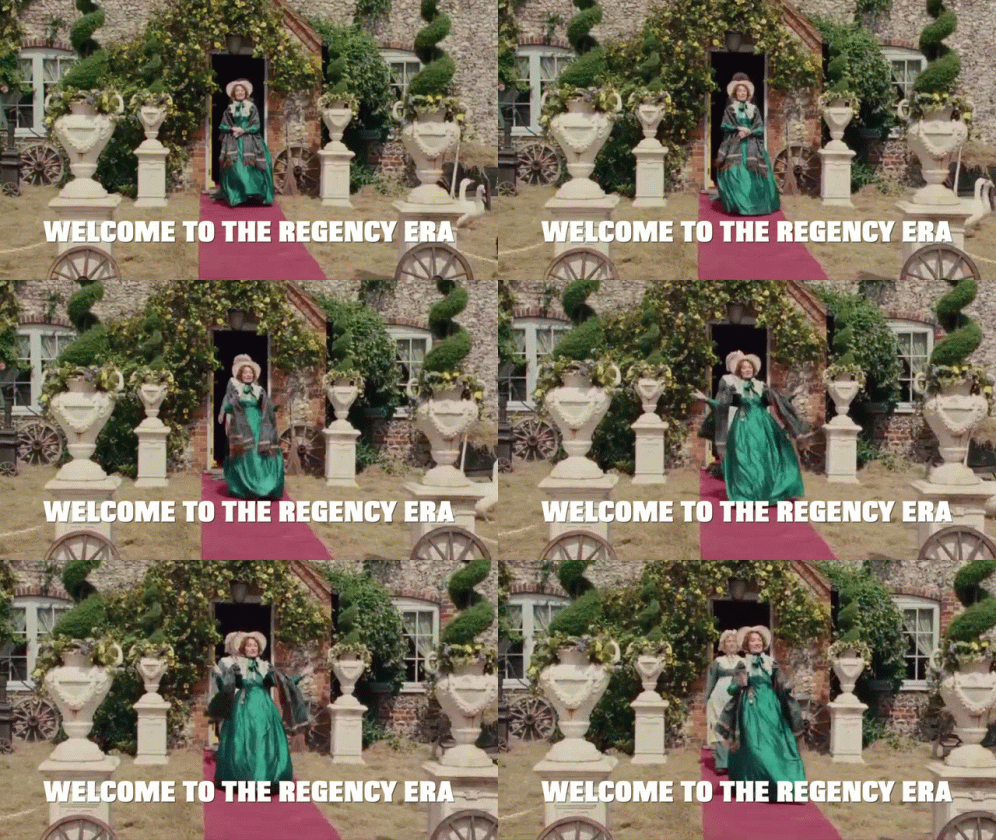
Bonus fact: Our title “Cents and Shenshibility” allowed us to sprinkle in Jane Austen easter eggs throughout the paper—try and find them all!
media.tenor.com
a woman in a green dress walks down a red carpet with the words welcome to the regency era written below her
Alt: a woman in a green dress walks down a red carpet with the words welcome to the regency era written below her
050
Hannah Mechtenberg @hannahmech.bsky.social · 06/05/2025
This work is reasonably exciting (to us) as it suggests that this process is relatively insulated from external influence – which begs the question: why? Food for future study, and we hope this work inspires renewed interest in the role of attention and reward in talker-specific phonetic learning.
media.tenor.com
a woman with curly hair is sitting in a chair and saying money please .
Alt: a woman with curly hair is sitting in a chair and saying money please .
230
Hannah Mechtenberg @hannahmech.bsky.social · 06/05/2025
(5/) We then followed up with several alternations: what if we reward at the level of the phoneme instead of at the talker? What if listeners know the value of the reward before they hear the ambiguous word? Results converge on the possibility that reward does not influence phonetic recalibration
Plots of the pooled results for three post hoc analyses summarizing over phonetic categorization data from multiple experiments reported here. For all, the x-axis depicts the acoustic energy as the proportion of /s/ energy, proceeding from more /ʃ/-like responses on the left to more /s/-like responses on the right-hand side. The y-axis plots the mean of participant /s/ responses. Error bars depict the standard error of the mean. Bias direction is indicated by the color of the line, with red indicating the /s/-biased talker and the blue indicating the /ʃ/-biased talker. A Post hoc analysis comparing all experiments with a high- and low-reward talker to assess if the magnitude of the bias effect is different for the value of the talker. Panel B) Post hoc analysis comparing experiments with and without reward components to test if tasks with reward makes the bias effect smaller. Panel C) Post hoc analysis comparing magnitude of the bias effect after either the talker-decision cover task or the phoneme-monitoring cover task during exposure to examine any task-related differences in phonetic recalibration.
220
Hannah Mechtenberg @hannahmech.bsky.social · 06/05/2025
(4/) In the first experiment, using a probabilistic reward schedule, we found that listeners learned just as much about the high reward talker as they did for the low reward talker, suggesting that perhaps external value may not factor into talker-specific phonetic recalibration. Curious
Results from the phonetic categorization task from Experiment 1A (left column) and Experiment 1B (right column). The red lines indicate categorization for the /s/-biased talker and the blue lines indicate categorization for the /ʃ/-biased talker. On the x-axis, we plot the acoustic energy as the proportion of /s/ energy, proceeding from more /ʃ/-like responses on the left to more/s/-like responses on the right-hand side. Shaded gray regions indicate the range depicted in Fig. 5. Rewarded Talker is indicated by line type: solid for high-reward talker and dashed for low-reward talker.
120
Hannah Mechtenberg @hannahmech.bsky.social · 06/05/2025
(3/) In our adaptation of a multitalker LGPL paradigm (randomly intermixed exposure then talker-specific test), we added a small monetary reward following correct trials more often for one talker vs the other. We then measured the amount of learning via a test for each talker. So, what did we find?
Schematic of the experiment task structure. All experiments had the same task progression. In the exposure phase, participants heard tokens from both talkers, presented in an interleaved fashion. The exposure task varied slightly for each experimental question (Panel B). After the exposure task, participants immediately completed a phonetic categorization task which was blocked by talker; talker order was counterbalanced across participants. The phonetic categorization task was a 2AFC decision where participants indicated by button press whether a given token on a 7-point continuum from sign-shine was more like “sign” or like “shine.” Panel B) Variants on the exposure task by experimental question. Experiments 1A and 1B used a talker decision task where participants indicated whether the talker was male or female and received feedback and a reward (points that corresponded to a small monetary payout) for correct answers on a subset of the trials. Experiments 2A, 2B, and 3 transitioned to a phoneme monitoring task where participants indicated if the auditory word contained the “n” phoneme or not. Again, they received feedback and a reward for a subset of correct responses. Experiment 3 used the same phoneme monitoring task but added a reward cue prior to the auditory stimulus that indicated the value of the talker. After the phoneme monitoring response, participants also received feedback.
120
Hannah Mechtenberg @hannahmech.bsky.social · 06/05/2025
(2/) We wanted to know if listeners might prioritize learning for one talker that was literally rewarded more often than another: something we might experience in real life. Might we learn more about the speech for those we value? And learn less about the speech for talkers that we value less?
media.tenor.com
a close up of a man 's face with the words `` i don 't care about your life . ''
Alt: A close up of a Tyrion Lanister from Game of Thrones with the words "I don't care about your life .''
120
Hannah Mechtenberg @hannahmech.bsky.social · 06/05/2025
New science alert!!! Myself, Shawn Cummings, Sahil Luthra, & @emilymyers.bsky.social tested whether monetary reward during talker-specific phonetic recalibration biased listeners to learn more about one talker vs another. The results are complicated? doi.org/10.3758/s13414-025-03048-z (1/thread)
doi.org
Cents and shenshibility: The role of reward in talker-specific phonetic recalibration - Attention, Perception, & Psychophysics
To what degree might speech perception be affected by factors external to the speech signal? Here, we consider whether listeners consider the value of individual talkers (e.g., a person that is import...
4172
Reposted by Hannah Mechtenberg
Jonathan Peelle @jpeelle.bsky.social · 15/04/2025
The Society for the Neurobiology of Language meeting will be at Gallaudet University, September 12-14th. We have 4 outstanding keynotes (Fumiko Hoeft, Duane Watson, Carol Padden, Fatemeh Geranmayeh). Abstract submissions are open! Hope to see you there! #SNL2025 2025.neurolang.org/abstract-sub...
Annual meeting of the Society for the Neurobiology of Language
September 12-14 2025
Gallaudet University
Abstract submission through April 29
neurolang.org
23316
Hannah Mechtenberg @hannahmech.bsky.social · 08/04/2025
Thank you for the shout-out! We have an open-source model (osf.io/db79q/) for anyone who wants to start a lab digest -- it leads your writers through all the skills they need to learn about public science communication! Stay tuned for our 10th issue that will be released soon!
osf.io
An Adaptable Model for Science Communication and Lab Outreach: The Lab Digest
Materials to create an in-lab research digest intended to share academic work with non-scientist audiences. It is designed for novice writers and science communicators to learn the skills needed to wr...
172
Reposted by Hannah Mechtenberg
Annenberg School at Penn @asc.upenn.edu · 03/04/2025
Researchers at Annenberg and @umdscience.bsky.social show that proposed NIH funding cuts lead to an estimated $16 billion in economic loss and 68,000 jobs lost nationwide. Learn about their project and view the interactive map here:
asc.upenn.edu
Data-Driven, Interactive Map Shows Local Economic Impact of Cuts to Federal Funding for Health Research
111284
Reposted by Hannah Mechtenberg
David Shiffman, Ph.D. 🦈 @whysharksmatter.bsky.social · 03/03/2025
Today, a broad coalition of scientific professional societies who represent over 92,000 scientists are speaking out against the politicization and demonization of Federally funded science and government scientist jobs. It was an honor to help the Union of Concerned Scientists with this! 🧪🌎
ucsusa.org
48 Scientific Societies Representing Almost 100,000 Scientists Ask Congress to Protect the Future of Science
48 scientific societies representing almost 100,000 scientists signed on to a letter asking Congress to protect the future of science
6733011420
Hannah Mechtenberg @hannahmech.bsky.social · 28/02/2025
This effort is headed by @emilymyers.bsky.social of the the Language and Brain Lab @uconn.bsky.social. We release new articles ~yearly, but we may start to increase frequency. Please consider giving us a subscribe. We also have audio versions of our articles available on the site and on Spotify!
010
Hannah Mechtenberg @hannahmech.bsky.social · 28/02/2025
If you need a break, come visit our new Substack space where you can read articles that translate work in speech and hearing science, aphasia, caregiving, and more. It's a small drop in the bucket, but increasing the reach of critical knowledge feels worthwhile: thespokenworddigest.substack.com
thespokenworddigest.substack.com
The Spoken Word | The Language and Brain Lab | Substack
Science digested by the Language and Brain Lab, where we cover topics in aphasia, speech and language science, and outreach. Available via print and podcast. Based at the University of Connecticut. Cl...
1116
Reposted by Hannah Mechtenberg
Alt National Park Service @altnps.bsky.social · 14/02/2025
Across the government, probationary employees and Schedule A workers—including individuals with severe physical, psychiatric, or intellectual disabilities, as well as veterans—are being let go.
394103813274
Reposted by Hannah Mechtenberg
Carl T. Bergstrom @carlbergstrom.com · 08/02/2025
1. Today the NIH director issued a new directive slashing overhead rates to 15%. I want to provide some context on what that means and why it matters. grants.nih.gov/grants/guide...
grants.nih.gov
NOT-OD-25-068: Supplemental Guidance to the 2024 NIH Grants Policy Statement: Indirect Cost Rates
NIH Funding Opportunities and Notices in the NIH Guide for Grants and Contracts: Supplemental Guidance to the 2024 NIH Grants Policy Statement: Indirect Cost Rates NOT-OD-25-068. OD
25469974076
Reposted by Hannah Mechtenberg
Karen James @kejames.bsky.social · 08/02/2025
Look up the impact of NIH funding in your state: www.unitedformedicalresearch.org/nih-in-your-...
unitedformedicalresearch.org
NIH In Your State - United For Medical Research
Select a state on the map to see the impact of NIH funding across America.
611887
Reposted by Hannah Mechtenberg
Carl Zimmer @carlzimmer.com · 30/01/2025
National Science Foundation suspends salary payments, leaving researchers unable to pay their bills www.statnews.com/2025/01/30/t... Story by @ericboodman.bsky.social
statnews.com
National Science Foundation suspends salary payments, leaving researchers unable to pay their bills
An NSF online payment system remained down after the federal funding freeze was lifted, leaving early-career scientists scrambling to pay bills
5914501012
Reposted by Hannah Mechtenberg
Emily Myers @emilymyers.bsky.social · 02/12/2024
Ever been curious about what happens in your brain when there is a topic shift during listening? I thought so. @hannahmech.bsky.social has some answers for you. But also more questions?
1202
Hannah Mechtenberg @hannahmech.bsky.social · 02/12/2024
In case you missed it at @psychonomicsociety.bsky.social's annual meeting - I worked with @jamiereillycog.bsky.social, @jpeelle.bsky.social, and @emilymyers.bsky.social to model changes in semantic distance during a podcast, which correlated with neural activity! drive.google.com/drive/u/0/fo...
A snippet from a poster. At the top is a heading reading, "The pattern of neural sensitivity to semantic distance during naturalistic listening varies based on region: from the STG to the supramarginal gyrus." Below the heading are graphical depictions of brains with the activation patterns on them. The four types of activation are: semantic distance, just word events, lexical frequency, and phonological neighborhood density.
0193
Reposted by Hannah Mechtenberg
Psychonomic Society @psychonomicsociety.bsky.social · 26/11/2024
Thanks to all who made the #psynom24 65th Annual Meeting in the Big Apple unforgettable! See you in Denver next year. buff.ly/49pjpD3
0302
Hannah Mechtenberg @hannahmech.bsky.social · 26/11/2024
I am so grateful to have had the opportunity to write up some of the amazing talks for @psychonomicsociety.bsky.social during this year's Annual Meeting. Check them out if you didn't get a chance to come (or missed a few talks)!
020
Reposted by Hannah Mechtenberg
Arielle Keller @ariellekeller.bsky.social · 21/11/2024
☀️ New preprint! ☀️ Cognitive tests from 23,000+ participants in 4 datasets show cyclical fluctuations across the calendar year, including a small but replicable “summer slide” where youth show worst performance after school vacation. t.ly/OMzgl #PsychSciSky #CogPsyc #CogDev #devpsy #CogSci Thread /1
a graph showing a drop in cognitive performance during the summer months in the ABCD Study dataset
1018774
Hannah Mechtenberg @hannahmech.bsky.social · 20/11/2024
Yes, come see me! I'm presenting Saturday evening (the 23rd) from 6:00-7:30!
010