Benjamin Lowe @brainboyben.bsky.social · 29/09/2026Super cool! I find it interesting that the effect of the lapse was super late—links up super nicely with the selective attention literature atm 020
Reposted by Benjamin LoweNico Schuck @nicoschuck.bsky.social · 21/09/20262023: 8,039 proposals 2024: 10,360 proposals 2025: 17,066 proposals 2026: 21,627 proposals Something's gotta give 210954
Reposted by Benjamin Lowesteven t. piantadosi @spiantado.bsky.social · 15/09/2026www.dailycal.org/news/campus/...dailycal.orgUC Berkeley research suggesting upper-class individuals are more likely to snatch children’s candy wins Ig Nobel PrizeUC Berkeley researchers were awarded the 2026 Ig Nobel Prize — a parody Nobel Prize — for research showing that “upper-class” individuals practice more unethical behaviors than “lower-class” individua... 1195
Reposted by Benjamin LowePieter Barkema @pieterbarkema.bsky.social · 11/09/2026What you see right now is not a livestream, but is delayed & edited by your brain 🧠. The brain uses a short time buffer to rewrite what you thought you saw using info that comes in later (postdiction). We study how (7T fMRI, retinotopy). Read our preprint: www.biorxiv.org/content/10.6... 👀 (1/N)biorxiv.org 36420
Reposted by Benjamin LoweBelvoir St Theatre @belvoirst.bsky.social · 11/09/2026Inside the rehearsal room of A ROOM WITH A VIEW. A smart new adaptation of Forster’s great novel of love and discovery. 3 Oct - 1 Nov Novel by E.M Forster Adapted by Grace Chapple Directed by Hannah Goodwin Co-produced with Melbourne Theatre Company & Black Swan State Theatre Company 022
Reposted by Benjamin LoweDerek Arnold @visnerd.bsky.social · 08/09/2026A recent paper argued that there is no visual binding problem. I disagree, and wrote a response... journals.sagepub.com/doi/10.1177/... Related demonstrations can be found here... staff.psy.uq.edu.au/~uqdarnol/JS... 62412
Benjamin Lowe @brainboyben.bsky.social · 04/09/2026As my Australian friends come visit the UK for conferences and the like, my partner returns home for rehearsals of an adaptation she’s written for the stage: E. M. Forster’s ‘A Room With a View’, set to tour the country this year! Here’s a fun little behind the scenes (@belvoirst.bsky.social):belvoirst.substack.comGrace Chapple Rehearsal Diary: Week 1Join us each week as we go behind the scenes of the rehearsal process of A Room with a View with adaptor Grace Chapple. 010
Reposted by Benjamin LoweHeleen Slagter @haslagter.bsky.social · 19/08/2026PhD position (4 years, paid) on an NWO-funded project on the Role of Foveal Processing in Spatial Attention at Vrije Universiteit Amsterdam, the Netherlands, supervised by Dr. Mieke Donk (main PI) and me! For more information: workingat.vu.nl/vacancies/ph...workingat.vu.nlVacancy — PhD position (4 years) on the Role of Foveal Processing in Spatial AttentionAre you interested in understanding how attention shapes what we see? Would you like to combine behavioural experiments, psychophysics, and eye tracking to uncover how the brain selects and prioritise... 03934
Reposted by Benjamin LoweCount Binface @countbinface.bsky.social · 12/08/2026Okay Clacton. Let’s go. 16569391261
Reposted by Benjamin LoweReza Shadmehr @rezashadmehr.bsky.social · 28/07/2026If an action results in error, each neuron requires an individualized teaching signal that guides change in its output. This is the credit assignment problem of learning. Are there neurons in the brain that can compute such a sophisticated teaching signal? Yes. www.biorxiv.org/content/10.6...biorxiv.orgClimbing fibers encode the gradient of a loss function for the cerebellumNeurons in the brain are often many synapses away from motoneurons, yet if a movement results in error, each distant neuron needs a teacher that considers its specific contribution to production of th... 218170
Reposted by Benjamin LowePeter Kok @peterkok.bsky.social · 27/07/2026The PhD position in our lab closes 31 July - apply now! 01918
Benjamin Lowe @brainboyben.bsky.social · 24/07/2026Sounds spooky scary. Almost like a werewolf bar mitzvah. Hope you’re feeling better soon! Sheep Detective is a wild ride if you go in completely blind 110
Reposted by Benjamin LoweDota Tianai Dong @dotadotadota.bsky.social · 21/07/20261/5 Over a decade of comparing deep neural networks to the human brain—but what have we actually learned? Our new @cp-trendscognsci.bsky.social Feature Review synthesizes a decade of brain–DNN comparisons, asking what they reveal about brain function across vision and language. 14421
Reposted by Benjamin LowePeter Kok @peterkok.bsky.social · 09/07/2026The hippocampus sits at the interface of perception & memory, allowing us to link past, present, & future through its role in generating predictions. Excited to share this theme issue in @royalsociety.org's Philosophical Transactions B, co-edited with @barense.bsky.social & @mariamaly.bsky.socialroyalsocietypublishing.orgVolume 381 Issue 1954 | Philosophical Transactions of the Royal Society B | The Royal SocietyInfluential themed journal issues across the life sciences. 211753
Benjamin Lowe @brainboyben.bsky.social · 17/06/2026Big swing, Alex! I hope this results in some healthy debate. Congrats on the paper :) 010
Reposted by Benjamin LoweScott Marek @smarek0502.bsky.social · 11/06/2026What matters most for childhood brain organization? We analyzed 649 variables. The answer: Socioeconomics (SES); with brain patterns pointing at sleep & stress as drivers. Even brain-IQ associations were better explained by SES. In Science today: www.science.org/doi/10.1126/... 6319169
Reposted by Benjamin LoweConsciousness - tlab @qualiastructure.bsky.social · 02/06/2026[Consciousness Radio] Prof Anina Rich - on synesthesia, attention, consciousness youtu.be/BF8xKOo9PeA?... via @YouTube chat with Anna, Anson and Nao at sunny MBI.youtu.be[Consciousness Radio] Prof Anina Rich - on synesthesia, attention, consciousnessYouTube video by Neural basis of Consciousness & Qualia Structure 022
Reposted by Benjamin LoweDragan Rangelov @neuronomist.bsky.social · 16/04/2026📢 Rare academic 💎 alert 📢 We’re hiring a Lecturer/Senior Lecturer (Level B/C) in Psychology & Cognitive Neuroscience @ Swinburne (Melbourne). Teach a brand‑new degree + access MRI, MEG, EEG & TMS/tDCS. ⏰ Apply by 17 May 2026, 11 pm 🔗 swinjobs.nga.net.au/cp/index.cfm... Reach out for more info.swinjobs.nga.net.au 01010
Benjamin Lowe @brainboyben.bsky.social · 17/04/2026Looks great, Tim! Keen to give it a gander next week 020
Reposted by Benjamin LoweTim Gastrell @tgastrell.bsky.social · 17/04/2026🏰 New preprint! 🏰 (w/ the excellent @neuronomist.bsky.social & Prof. Jason Mattingley) For my PhD I've been using EEG, psychophysics and modelling to explore how the brain uses uncertainty to balance sensory information against expectations about what's out there. 🧵1/n 21910
Benjamin Lowe @brainboyben.bsky.social · 09/04/2026Great to see that this is out, Runhao! Looking forward to implementing it in some of my work ;) 100
Reposted by Benjamin LoweRunhao Lu | 陆润豪 @runhaolu.bsky.social · 08/04/2026Using time-resolved EEG/MEG decoding?🧠 Here’s a new approach! No feature engineering (decode from raw signals), but capturing info that standard decoding often misses (oscillatory/aperiodic activity, connectivity). Lightweight, INTERPRETABLE, and easy to use. (1/6) www.biorxiv.org/content/10.6...biorxiv.org 46124
Reposted by Benjamin LoweJohn Tuthill @tuthill.bsky.social · 24/03/2026🧵 New preprint led by @bingbrunton.bsky.social, @elliottabe.bsky.social, @lawrencehu.bsky.social We gave a worm brain control of a fly body and it walked What did we learn? Nothing, other than deep reinforcement learning is effective We call it the digital sphinx www.biorxiv.org/content/10.6... 10412151
Reposted by Benjamin LoweAaron Kaltenmaier @akalt.bsky.social · 06/03/2026Excited to share that our MEG project is now out in Current Biology! We show how visual content codes relate to motor oscillations in telling time. Huge thanks to Quirin Gehmacher, Peter Kok, Matt Davis and Clare Press (bsky links below).🧵 authors.elsevier.com/sd/article/S...authors.elsevier.comScienceDirect.com | Science, health and medical journals, full text articles and books. 13715
Benjamin Lowe @brainboyben.bsky.social · 24/02/2026Had a quick play around in Coder View on my Mac and it feels incredibly light weight. Bravo! 030
Reposted by Benjamin LowePsychoPy @psychopy.org · 23/02/2026📣 PsychoPy Studio is out now!! ✨ Which also means swish new branding on psychopy.org ✨ We really hope that this improves user experience in general. Please download and try it. Let us know how you get on via the forum discourse.psychopy.org/t/introducin... 22112
Reposted by Benjamin LoweBrisbane Experimental Psychology Student Initiative (BEPSI) @brisepsi.bsky.social · 20/02/2026Our first meeting for 2026 is just 5 days away! To kick things off we have 2 awesome Tims presenting their research @tvcottier.bsky.social & @tgastrell.bsky.social You can join in-person or online via Zoom - register here to receive the link 👇 uniofqueensland.syd1.qualtrics.com/jfe/form/SV_... 171
Benjamin Lowe @brainboyben.bsky.social · 16/02/2026It was my pleasure! :) FYI: @psychopy.org is looking for more Australian Ambassadors. Definitely reach out if you're interested! 040
Reposted by Benjamin LoweNatalie Christie Peluso 🧠 @nataliepeluso.com · 16/02/2026Introducing @brisepsi.bsky.social - we're an experimental psychology initiative run by grad students in Brisbane (Meanjin) across UQ & QUT 🧠 We host a monthly dose of freshly baked research (students, ECRs, & bigwigs) followed by social goodness. Help us grow with a follow! 🤗 #neuroskyence 1187
Reposted by Benjamin LoweMargot Finn @eicathomefinn.bsky.social · 03/02/2026'to treat peer review as a throughput problem is to misunderstand what is at stake. Review is not simply a production stage in the research pipeline; it is one of the few remaining spaces where the scientific community talks to itself.' 1/3timeshighereducation.comAI is not a peer, so it can’t do peer reviewIf we still believe that science is a vocation grounded in argument, curiosity and care, we can’t delegate judgement to machines, says Akhil Bhardwaj 6359155
Reposted by Benjamin LoweDavid Brang @dbrang.bsky.social · 20/01/2026Interpreting EEG requires understanding how the skull smears electrical fields as they propagate from the cortex. I made a browser-based simulator for my EEG class to visualize how dipole depth/orientation change the topomap. dbrang.github.io/EEG-Dipole-D... Github page: github.com/dbrang/EEG-D... 412749
Reposted by Benjamin LoweManikya Alister @manikyaalister.bsky.social · 20/01/2026Most popular decision-making models assume that cognitive processes are static over time. In our new paper in Psych Review, we offer a simple extension to evidence accumulation models that lets researchers account for systematic changes in parameters across time 📈 psycnet.apa.org/fulltext/202... 1289
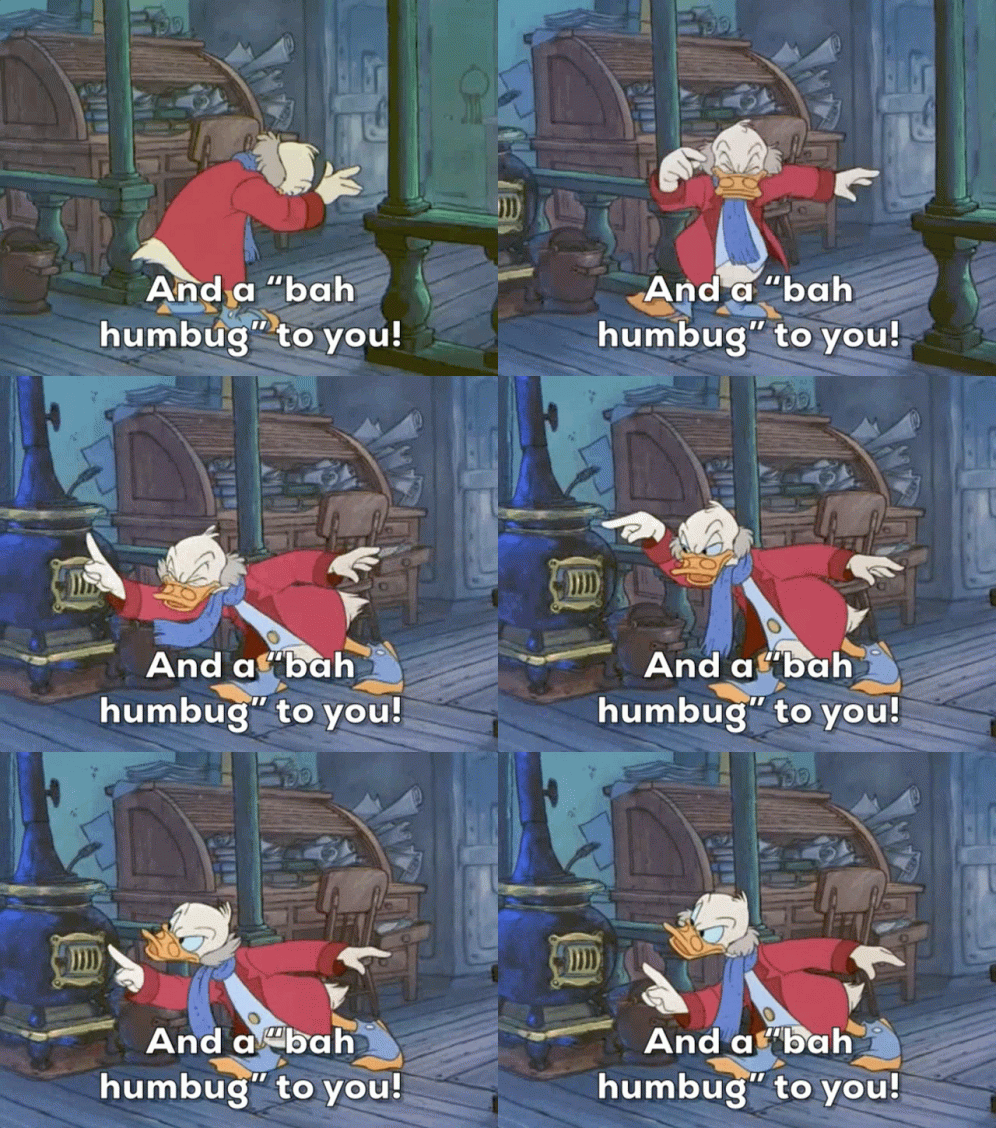
Reposted by Benjamin LoweWilliam Ngiam | 严祥全 @williamngiam.github.io · 18/01/2026Our publishing system does not prioritise or value the careful curation of research data to be FAIR nearly enough. I have been data editing for AP&P for a year now, and it is sad to see no reward for the clearly careful organisation of data and materials vs that which is thrown on OSF with no care!media.tenor.coma cartoon of donald duck says " and a bah humbug " to youALT: a cartoon of donald duck says " and a bah humbug " to you 1245
Benjamin Lowe @brainboyben.bsky.social · 12/12/2025Also, I apologise for the poor figure quality in the HTML version of the article. Elsevier’s typesetting team made some nonsense changes that I did not consent to, which have somehow proved to be frustrating to fix on their end. The PDF version is fine though! 000
Benjamin Lowe @brainboyben.bsky.social · 12/12/2025I’d like to thank my co-authors (particularly Naohide and Jonny) and reviewers for helping me elevate the quality of this work 😊 100
Benjamin Lowe @brainboyben.bsky.social · 12/12/2025This suggests that visual surprise may operate at the bound object level and/or is a domain-general response, which is identical to the conclusion drawn from our previous work! www.sciencedirect.com/science/arti...sciencedirect.comSame but different: The latency of a shared expectation signal interacts with stimulus attributesPredictive coding theories assert that perceptual inference is a hierarchical process of belief updating, wherein the onset of unexpected sensory data… 100
Benjamin Lowe @brainboyben.bsky.social · 12/12/2025Perhaps the coolest result was that these surprise signals were *shared across attributes*. That is, classifiers trained to decode surprise for shape could reliably do so for colour (and vice versa), after accounting for latency shifts. 100
Benjamin Lowe @brainboyben.bsky.social · 12/12/2025Interestingly, we were still able to decode multivariate whole-scalpe representations of surprise (neutral vs. violation) separately for each attribute. Moreover, these signals were reliable from ~250 ms, suggesting that surprise is predominantly signalled after the initial feedforward sweep. 100
Benjamin Lowe @brainboyben.bsky.social · 12/12/2025We first looked at the evoked responses and found classic effects of adaptation via the constant vs. change sequence comparisons. This said, we found no evidence for visual surprise after controlling for cortical adaptation (i.e., when comparing surprising changes to neutral changes). 100
Benjamin Lowe @brainboyben.bsky.social · 12/12/2025Here, we recorded EEG from participants who viewed sequences of a bound object that changed in either colour or shape over four steps. Crucially, the contexts of these changes were designed to appear random (and unsurprising) or violate the established trajectory (and cause surprise). 100
Benjamin Lowe @brainboyben.bsky.social · 12/12/2025But when does the visual system signal surprise? And do the dynamics of a surprise signal depend on which attributes (features) violate a prediction? This is important to think about, given the functionally segregated organisation of the visual system. 100
Benjamin Lowe @brainboyben.bsky.social · 12/12/2025Predictive coding theories assert that the brain uses prior knowledge when resolving percepts. Deviations between what is predicted and sensed generate surprise signals (so-called ‘prediction errors’), which calibrate the relevant erroneous predictions. 110
Benjamin Lowe @brainboyben.bsky.social · 12/12/2025And it's out now in Cortex: www.sciencedirect.com/science/arti... Summary below 🧵sciencedirect.comThe latency of a domain-general visual surprise signal is attribute dependentPredictions concerning upcoming visual input play a key role in resolving percepts. Sometimes input is surprising, under which circumstances the brain… 1217
Benjamin Lowe @brainboyben.bsky.social · 12/12/2025This suggests that visual surprise may operate at the bound object level and/or is a domain-general response. This is identical to the conclusions drawn from our previous work :) doi.org/10.1016/j.co...doi.orgRedirecting 000
Benjamin Lowe @brainboyben.bsky.social · 12/12/2025Perhaps the coolest result was that surprise signals were *shared across attributes*. That is, classifiers trained to decode surprise for shape could reliably do so for colour (and vice versa), after accounting for latency shifts. 100