Sign in

Ted Stankowich

@tedstankowich.bsky.social
1.1K followers 516 following 287 posts

Professor & Curator @ Cal State Univ Long Beach Evol Behavioral Ecol of armor, weaponry, aposematism, antipredator behavior, urban ecology www.csulb.edu/mammal-lab Creator themammallab.com an online mammalogy lab manual #TautonymTuesday

PostsRepliesMedia
Ted Stankowich @tedstankowich.bsky.social · 23/09/2026
Come join our faculty in Southern CA at Cal State Univ Long Beach @csulb.bsky.social ! We're hiring a TT physiologist - broadly defined! careers.pageuppeople.com/873/lb/en-us...
careers.pageuppeople.com
Jobs @ The Beach
033
Ted Stankowich @tedstankowich.bsky.social · 17/09/2026
Come work with us at CSU Long Beach in beautiful SoCal!! TT Assistant Professor of Marine Invertebrate Zoology. Topics are broad: behavior, conservation bio, development, evolution, fisheries, genomics, physiology, &systematics Please repost and forward! careers.pageuppeople.com/873/lb/en-us...
122
Ted Stankowich @tedstankowich.bsky.social · 25/08/2026
This is a very special #TautonymTuesday as we feature 𝑀𝑒𝑝ℎ𝑖𝑡𝑖𝑠 𝑚𝑒𝑝ℎ𝑖𝑡𝑖𝑠, the striped skunk, to celebrate the two part @ologies.bsky.social Mephitology episode with @jwdragoo.bsky.social!! I was happy to help convince Jerry to do the interview and thought Part 1 was fantastic! Now let's begin...
static.klipy.com
Skunks Walking Together
ALT: Skunks Walking Together
2354
Ted Stankowich @tedstankowich.bsky.social · 12/08/2026
It’s #TautonymTuesday! Meet 𝐻𝑜𝑜𝑙𝑜𝑐𝑘 ℎ𝑜𝑜𝑙𝑜𝑐𝑘, the western hoolock gibbon. Native to NE India, Bangladesh, and western Myanmar, this agile ape spends nearly its entire life in the forest canopy, moving through the trees with remarkable speed and grace. #TaxonomyTuesday #Systematics Photo: Abdul Momin
192
Ted Stankowich @tedstankowich.bsky.social · 05/08/2026
It’s #TautonymTuesday! Meet 𝐶𝑎𝑡𝑜𝑠𝑡𝑜𝑚𝑢𝑠 𝑐𝑎𝑡𝑜𝑠𝑡𝑜𝑚𝑢𝑠, the longnose sucker. This fish is found across northern N America & Eurasia, inhabiting cold lakes, rivers, & streams. Its elongated snout helps it forage along the bottom for aquatic insects and other inverts. #Systematics Photo: Dustin Snider
130
Ted Stankowich @tedstankowich.bsky.social · 28/07/2026
It’s #TautonymTuesday! Meet iconic 𝑉𝑢𝑙𝑝𝑒𝑠 𝑣𝑢𝑙𝑝𝑒𝑠, the red #fox. Found across much of the N Hemisphere, it is the world's most widespread wild #canid. Its adaptability allows it to thrive in habitats ranging from forests and grasslands to farms and even cities. #TaxonomyTuesday #Systematics
static.klipy.com
Red Fox in Snow
ALT: Red Fox in Snow
131
Ted Stankowich @tedstankowich.bsky.social · 07/07/2026
It’s #TautonymTuesday! Meet 𝑁𝑦𝑐𝑡𝑖𝑐𝑜𝑟𝑎𝑥 𝑛𝑦𝑐𝑡𝑖𝑐𝑜𝑟𝑎𝑥, the black-crowned night #heron. Found on every continent except Australia & Antarctica, this heron is most active at dusk and night, stalking fish, amphibians, and crustaceans along shorelines & wetlands. #TaxonomyTuesday #Systematics Photo: Calibas
151
Reposted by Ted Stankowich
Ted Stankowich @tedstankowich.bsky.social · 23/06/2026
It’s #TautonymTuesday! Meet 𝐶𝑟𝑖𝑐𝑒𝑡𝑢𝑠 𝑐𝑟𝑖𝑐𝑒𝑡𝑢𝑠, the European hamster. Native to grasslands and agricultural regions of Central & Eastern Europe, this burrowing rodent is known for its bold coloration: black belly, reddish flanks, and white patches. #TaxonomyTuesday #Systematics Photo: Charles J Sharp
2102
Ted Stankowich @tedstankowich.bsky.social · 23/06/2026
It’s #TautonymTuesday! Meet 𝐶𝑟𝑖𝑐𝑒𝑡𝑢𝑠 𝑐𝑟𝑖𝑐𝑒𝑡𝑢𝑠, the European hamster. Native to grasslands and agricultural regions of Central & Eastern Europe, this burrowing rodent is known for its bold coloration: black belly, reddish flanks, and white patches. #TaxonomyTuesday #Systematics Photo: Charles J Sharp
2102
Ted Stankowich @tedstankowich.bsky.social · 16/06/2026
It’s #TautonymTuesday! Meet 𝐵𝑎𝑠𝑖𝑙𝑖𝑠𝑐𝑢𝑠 𝑏𝑎𝑠𝑖𝑙𝑖𝑠𝑐𝑢𝑠, the brown #basilisk. Native to Central America, this semi‑aquatic #lizard is famous for its ability to run across water, earning it the nickname “Jesus Christ lizard.” #TaxonomyTuesday #Systematics Photo: Charles J Sharp
121
Ted Stankowich @tedstankowich.bsky.social · 09/06/2026
It’s a very special #TautonymTuesday! 𝐺𝑜𝑟𝑖𝑙𝑙𝑎 𝑔𝑜𝑟𝑖𝑙𝑙𝑎, the western #gorilla, is native to the forests of Cen. Africa. It’s the largest living #primate, known for immense strength, social #intelligence, & complex group structures led by dominant silverbacks. #Systematics Photo: Anil Oxtaz
140
Ted Stankowich @tedstankowich.bsky.social · 02/06/2026
Thrilled to receive this permanent loan from the USFWS Repository of siezed items. We finally have a tiger skin, lion skull, & babirusa skull! Plus a small sea lion skin, wallaby skull, & mounts of a long eared owl, tawny owl, Northern goshawk, red kite, mangrove cuckoo, & black-capped Kingfisher.
140
Ted Stankowich @tedstankowich.bsky.social · 02/06/2026
It’s #TautonymTuesday! Meet 𝑂𝑝𝑙𝑜𝑝𝑜𝑚𝑢𝑠 𝑜𝑝𝑙𝑜𝑝𝑜𝑚𝑢𝑠, the spinecheek goby. This Indo‑Pacific species inhabits sandy and muddy coastal habitats, where its subtle coloration helps it blend into the seafloor and avoid predators. #TaxonomyTuesday #Systematics Photo: US National Parks Service
151
Ted Stankowich @tedstankowich.bsky.social · 12/05/2026
It’s #TautonymTuesday! Meet 𝐺𝑒𝑛𝑒𝑡𝑡𝑎 𝑔𝑒𝑛𝑒𝑡𝑡𝑎, the common #genet. This slender, spotted #carnivore ranges across #Africa and parts of southern #Europe, with a long ringed tail and cat‑like agility that makes it an excellent nocturnal #hunter. #TaxonomyTuesday #Systematics Photo: Frédéric Salein
151
Ted Stankowich @tedstankowich.bsky.social · 21/04/2026
It’s #TautonymTuesday! Meet 𝐶𝑜𝑡𝑢𝑟𝑛𝑖𝑥 𝑐𝑜𝑡𝑢𝑟𝑛𝑖𝑥, the 𝐜𝐨𝐦𝐦𝐨𝐧 𝐪𝐮𝐚𝐢𝐥. This small, ground‑dwelling galliform bird breeds across Europe & W Asia and migrates to Africa for winter. It’s one of the few truly long‑distance migratory gamebirds. #TaxonomyTuesday #Systematics Photo: christoph_moning
150
Reposted by Ted Stankowich
SICB journals @sicbjournals.bsky.social · 14/04/2026
ICB "#Bioinspired designs informed by natural armor have led to innovations in impact-resistant materials, flexible ceramics, and modular protective systems." #Biological Armors–Evolution, Materials, and #Bioinspiration doi.org/10.1093/icb/... @karlycohen.bsky.social et al
Biological Armors–Evolution, Materials, and Bioinspiration 
Karly E Cohen , 
Cassandra M Donatelli , 
Andrew K Schulz , 
Julia B Teeple , 
Theodore Stankowich , 
E W Misty Paig-Tran
Integrative and Comparative Biology, Volume 65, Issue 6, December 2025, Pages 1649–1666, https://doi.org/10.1093/icb/icaf074
041
Reposted by Ted Stankowich
SICB journals @sicbjournals.bsky.social · 15/04/2026
Methods used to study these systems—CT scanning, histology, finite element analysis, & mechanical testing—directly influence how the biological principles of armor are defined and understood. @karlycohen.bsky.social @cmdonatelli.bsky.social @schulzscience.bsky.social et al doi.org/10.1093/icb/...
Fig. 2.
Comparative osteoderm morphology of fossil and extant armadillos, highlighting the structural conservation of body armor across evolutionary time. (A) Extant screaming hairy armadillo (Chaetophractus vellerosus) with inset showing a close-up of its osteoderms. (B) Fossil Glyptodon sp. osteoderm, exhibiting a rosette-like pattern characteristic of glyptodonts. (C–D) Fossil osteoderms of Glyptotherium floridanum, showing variation in surface texture and overall shape. (E–I) Fossil osteoderms of Holmesina floridanus, demonstrating rectangular morphology and diverse surface ornamentation. The arrangement showcases the remarkable continuity in osteoderm shape and function from extinct armored xenarthrans to their modern relatives. Fossil specimens were donated for scanning by T. Stankowich. Chaetophractus vellerosus specimen was donated to M. Paig-Tran from the Orange County Zoo and Scott Weldy, DVM.
073
Reposted by Ted Stankowich
SICB journals @sicbjournals.bsky.social · 17/04/2026
This ICB paper #Biological #Armors – #Evolution, Materials, and #Bioinspiration by @karlycohen.bsky.social @cmdonatelli.bsky.social @schulzscience.bsky.social @tedstankowich.bsky.social et al doi.org/10.1093/icb/... has incredible figures like fig 4's Micro to Macro Case Study
Fig. 4
Micro to Macro Case Study. (A) Photo of Bathyagonus alascansus. (B) Micro-CT scan of B. alascansus. (C) Single scale (see blue highlighted region in B, E) showing hexagonal shape. (D) Idealized hexagonal models tessellated for 3D printing. (E) Three scales in a single row showing overlap (see dotted box in B). (F) Histology of overlapping scales (see white box in E). (G) Side profile of our idealized CAD models (D) showing overlap profile. The top and bottom (light gray) are perfect hexagons, and the middle (darker grays) is interpolated between them. (H) Force required to bend differently shaped models with a 30% overlap profile. Models were tested in three-point bending on a material testing system. Max load (N) was extracted from the data and plotted. (I) Model of shape, orientation, and overlap plotted on a log-log scale. MF is a dimensionless metric ((d + Overlap%)/L) where d is the distance between the tile border and bending axis and L is the length of the tile border (see inset). The unitless metric can be measured on models of all shapes from triangle to octagon. Using that metric, plus the coefficients resulting from the logarithmic fit in the figure, we can estimate the force required to bend models not physically tested in this study.
031
Ted Stankowich @tedstankowich.bsky.social · 24/03/2026
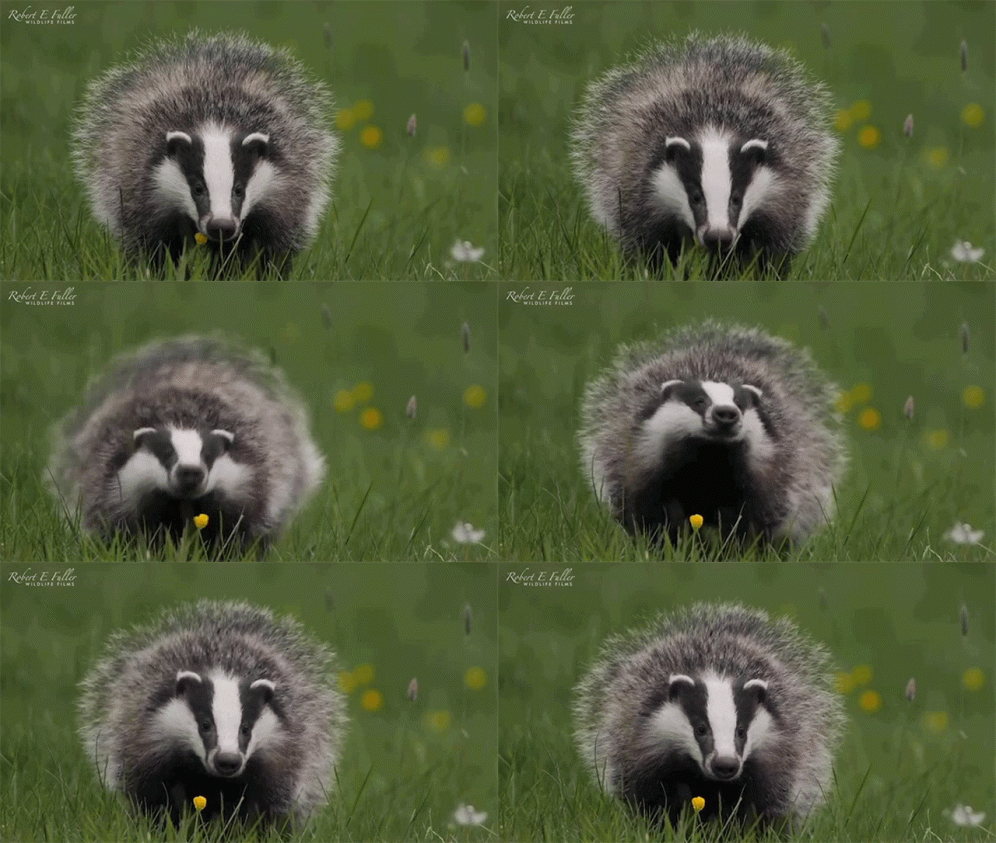
It’s #TautonymTuesday! Meet 𝑀𝑒𝑙𝑒𝑠 𝑚𝑒𝑙𝑒𝑠, the European #badger. This powerful mustelid ranges across much of Europe and W Asia, With a bold black‑and‑white facial stripes and stocky build, it's a strong digger and adaptable omnivore living in woodlands and farmlands. #TaxonomyTuesday #Systematics
media.tenor.com
a badger is standing in a field with robert e. fuller wildlife films written on the bottom
ALT: a badger is standing in a field with robert e. fuller wildlife films written on the bottom
150
Ted Stankowich @tedstankowich.bsky.social · 10/03/2026
Talking mammal coloration! Why aren't mammals as colorful as reptiles, birds or fish? www.livescience.com/animals/why-...
livescience.com
Why aren't mammals as colorful as reptiles, birds or fish?
Many mammals have fur the color of brown and black. Why don't they have more exotic colors, like purple and neon pink?
0145
Ted Stankowich @tedstankowich.bsky.social · 27/02/2026
Last week, a production team came to CSU Long Beach to film a sit-down interview for a documentary on wildlife living in Los Angeles. Hopefully, they got some good material, and the plan is to go out and film some skunks in the field later this spring!
030
Ted Stankowich @tedstankowich.bsky.social · 24/02/2026
#TautonymTuesday is back! Meet 𝑆𝑡𝑒𝑙𝑙𝑖𝑓𝑒𝑟 𝑠𝑡𝑒𝑙𝑙𝑖𝑓𝑒𝑟, the little croaker, a small sciaenid fish found along the Atlantic coasts of S America. It inhabits shallow coastal waters and estuaries, where it schools in soft‑bottom habitats rich in invertebrate prey. #TaxonomyTuesday #Systematics
150
Ted Stankowich @tedstankowich.bsky.social · 23/02/2026
New paper out with Nicole Lopez showing that predation risk, male horn size, and female territoriality drive the evolution of and investment into female horns! "Territoriality, sociality and male weaponry shape horn investment in female bovids": academic.oup.com/beheco/artic...
academic.oup.com
Territoriality, sociality and male weaponry shape horn investment in female bovids
Female weaponry remains underexplored across animal taxa. We analyzed socio-ecological predictors of female horn presence and size within the mammalian fam
031
Reposted by Ted Stankowich
Ologies with Alie Ward @ologies.bsky.social · 23/02/2026
Animal defenses with Dr. @tedstankowich.bsky.social. Get into it: alieward.com/ologies/zooh...
alieward.com
Zoohoplology (ANIMAL DEFENSES) with Dr. Ted Stankowich — alie ward
Barbs. Spurs. Stinks. Scutes. Shrieks. Fashion. Drama. Animal behaviorist, evolutionary biologist, Cal State Long Beach professor, and your new favorite Zoohoplologist, Dr. Ted Stankowich, divulges ab...
3765
Reposted by Ted Stankowich
Ologies with Alie Ward @ologies.bsky.social · 20/02/2026
Barbs. Spurs. Stinks. Scutes. Shrieks. Fashion. Drama. Zoohoplology (ANIMAL DEFENSES) w/ *the* Dr. @tedstankowich.bsky.social has armadillos, skunks, pangolins, horned lizards, wombats, coyotes, kit foxes, poodles, porcupines, tigers, deer & the will to survive. www.alieward.com/ologies/zooh...
alieward.com
Zoohoplology (ANIMAL DEFENSES) with Dr. Ted Stankowich — alie ward
Barbs. Spurs. Stinks. Scutes. Shrieks. Fashion. Drama. Animal behaviorist, evolutionary biologist, Cal State Long Beach professor, and your new favorite Zoohoplologist, Dr. Ted Stankowich, divulges ab...
0456
Ted Stankowich @tedstankowich.bsky.social · 20/02/2026
My @ologies.bsky.social episode on animal defenses is out now!
051
Reposted by Ted Stankowich
Natalie Sylvia Tocco, DVM, MS, DACVP @deadpetvet.bsky.social · 19/02/2026
Take a listen to this awesome episode on animal defenses with @tedstankowich.bsky.social on @ologies.bsky.social with @alieward.bsky.social !!! I’ve had the pleasure of following Ted and meeting him in person and he is extremely knowledgeable! 🦨🦨🦨
open.spotify.com
Zoohoplology (ANIMAL DEFENSES) with Ted Stankowich
022
Ted Stankowich @tedstankowich.bsky.social · 21/01/2026
It’s #TautonymTuesday! Meet 𝐶ℎ𝑖𝑛𝑐ℎ𝑖𝑙𝑙𝑎 𝑐ℎ𝑖𝑛𝑐ℎ𝑖𝑙𝑙𝑎, the short-tailed #chinchilla. Native to the high #Andes , this species is built for cold mountains—with the densest of any land mammal, compact bodies, and strong hind legs for navigating rocky slopes. #TaxonomyTuesday #Systematics Photo: Britannica
171
Ted Stankowich @tedstankowich.bsky.social · 14/01/2026
Check out this great episode of the kids' podcast Brains On! where I talk about skunks! My parts are at 2:00 and 20:45. omny.fm/shows/brains...
omny.fm
Why do skunks stink? - Brains On! Science podcast for kids
Skunks can stink, no doubt about it. But that stink is actually a superpower! Join Molly and co-host Diya as they find out how these critters use their smell to scare away enemies, what the smell is m...
030
Ted Stankowich @tedstankowich.bsky.social · 14/01/2026
It’s #TautonymTuesday! 𝐶𝑒𝑟𝑎𝑠𝑡𝑒𝑠 𝑐𝑒𝑟𝑎𝑠𝑡𝑒𝑠, the Saharan horned #viper, thrives in N African deserts, where its horn-like scales help break up its outline against the sand. It can bury itself, exposing only its eyes—perfect for ambushing prey. #TaxonomyTuesday #Systematics Photo: Holger Krisp
181
Reposted by Ted Stankowich
Ted Stankowich @tedstankowich.bsky.social · 25/11/2025
It’s #TautonymTuesday! Meet 𝐵𝑎𝑟𝑏𝑎𝑡𝑢𝑙𝑎 𝑏𝑎𝑟𝑏𝑎𝑡𝑢𝑙𝑎, the stone loach. This small benthic #fish inhabits cool, fast-flowing streams across Europe and western Asia. They live on the bottom, often partly buried. A classic tautonym in freshwater ichthyology! #Systematics #TaxonomyTuesday Photo: Holger Krisp
1272
Ted Stankowich @tedstankowich.bsky.social · 06/01/2026
After a week away, we’re back with #TautonymTuesday! Meet 𝐺𝑙𝑖𝑠 𝑔𝑙𝑖𝑠, the edible #dormouse. Native to Europe & W Asia, this nocturnal #rodent is famous for its long hibernation—up to 7 months! It’s also the largest dormouse species, reaching up to 30 cm long. #TaxonomyTuesday #Systematics Photo: Azay
171
Ted Stankowich @tedstankowich.bsky.social · 24/12/2025
All grades are now finalized and posted! I am officially on sabbatical until August 2026!!
media.tenor.com
a man and a woman are jumping in the air in a living room .
ALT: a man and a woman are jumping in the air in a living room .
070
Ted Stankowich @tedstankowich.bsky.social · 23/12/2025
It’s #TautonymTuesday! Meet 𝑃𝑒𝑡𝑟𝑜𝑛𝑖𝑎 𝑝𝑒𝑡𝑟𝑜𝑛𝑖𝑎, the rock #sparrow. This hardy passerine is native to southern Europe, North Africa, and parts of Asia, often found in rocky hillsides and open scrub. Sparrow in a rock >> Partridge in a pear tree! #TaxonomyTuesday #Systematics #bird Photo: Zeynel Cebeci
1235
Ted Stankowich @tedstankowich.bsky.social · 22/12/2025
New Publication! Territoriality, sociality and male weaponry shape horn investment in female bovids url: academic.oup.com/beheco/artic...
academic.oup.com
Territoriality, sociality and male weaponry shape horn investment in female bovids
Female weaponry remains gravely understudied across animal taxa. To investigate the factors driving female weapon investment, we analyzed socio-ecological
031
Ted Stankowich @tedstankowich.bsky.social · 19/12/2025
Check out the recording of Tuesday's livestream with Natalia Reagan! www.youtube.com/live/X4-vE-R...
youtube.com
Survival of the Filthiest: Wild Animal Defenses with Dr. Ted Stankowich (Vertical)
YouTube video by Natalia Reagan
021
Ted Stankowich @tedstankowich.bsky.social · 17/12/2025
It’s #TautonymTuesday! Meet 𝑀𝑎𝑐𝑟𝑜𝑝ℎ𝑦𝑙𝑙𝑢𝑚 𝑚𝑎𝑐𝑟𝑜𝑝ℎ𝑦𝑙𝑙𝑢𝑚, the long-legged #bat. Native to Central and South America, this species is named for its distinctive large nose leaf and elongated limbs—perfect for its unique #hunting style. #TaxonomyTuesday #Systematics Photo: Pedro Aguilar
152
Ted Stankowich @tedstankowich.bsky.social · 13/12/2025
Great meeting today with a book publisher - guess it's time to write that proposal and get cooking on my big sabbatical project!
media.tenor.com
a group of men in military uniforms walking on a runway with the words let 's do this written on the bottom
ALT: a group of men in military uniforms walking on a runway with the words let 's do this written on the bottom
070
Reposted by Ted Stankowich
Ted Stankowich @tedstankowich.bsky.social · 02/12/2025
For #TautonymTuesday this week, we celebrate Europe’s most widespread #deer! 𝐶𝑎𝑝𝑟𝑒𝑜𝑙𝑢𝑠 𝑐𝑎𝑝𝑟𝑒𝑜𝑙𝑢𝑠, the roe deer, ranges from the Atlantic to western Asia. Agile and adaptable, it thrives in forests, farmland, and even urban edges. #TaxonomyTuesday #Systematics Photo: Clément Bardot
193
Reposted by Ted Stankowich
TonQuinn @mahoganyobsidian.blacksky.app · 10/12/2025
And its delicious too!!!!!!
011
Ted Stankowich @tedstankowich.bsky.social · 09/12/2025
Today’s feature for #TautonymTuesday is 𝐶𝑟𝑒𝑛𝑖𝑑𝑒𝑛𝑠 𝑐𝑟𝑒𝑛𝑖𝑑𝑒𝑛𝑠, the karanteen #seabream, a sparid fish found in coastal waters of the W Indian Ocean. Known for its compressed body and strong jaws, it lives in reef and nearshore ecosystems. #TaxonomyTuesday #Systematics Photo: Hamid Badar Osmany
218714
Ted Stankowich @tedstankowich.bsky.social · 02/12/2025
For #TautonymTuesday this week, we celebrate Europe’s most widespread #deer! 𝐶𝑎𝑝𝑟𝑒𝑜𝑙𝑢𝑠 𝑐𝑎𝑝𝑟𝑒𝑜𝑙𝑢𝑠, the roe deer, ranges from the Atlantic to western Asia. Agile and adaptable, it thrives in forests, farmland, and even urban edges. #TaxonomyTuesday #Systematics Photo: Clément Bardot
193
Reposted by Ted Stankowich
Wildlife & Conservation at Uni Freiburg @wild-ecol-cons.bsky.social · 01/12/2025
Hot off the press!🔥 How does human recreation & hunting affect wildlife?🥾🦌 Increased hunting intensity led to a significantly increasing avoidance of recreational activities by all species, independent of whether they were subjected to hunting or not! 📰 doi.org/10.1016/j.ge...
The image shows a results figure from the linked paper of the prediction of the temporal dynamics of the event rate (number of events per hour) after a recreation event for A) red deer, B) roe deer, C) wild boar and D) red fox in the non-hunting (top) and hunting (bottom) zones.
032
Ted Stankowich @tedstankowich.bsky.social · 26/11/2025
It's on the schedule!
070
Reposted by Ted Stankowich
Graham Coop @gcbias.bsky.social · 26/11/2025
Do check out @tedstankowich.bsky.social 's lovely #TautonymTuesday hashtag bsky.app/profile/teds...
041
Ted Stankowich @tedstankowich.bsky.social · 25/11/2025
It’s #TautonymTuesday! Meet 𝐵𝑎𝑟𝑏𝑎𝑡𝑢𝑙𝑎 𝑏𝑎𝑟𝑏𝑎𝑡𝑢𝑙𝑎, the stone loach. This small benthic #fish inhabits cool, fast-flowing streams across Europe and western Asia. They live on the bottom, often partly buried. A classic tautonym in freshwater ichthyology! #Systematics #TaxonomyTuesday Photo: Holger Krisp
1272
Ted Stankowich @tedstankowich.bsky.social · 25/11/2025
Star Wars Rankings are trending, so... EMPIRE STRIKES BACK [ANDOR] [CLONE WARS] [MANDALORIAN] RETURN OF THE JEDI A NEW HOPE REVENGE OF THE SITH ROGUE ONE [AHSOKA] [REBELS] [KENOBI] [BAD BATCH] FORCE AWAKENS RISE OF SKYWALKER [ACOLYTE] ATTACK OF THE CLONES THE PHANTOM MENACE THE LAST JEDI SOLO
000
Ted Stankowich @tedstankowich.bsky.social · 18/11/2025
It’s #TautonymTuesday! Meet the Himalayan white-bellied #rat, 𝑁𝑖𝑣𝑖𝑣𝑒𝑛𝑡𝑒𝑟 𝑛𝑖𝑣𝑖𝑣𝑒𝑛𝑡𝑒𝑟, a murid rodent that inhabits forests and montane regions, playing an important role in seed dispersal and ecosystem dynamics. #TaxonomyTuesday #Systematics Photo: National Biodiversity Centre
1122
Reposted by Ted Stankowich
Amy Leedale @amyleedale.bsky.social · 23/10/2025
Looking for a PhD? 🦜 Interested in ornithology, animal behaviour, bioacoustics? I am advertising a PhD on vocal communication in ring-necked parakeets tinyurl.com/44a3hcnz Eligible candidates are encouraged to apply for University of Salford Widening Participation Scholarships tinyurl.com/4wtzzh3z
tinyurl.com
Genetic and Acoustic Diversity in an Invasive Parrot at University of Salford on FindAPhD.com
PhD Project - Genetic and Acoustic Diversity in an Invasive Parrot at University of Salford, listed on FindAPhD.com
03853
Reposted by Ted Stankowich
Jeffrey Ross-Ibarra @jrossibarra.bsky.social · 12/11/2025
Just discovered #TautonymTuesday. See what we’re missing out on botanists? Change the code!
2112