Sign in

Richard Dashnau

@rickubis.bsky.social
1K followers 103 following 153 posts

Retired after 40 years of tech work. Volunteer Interpretive Guide at Brazos Bend SP >20 years. New material usually posts 1st on this web page: www.rickubis.com/rick/mycam.html then disperses into www.rickubis.com Sometimes I link to it from here.

PostsRepliesMedia
Reposted by Richard Dashnau
Katharine Hayhoe @katharinehayhoe.com · 29/07/2026
Overnight, a masked bandit broke into our kitchen. Armed with opposable thumbs, he proceeded to sample everything on offer. I’d just visited the farmers market, so the menu was extensive. I can now share a highly specific peer-reviewed list of what this particular raider did & did not enjoy. 🧵
static.klipy.com
Raccoon's Evil Smile: 'Good, Good'
Alt: Raccoon's Evil Smile: 'Good, Good'
852136706
Reposted by Richard Dashnau
twarda.bsky.social @twarda.bsky.social · 28/05/2026
Hej! I'm working on another game, Zid Journey. I ask you to help spreading the word. This game's the result of actual human work & passion. No AI. Find & wishlist ZJ (or try our previous game, Zniw Adventure) on Steam. We have demos, free OST, and manual. Or just tell your friend about it!
Zid Journey promo artFour sreenshots from Zid Journey set in a grid.Concept art of a basement-like warehouseA nighttime screen from the game showcasing a dinosaur village in a forest
2597217
Richard Dashnau @rickubis.bsky.social · 15/02/2026
Otters are rarely seen at Brazos Bend SP, but since last Dec, a group of 4 have been seen in 40Acre & Elm Lakes.. On 2/1/2026, they foraged the south side of Elm for about an hour. I got to see them-AGAIN. #Otters 🦊 This pic is a frame from this video: www.rickubis.com/rick/otter02...
Close view, looking towards the edge of a lake. The water goes into the base of a thick growth of tall grass (Giant Cutgrass), so we cannot see dirt. Water in front is thick with other floating plants. In the center, 4 large mammals are in the water. They are long, but we see just their backs in the water; and their heads are raised above the water on thick necks. Their fur is saturated, and slick with moisture. Their backs are dark brown, while the front of their necks are light brown as they face us. Their muzzles are light grey, with black noses at center above their lips. They are Otters, and are in a loose group, and they are looking our way. These are wild Otters, and were foraging along that far bank--about 50 yards away.
0101
Reposted by Richard Dashnau
Alex Wild @alexwild.bsky.social · 31/01/2026
Gosh I have photographed a lot of flies over the years.
alexanderwild.com
Acalyptrate flies - Alex Wild
A gallery of various acalyptrate flies.
313023
Richard Dashnau @rickubis.bsky.social · 18/01/2026
Since a cling-on was the cause of the incident, it seemed proper for a Klingon to...be friendly.
010
Richard Dashnau @rickubis.bsky.social · 16/01/2026
media.tenor.com
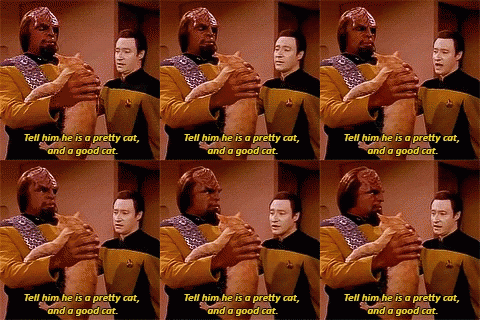
a man is holding a cat and says tell him he is a pretty cat and a good cat
Alt: a man is holding a cat and says tell him he is a pretty cat and a good cat
110
Richard Dashnau @rickubis.bsky.social · 03/01/2026
Does it sound like words in an unknown language? The sounds could be feline insults.
110
Reposted by Richard Dashnau
In Otter News @in-otter-news.bsky.social · 02/01/2026
1145131
Richard Dashnau @rickubis.bsky.social · 30/12/2025
Reposting for the mammals feed with #addMam Most of my content (www.rickubis.com) is "non-charismatic" animals; but I will document whatever I find interesting-like these #otters . They hunt at BBSP, but few of the 1000's of visitors get to see them. My otter page: www.rickubis.com/rick/brazmam...
rickubis.com
Welcome to Rickubis.com
130
Richard Dashnau @rickubis.bsky.social · 28/12/2025
12/07/25, a very foggy morning at 40-Acre Lake in Brazos Bend SP. I heard crunching sound, which usually means a gator caught something. An Otter surfaced instead! For 30 minutes, I saw four Otters swim, eat, go to an island, groom & then walk off into cover. video: www.rickubis.com/rick/otters4...
Image 1 of 3 Close view of the surface of a lake, mostly covered by dense floating vegetation in a combination of green and brown plants. At center, some water can be seen in a small clear area. In that area, at center image the blunt grey head of a mammal protrudes from the water. It is facing towards us, but angled to our left. We can see one tiny ear, one eye, the nostrils. Its mouth is slightly open as it is chewing something. We can see two white, pointed front bottom teeth. The animals back is a bit off to our right, and the fur is shiny and slick from being saturated. The mammal is a River Otter.Image 2 of 3  Close view of the surface of a lake. This area is totally clear, showing us a clear view of the water. The image has a grayed aspect, as all three of these images were taken in dense fog. At center of this image the heads of two mammals (Otters) break the surface, with one directly behind the other from our perspective. The heads are blunt; shaped somewhat like a closed fist.  The one in front has its mouth open, showing many pointed teeth as well as whatever meaty prey it is chewing on. We can see the whiskers on its snout, and the nostrils which are pointed straight up. We can also see one eye, since the head is angled a bit.  The head behind is flat relative to the water, so its chin is submerged, but the rest of the head is above water. That one is angled to look towards our right, but not quite in profile view. We can see one ear, one eye, and the dark nose.  These two had moved from the position of the Otter shown in image 1. Image 3 of 3 Close view of a steep bank covered by dense vegetation. Details are a bit murky, since this was 50 yards away and taken through dense fog. The plants are a mixture of tall grasses and other plants, in mixtures of green and brown. In the center, are two Otters. One is standing so its body is vertical. Its front paws are relaxed as it stands and looks around. The Otter is mostly dark grey. The head is turned towards our right. We can see a "moustache" of lighter grey just under its nose and extending to its cheeks. Right next to that, another Otter is on the ground. We can just barely see its chest, but the nose, eyes, and moustache are pointing towards us. 3 Otters piled here briefly to rest, and to groom themselve (and each other). They walked off to our right, in single file. When they moved away, a fourth Otter appeared from the left and followed them.
082
Reposted by Richard Dashnau
TexasBirder @texasbirder.bsky.social · 27/12/2025
This Long-billed Curlew was giving off those Greater Roadrunner vibes as it hurried over to its next bite. #CorpusChristiTx #Birds
This Long-billed Curlew was crouched and speeding toward the left. Maybe it spotted some prey, as it soon had a small crab in its beak.
317217
Reposted by Richard Dashnau
Brian Smith @briansmith-photos.eurosky.social · 06/11/2025
No kings, only Kingfishers. #Birds 🪶 #EastCoastKin #Photography
A Belted Kingfisher getting a snack, bill open, inches from the surface with a rippled reflection
814321
Reposted by Richard Dashnau
In Otter News @in-otter-news.bsky.social · 03/11/2025
The week is off to a bad start. Steve has stubbed his toe.
2181266
Reposted by Richard Dashnau
Entomological Society of America @entsocamerica.bsky.social · 29/10/2025
Arthropod Photo of the Week: October 29, 2025 Net-casting spider Asianopis sp. Araneae: Deinopidae By Dennis Botterbusch, North Rhine-Westphalia, Germany #arthropodPOTW
Close-up of a spider facing the camera with a yellow egg sac beneath it, surrounded by soil and debris. The image shows fine details of the spider’s eyes, legs, and body texture.
613333
Reposted by Richard Dashnau
In Otter News @in-otter-news.bsky.social · 27/10/2025
Midway through a crucial work meeting, Brad informs Steve that the local pub landlord is in reception and wants to discuss his bar tab.
1064046
Reposted by Richard Dashnau
Space City Weather @spacecitywx.bsky.social · 22/10/2025
We discuss rainfall amounts for this weekend, when the Houston are is likely to see its greatest totals in a quite some time. We also provide an update on Saturday’s Fall Day celebration, and look ahead to a stronger front next week. #houwx
spacecityweather.com
Houston to face widespread rain showers this weekend, followed by a stronger front next week
In brief: In today’s post we discuss rainfall amounts for this weekend, when we are likely to see our greatest totals in a quite some time. We also provide an update on our Fall Day celebrati…
1154
Reposted by Richard Dashnau
In Otter News @in-otter-news.bsky.social · 21/10/2025
1055848
Richard Dashnau @rickubis.bsky.social · 09/10/2025
Cullinen Park, 9/20/2025: Snowy Egrets forage by shuffling their feet, then stabbing at flushed prey. Spoonbills swish their bills sideways through the water, flushing and catching prey. This Spoonbill seemed to be catching prey flushed out by the Egret. 🦉 video: www.rickubis.com/rick/spoonbi...
Close view of a large puddle. The water is smooth. Centered in the picture are two large birds, wading from our right to the left. The water is "ankle deep" for the birds. (The large joint between the foot and the body is not a knee, but functions as an ankle.) The one in front covered with white feathers. It has a long neck, bent in a sharp "S" shape, a long sharp black beak with a yellow band from the base of the beak to around its eye. The legs are long and black. The leg near us is raised to show a bright yellow foot lifted above disturbed water. That bird is a Snowy Egret. Walking behind it is a larger bird. This bird is mostly pink on the wings and hindquarters, phasing into white at the front and the neck. The neck is also long and thin. The head has tilted so we can see it from the top. The beak is long, grey, and ends in a wide, spoonlike shape. The tip of it has dipped into the water. That bird is a Roseate Spoonbill. Both birds are foraging. The Egret shuffled its feet to flush prey. The Spoonbill swished its beak sideways to flush and grab prey. It seemed to be following the Egret on purpose. This is one of a series of images showing the Spoonbill definitely probing directly behind the Egret.
050
Reposted by Richard Dashnau
In Otter News @in-otter-news.bsky.social · 05/10/2025
201132104
Richard Dashnau @rickubis.bsky.social · 06/10/2025
Larry deserves cheese for showing up in my feed. It's always great to see him.
010
Reposted by Richard Dashnau
Texas Science @texasscience.bsky.social · 03/10/2025
The Mexican honey wasp is a bit of an oddball: it makes and eats honey like a bee, but when it’s hankering for protein, instead of pollen, it eats other insects. A new study finds its gut microbiome is more like bees than wasps. Funded by USDA and NSF. journals.asm.org/doi/10.1128/...
Two Mexican honey wasps, which are bee-like insects with black bodies, yellow stripes on the lower abdomen and honey-colored wings. Photo credit: Alex Wild.
34911
Richard Dashnau @rickubis.bsky.social · 03/10/2025
Kind of makes one...tingle.
media.tenor.com
a man in a white shirt and tie is standing in front of a window with his hands on his face .
Alt: Vincent Price in a white shirt and tie is standing in front of a window with his hands on his face, trying not to scream
020
Richard Dashnau @rickubis.bsky.social · 26/09/2025
Just want to say that I really enjoy your #ScienceAdviser emails. I can't remember when or how I signed up for them...but I'm glad I did. Great work!
110
Reposted by Richard Dashnau
In Otter News @in-otter-news.bsky.social · 21/09/2025
Why are you like this, Steve!?
1765660
Reposted by Richard Dashnau
In Otter News @in-otter-news.bsky.social · 06/09/2025
1049242
Reposted by Richard Dashnau
In Otter News @in-otter-news.bsky.social · 28/08/2025
Happy little friends
181295158
Reposted by Richard Dashnau
Laura G. @hawklady.bsky.social · 22/08/2025
Weee! A red-tailed hawk dives towards the camera. I love when they fold their wings to accelerate and form this beautiful shape. 🪶 #Raptors
An adult male red-tailed hawk named Christo dives towards the camera. His wings are half spread and resemble an angel.
417938
Richard Dashnau @rickubis.bsky.social · 02/08/2025
I probably shouldn't mention colorizing old black-and-white films. So I won't. Oh...heck.
010
Richard Dashnau @rickubis.bsky.social · 02/08/2025
Do you remember when they offered movies in Letterbox format on some tapes (more Laserdiscs offered letterbox than tapes); and some folks complained that they were seeing *less* of the film?
230
Reposted by Richard Dashnau
twarda.bsky.social @twarda.bsky.social · 23/07/2025
Agu's reference sheet has been finalized!!✨🙏😭💛 [ #dinosaurs #indiegames #ZniwAdventure ]
Detailed reference sheet of a cartoony Struthiomimus from Zniw Adventure
823254
Reposted by Richard Dashnau
Texas Observer @texasobserver.org · 25/07/2025
Yesterday: I've had it with hearing the same story over and over again—another 100-year-plus rainfall event, another tragic result from people occupying the floodplain without an adequate warning system. More pain. More loss.
texasobserver.org
Floodplains Belong to the Rivers
From Houston to the Hill Country, we Texans keep doing the same thing over and over while expecting a different result.
37327
Reposted by Richard Dashnau
Mart_the_Gooner @mart-the-gooner.bsky.social · 25/07/2025
Common Swift with a very full crop #CommonSwift #Bolus #Birdsinflight #Birdphotography @rspb.bsky.social @rspbengland.bsky.social
Close up of a Common Swift in flight with it's wings spread showing  a full crop of insects known as a bolus
816425
Reposted by Richard Dashnau
Anthony (Tony) J. Martin @ichnologist.bsky.social · 25/07/2025
For #FossilFriday, an ichnological 2-for-1 deal, with fossil scorpion tracks (L) & synapsid tracks (R) preserved from a Early Cretaceous (~130 mya) sand-dune surface: specimen displayed in the Mário Tolentino Museum of Science, São Carlos, Brazil; scale = 5 mm squares. 🧪🐾🦂 #ichnology
Two different types of 130-million-year-old fossil tracks from southern Brazil, preserved as impressions on a gray sandstone surface. On the left are smaller round impressions (3-5 millimeters wide) in alternating sets of 2 or 3 with a thin groove between them, made by a scorpion walking on the sand. To the right are larger (1.5-2 centimeters wide) in an alternating right-left pattern, which are tracks made by a synapsid that placed its same-side rear foot into the front-foot impression, known as direct register. A scale card to the left has alternating white-black squares that are 5 millimeters wide.
04413
Reposted by Richard Dashnau
twarda.bsky.social @twarda.bsky.social · 23/07/2025
FINALLY, you can make an accurate size estimation lol!! (But more importantly, I can stop using the ancient game's sprites to measure my characters when I talk to my team) #art #dinosaurs #oc #gamedev
Size comparison of various cartoony dinosaur characters!
213335
Reposted by Richard Dashnau
Nancy 🪲SciBugs🪲 Miorelli @scibugs.bsky.social · 14/07/2025
I finally saw it! A turtle ant mimicking crab spider actually attacking a turtle ant. This had been in presentations of mine for 7+ years now and I finally saw it! Waita Lodge, Ecuador
A turtle ant mimicking spider (top) and the turtle ant it captured (bottom)
617920
Reposted by Richard Dashnau
twarda.bsky.social @twarda.bsky.social · 09/07/2025
Hej! I almost forgot xD My first game's on sale now! We have cartoon dinos, paleofacts, rich story, and point'n'clicking. store.steampowered.com/app/904750/Z... PS! Zniw Adventure has a whooping 5 mins frame-by-frame cutscenes, animated by yours truly. I would love if more people knew abt that xD
Summer sale Steam banner featuring Zniw swimming in a tube with a drinkPart of Zniw Adventure cover artA nostalgia photo where Zniw Adventure is running on some old Apple computer, 4:3 resolution (it looks so beautiful there)
18541
Reposted by Richard Dashnau
Alex Spahn 🌋🌪️☄️ @spahn711.bsky.social · 09/07/2025
5 years ago today, I took my first photo of comet Neowise. I had no idea what I was doing, but I had my mind set on capturing the best shot I could. I spent much of the rest of July 2020 practicing my shots, obtaining the right gear (within my tight budget), etc. I am proud of my end result:
A photo of comet Neowise among a sea of stars. The comet is oriented vertically, with a wide white tail trailing off to the top right and the blue ion tail pointing toward the top left.
1530536
Richard Dashnau @rickubis.bsky.social · 09/07/2025
That sounds as far-fetched as duck- billed otters that lay eggs.
010
Reposted by Richard Dashnau
Thomas R. Holtz, Jr. @arctomet.bsky.social · 07/07/2025
Mechanical stress may initiate osteoderm development in the American alligator (Alligator mississippiensis) - Dubansky - The Anatomical Record - Wiley Online Library anatomypubs.onlinelibrary.wiley.com/doi/10.1002/...
anatomypubs.onlinelibrary.wiley.com
Mechanical stress may initiate osteoderm development in the American alligator (Alligator mississippiensis)
Osteoderms are bones that form in the dermis of several species, but their development and function are not well understood. Comparing cellular and molecular events that initiate and drive pathologie...
0134
Reposted by Richard Dashnau
Dannyboy wildlife @dannyboywildlife.bsky.social · 01/07/2025
White porcupine
1042962
Reposted by Richard Dashnau
Alberta Claw @albertonykus.bsky.social · 01/07/2025
Forelimb feathering and other soft tissues of Microraptor: bmcecolevol.biomedcentral.com/articles/10.... 🪶🧪 (📷Grosmougin et al.)
The fossilized skeleton of a bird-like dinosaur under fluorescent light (left) and an illustration of the feathers and other soft tissues preserved around its wings (right).
04311
Reposted by Richard Dashnau
Dr. Wendy Bohon @drwendyrocks.bsky.social · 28/06/2025
This shake table test at the @ucsdshaketable.bsky.social is re-creating the shaking experienced at a specific location in Gilroy, California during the 1989 magnitude 6.9 Loma Prieta earthquake. 🧪
39623
Richard Dashnau @rickubis.bsky.social · 27/06/2025
reposting because the link to the video didn't light up right. Trying that again: www.rickubis.com/rick/limpkin... 🦉
rickubis.com
040
Richard Dashnau @rickubis.bsky.social · 27/06/2025
I've seen Limpkins in TX since 2021. On 06/19/2025, at Cullinen park, I watched this Limpkin family until they moved into cover. The chicks were about 10 days old. video:http://www.rickubis.com/rick/limpkin_family_061925.mp4 My limpkin page: www.rickubis.com/rick/limpkin... 🦉
Image 1 of 4  Medium-range view of a clear section of water among mats of vegetation. We are looking down an an angle. Swimming from top right corner to bottom left corner, a group of birds is swimming on the surface. The leading bird is large, with a long grayish beak with a slight downward bend and a black, sharp tip. The head is covered with a dense pattern of tiny white spots that expand in size and distance between them as it the pattern goes down the neck to the body. The body is brown,with a sparse pattern of white spots. Behind the adult bird, 6 small fuzzy birds are following in a loose group. These chicks are much smaller than the adult, with much shorter beaks. The birds are Limpkins, and the chicks are about 10 days old.Image 2 of 4  Medium-range view of a clear section of water among mats of vegetation. We are looking down an an angle. Swimming from right to  left corner, a group of birds is swimming on the surface. The leading bird is large, with a long grayish beak with a slight downward bend and a black, sharp tip. The tips of the beak are holding a very large black snail, which the bird had just pulled out of the water. The snail is nearly the size of the bird's head (without the beak). The bird's head is covered with a dense pattern of tiny white spots that expand in size and distance between them as it the pattern goes down the neck to the body. The body is brown,with a sparse pattern of white spots. Behind the adult bird, another adult is following. Behind the 2nd adult, 6 small fuzzy birds are following in a loose group. These chicks are much smaller than the adult, with much shorter beaks. The birds are Limpkins, and the chicks are about 10 days old.Image 3 of 4  Very close view of a section of a mat of vegetation. We are looking down an an angle. Centered in the image are two birds that are facing towards us. One is adult, one is a chick. The adult is large, with a long grayish beak with a slight downward bend and a black, sharp tip. The head is covered with a dense pattern of tiny white spots that expand in size and distance between them as it the pattern goes down the neck to the body. The body is brown,with a sparse pattern of white spots. Its beak is pointed down, where the chick has just taken a piece of food from it. Behind the adult's beak, a small fuzzy  brown bird is standing and is holding a tiny piece of pale snail meat. The chick is much smaller than the adult, with a much shorter beak. The birds are Limpkins, and the chick is about 10 days old. Among the dense leaves of the floating vegetation (it is Water Hyacinth) are many discarded shells from previously devoured snails. The adult had opened the snail it was carrying in image #2, and was feeding the chicks fragments of snail meat. Image 4 of 4  Far view of a section of  floating mats of vegetation with scattered wide, flat leaves growing on stalks out of them. We are looking down an an angle. Centered in the image is a group of birds that is moving from lower right corner towards upper left corner. One is adult, and six are chicks. The adult is large, with a long grayish beak with a slight downward bend and a black, sharp tip. The head is covered with a dense pattern of tiny white spots that expand in size and distance between them as it the pattern goes down the neck to the body. The body is brown,with a sparse pattern of white spots. It ss standing and looking back towards the chicks.  The chicks are small fuzzy  brown birds walking in a line towards the adult. The chicks are much smaller than the adult, with a much shorter beak. The birds are Limpkins, and the chicks are about 10 days old. The Limpkins continued moving until they were hidden from view by the denser cover.
060
Richard Dashnau @rickubis.bsky.social · 24/06/2025
Reposting to add to the 🐊 feed.
080
Richard Dashnau @rickubis.bsky.social · 24/06/2025
Reposting this to add this group. I keep forgetting to do that. 🦉
060
Reposted by Richard Dashnau
Zid & Zniw Chronicles @zidandzniw.bsky.social · 11/06/2025
There's actually some more of camera panning shots in the intro that are otherwise never fully shown...
The entire shot of Wajapulka from Zniw Adventure's introZniw looking at the edge of Scattered woods, with Jaw Mountain looming over the horizon. Shot from Zniw Adventure's intro
0568
Reposted by Richard Dashnau
American Museum of Natural History @amnh.org · 11/06/2025
The blunthead slug snake primarily feeds on slugs and snails, eating using a technique called mandibular sawing. To slice off the indigestible parts of prey, this species slides its jaws back and forth like a saw! Photo: Alexander Gregory Mason, CC BY-NC 4.0, iNaturalist
A photo of a blunthead snake clinging to a branch. The snake is brownish in color, has a blunted face, and a huge round eye.
1505
Reposted by Richard Dashnau
Walter @walts-comics.bsky.social · 05/06/2025
New Page Up on my Webcomic! Check it out here: outworldproblems.thecomicseries.com #comics #comic #comicart #comicstrip #comicstrips #comix #webcomic #webcomics #webcomicseries #cartoons #indiecomic #indiecomix
031
Richard Dashnau @rickubis.bsky.social · 10/06/2025
05/29/2025 I was surprised to see a Purple Gallinule eat an Apple Snail at Cullinen Park a month ago, so I started filming this one as it seemed to be hunting for deeper prey. It caught a small Apple Snail & ate it. What a gorgeous bird! Limpkins hunt there, too vid: www.rickubis.com/rick/gallinu...
Image 1 of 4 Telephoto close shot of a lake surface. The surface is clogged with green and browning floating plants, so water is mostly in the gaps between the plants. Filling the foreground, a bird is leaning over with neck extended horizontally to our left and looking down into a larger gap of clear water. The bird bears a striking combination of colors. The tip of the beak (pointing down) is yellow, followed by orange, bounded by a yellow line as it meets the face. It has a pale-blue shield on its forehead, which see from the side. The bird's head is dark purple, with color blending and shading into royal blue as it extends down to the body, where it blends into an irridescent green. The bird is squatting on a submerged lily pad so its belly is touching the water, but we can see its bright yellow legs and feet under the water. The bird is Purple Gallinule (Porphyrio martinica), and it is foraging.Image 2 of 4 Telephoto close shot of a lake surface. The surface is clogged with green and browning floating plants, so water is mostly in the gaps between the plants. Filling the foreground, a bird is leaning far over to our left and looking down into a larger gap of clear water. Only its rear half is visible, with the rest under water as the bird reaches for something. The tail is pointing straight up.The bird bears a striking combination of colors.  The bird's rear half is an irridescent green. The bird is squatting on a submerged lily pad and we can see its bright yellow legs and ankles as it supports the bird reaching so far down. The bird is Purple Gallinule (Porphyrio martinica), and it is foraging.Image 3 of 4 Telephoto close shot of a lake surface. The surface is clogged with green and browning floating plants, so water is mostly in the gaps between the plants. Filling the foreground, a bird is tilted over with neck extended to our left and holding a brown snail with the lip of its shell in its beak. The snail is about the size of the bird's head. The bird bears a striking combination of colors. The tip of the beak (pointing down) is yellow, followed by orange, bounded by a yellow line as it meets the face. It has a pale-blue shield on its forehead, which see from the side. The bird's head is dark purple, with color blending and shading into royal blue as it extends down to the body, where it blends into an irridescent green. The bird is squatting on a submerged lily pad so its belly is touching the water, but we can see its bright yellow legs and feet under the water. The bird is Purple Gallinule (Porphyrio martinica), and it has pulled up a snail after dunking for it in image #2.Image 4 of 4 Telephoto close shot of a lake surface. The surface is clogged with green and browning floating plants, so water is not visible. Filling the foreground, a bird is leaning over with neck extended horizontally to our right and holding a brown snail by the edge of the shell opening with the tips its beak. The bird bears a striking combination of colors. The tip of the beak is yellow, followed by orange, bounded by a yellow line as it meets the face. It has a pale-blue shield on its forehead, which see from the side. The bird's head is dark purple, with color blending and shading into royal blue as it extends down to the body, where it blends into an irridescent green. A puffy patch of white feathers shows under its tail. We can see its bright yellow legs, but its feet are hidden by the plants. The bird is Purple Gallinule (Porphyrio martinica), and it was carrying the snail it had caught in image #3 to a stable surface so it could pry the snail open.
010