Sign in

Slow Moving Pictures

@lewisbeerblog.bsky.social
2.9K followers 12K following 699 posts

A film blog: I spent 2025 analysing Red Desert. www.slowmovingpictures.org

PostsRepliesMedia
Reposted by Slow Moving Pictures
Farran Smith Nehme 🇱🇧 @selfstyledsiren.bsky.social · 02/10/2026
PRAISE BE TO THE CINEMA GODS!! 2026 IS REDEEMED! 🙏
47011
Reposted by Slow Moving Pictures
John Bleasdale @www.johnbleasdale.com · 03/10/2026
By the way pals Writers on Film breezed past its 300th episode without much fanfare a few weeks ago. I really have no time to promote the show at all! But I am hugely grateful to those who listen and the guests who come on podcasts.apple.com/it/podcast/w...
podcasts.apple.com
Writers on Film
TV & Film Podcast · Updated weekly · Writers on Film is the only podcast to focus on film books and to talk to the best authors working in the area of cinema. From Making Of tomes to biographies, stud...
83114
Slow Moving Pictures @lewisbeerblog.bsky.social · 12/09/2026
I stand by my hot take in this podcast: ‘Sixty years before Thelma and Louise, there was East Lynne…’ Don’t be put off by the compromised state of this film as it appears on YouTube – it’s very watchable, and a fascinating example of subversive pre-code attitudes to marriage and adultery.
theoscarproject.substack.com
4.61-East Lynne with Lewis Beer
Today’s episode is my conversation about the 1931 film East Lynne. I’m joined by Lewis Beer from the Slow Movie Pictures newsletter and we talk about some drastic changes the film made from the source...
020
Reposted by Slow Moving Pictures
tnyfrontrow.bsky.social @tnyfrontrow.bsky.social · 29/04/2026
Visconti may be the diametrical opposite of Antonioni in the postwar Italian cinematic pantheon, but the film that his 1951 melodrama Bellissima (opening Friday at @filmforumnyc.bsky.social in a new restoration) is closely related to (and maybe inspired?) is The Lady Without Camelias:
newyorker.com
DVD of the Week: “Bellissima”
1283
Reposted by Slow Moving Pictures
JacquiWine @jacquiwine.bsky.social · 06/04/2026
LA NOTTE (Michelangelo Antonioni, 1961, rewatch). Fabulous to see this on the big screen yesterday, which really accentuated how unsettling and discordant the sound design is here (especially in the first hour). Rarely have urban alienation, ennui and disaffection looked so stylish. #FilmSky
A black and white shot from the film showing Marcello Mastroianni looking at Monica Vitti from behind. Her eyes are downcast and she looks sad / wistful. They are at a party - he’s wearing a suit and tie and she’s wearing a black cocktail dress with spaghetti straps.   Marcello is sitting on the grass next to Jeanne Moreau and kissing her hand.. He’s wearing the same suit as before, while she’s wearing a black slip with spaghetti straps.
3588
Slow Moving Pictures @lewisbeerblog.bsky.social · 28/03/2026
Great review of an early Antonioni that deserves more love. I kind of disagree about Clara being naïve and complicit; I think the film is more absolute in its insistence on both her victimhood and her lucidity. From start to finish, she is self-aware and powerless in ways that Gianni is not.
0282
Reposted by Slow Moving Pictures
Mad Scholar Frights @mattzollerseitz.bsky.social · 08/03/2026
THREAD: I got laid off from NYMag/Vulture after 14 years. The family lost 75% of income + medical. Now mzs.press bookstore, once a side project. is do-or-die for Judith & I. I feel weird telling you this because others are doing much worse. But if you could like or share this, we'd be so grateful!
28760773480
Reposted by Slow Moving Pictures
David M Rubin @six18sfoundry.bsky.social · 20/02/2026
Watching Chantal Akerman watch. Camera placed. Events stream by. These 4 random moments from first ~4 minutes of Les rendez-vous d’Anna
Station w tracks on either side of staircase going down w train schedule listed. Yellow phone booth beyondSame exact shot w crowd heading down stairs and train on right sideSame shot. People gone. Woman enters phone booth. Train at right now Sad w train pulling away and woman walking towards us
0222
Slow Moving Pictures @lewisbeerblog.bsky.social · 14/02/2026
Frances Marion called the Oscar statuette 'a perfect symbol of the picture business: a powerful athletic body clutching a gleaming sword, but with half of his head, the part that holds his brains, completely sliced off.’ Then she won an Oscar for The Big House. Someone should make a film about her.
open.substack.com
4.15-The Big House with Lewis Beer
Today’s episode is my conversation about the 1930 film The Big House. I’m joined by Lewis Beer who writes the Slow Moving Pictures newsletter, and we talk about the key themes that weave throughout th...
052
Slow Moving Pictures @lewisbeerblog.bsky.social · 11/02/2026
The 'safe space' created by content warnings is one where people can confront difficult topics honestly because they have opted in - they have agency. Otherwise, in my experience, they tend to bottle up their feelings and/or use defensive humour, resulting in an oppressive space and a boring one.
091
Reposted by Slow Moving Pictures
Tom Reagan’s Witch’s Hat @rufustsuperfly.bsky.social · 08/02/2026
Balls. I gave my students content warnings before films because I’ve seen what happens when I don’t and students would have panic attacks or worse in my room because of PTSD.
25011
Slow Moving Pictures @lewisbeerblog.bsky.social · 09/02/2026
The blue surfaces and fabrics in Mantoa’s bedroom (in This is Not a Burial, It’s a Resurrection) make an indelible impression on the viewer. This room is like a microcosm of the Plains of Weeping: the richly textured colours have so much history buried (and resurrected) in them.
From Lemohang Mosese's This is Not a Burial, It's a Resurrection: a medium shot of Mantoa sitting on the edge of her bed; she is framed by blue drapes hanging on either side, and behind her is a dark blue wall.
0101
Reposted by Slow Moving Pictures
Frances Evangelista @nonsuchbook.bsky.social · 07/02/2026
“My friend, Pasolini says, we are demonstrating that facts are immaterial in fascism, that truth is dead, that meaning is on a permanent migration. I think we are engaged in honorable work.”
1173
Reposted by Slow Moving Pictures
Frances Evangelista @nonsuchbook.bsky.social · 07/02/2026
Fellini and Pasolini’s favourite costume designer was a movie hero in his own right, says the novelist. www.ft.com/content/4b2e...
ft.com
Olivia Laing on Danilo Donati, ‘the secret magician of Italian cinema’
Fellini and Pasolini’s favourite costume designer was a movie hero in his own right, says the novelist
0124
Reposted by Slow Moving Pictures
phiiphalpenny.bsky.social @philiphalpenny.bsky.social · 07/02/2026
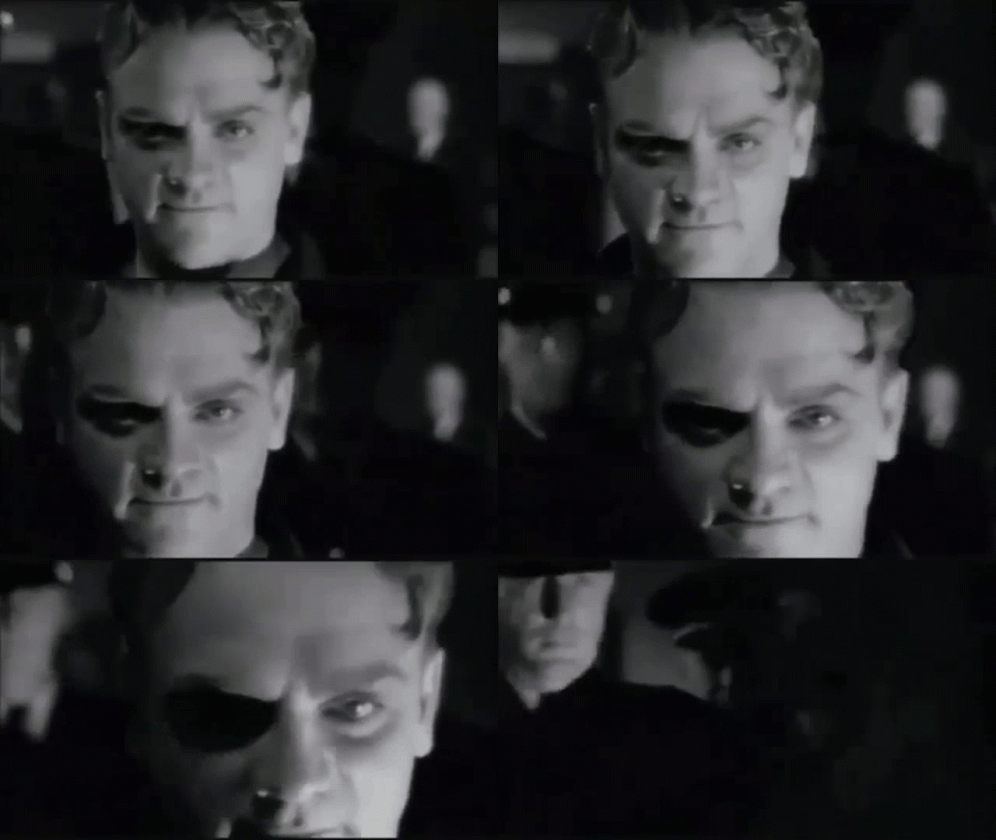
Yes, Frank Ross' collapse into paroxysms of pain in 'Each Dawn I Die' recalls the raw emotion of Cagney in several films; 'Taxi', 'The Crowd Roars', 'Angels With Dirty Faces', 'The Roaring Twenties & ,of course, the astonishing grief scene in 'White Heat;. The Irish in him!
media.tenor.com
a black and white photo of a man with a black eye and a beard .
ALT: a black and white photo of a man with a black eye and a beard .
021
Reposted by Slow Moving Pictures
Michael Warburton @michaelwarburton.bsky.social · 06/02/2026
Francis Ford Coppola's top choice for ‘Hyman Roth’ in THE GODFATHER: PART II (1974) was the great James Cagney. Coppola even went to Cagney's house to discuss the role, but Cagney couldn’t be tempted, passed on it & of course it went to Pacino’s old acting teacher Lee Strasberg.
1183
Slow Moving Pictures @lewisbeerblog.bsky.social · 06/02/2026
James Cagney in Each Dawn I Die: as an innocent man framed for manslaughter, he shows how integrity and a strong will are no match for relentless isolation and punishment. Cagney is best known for playing tough guys (on either side of the law), but he was also a consummate gibbering wreck.
From William Keighley's Each Dawn I Die: a medium close-up of James Cagney chained to the bars of his solitary cell, yelling defiantly at the warden.From William Keighley's Each Dawn I Die: a medium close-up of James Cagney as he receives a visit from his mother; unable to watch her cry, he clenches his eyes shut.From William Keighley's Each Dawn I Die: a medium close-up of James Cagney, seen over George Bancroft's shoulder; he is unshaven and dishevelled after months in solitary; he bares his teeth furiously and jabs his finger at the warden. From William Keighley's Each Dawn I Die: a medium shot of James Cagney breaking down during his parole hearing, clutching the table and sobbing violently as he cries, 'I can't do any more time!'
281
Slow Moving Pictures @lewisbeerblog.bsky.social · 05/02/2026
In this scene from Midnight Run, Robert De Niro conveys so much through his awkward small-talk with his daughter (‘Are you in the eighth grade?’), while Charles Grodin suggests the growing empathy between him and his captor by shutting up for a change and looking tactfully at the ceiling.
From Martin Brest's Midnight Run: Jack (Robert De Niro) and the Duke (Charles Grodin) are in the house of Jack's ex-wife; Jack is trying to talk to his daughter (out of focus in the foreground), while the Duke gives them space and looks at his surroundings.
251
Slow Moving Pictures @lewisbeerblog.bsky.social · 03/02/2026
Look at the care and tenderness with which Edward G. Robinson lights Fred MacMurray’s cigarette. Double Indemnity is about the loneliness of its three central characters; it’s about those small moments (in between the snappy dialogue) when they express emotion without verbalising it.
From Billy Wilder's Double Indemnity: Keyes (Edward G. Robinson) lights Walter Neff's (Fred MacMurray) cigarette as the latter lies sprawled out in an open doorway.
1130
Slow Moving Pictures @lewisbeerblog.bsky.social · 01/02/2026
Phyllis Dietrichson, in Double Indemnity, is no ordinary femme fatale: beneath the scheming, evil exterior is a deeply lonely, vulnerable person who doesn’t know what she’s doing or why she’s doing it. Barbara Stanwyck plays both sides of the character with total conviction, and she breaks my heart.
From Billy Wilder's Double Indemnity: a medium close-up (over Walter Neff's shoulder) of Phyllis Dietrichson looking intensely into Walter's eyes, as she tries to explain why she 'couldn't fire that second shot.'
270
Slow Moving Pictures @lewisbeerblog.bsky.social · 29/01/2026
Carl Dreyer’s films are about bodies and how they interact through the medium of art. Mikaël shines a light on a painting of his own naked body; Countess Zamikow looks from the painting to his (clothed) body, but ‘sees’ what is beneath the clothes.
From Carl Dreyer’s Mikaël (a.k.a. Michael): a medium close-up of Mikaël (Walter Slezak) holding a light, just out of frame, and looking towards the camera. From Carl Dreyer’s Mikaël (a.k.a. Michael): a medium close-up of Countess Zamikow (Nora Gregor) looking from the illuminated painting towards Mikaël, her eyes directed downwards to the lower part of his body.
090
Slow Moving Pictures @lewisbeerblog.bsky.social · 28/01/2026
Carl Dreyer’s films are about looking: he cuts off part of the frame to isolate Nora Gregor’s eyes, and gradually brings Walter Slezak into focus as his paintbrush replicates those eyes on a canvas. How do you show (to the viewer) the 'look' of another person?
From Carl Dreyer’s Mikaël (a.k.a. Michael): a close-up of Nora Gregor, with the frame cut off from her nose downwards and blackness obscuring her hair, isolating her eyes and forehead.From Carl Dreyer’s Mikaël (a.k.a. Michael): Walter Slezak, slightly out of focus as the camera dollies towards him, stands against a black void and reaches out of frame with his right hand to apply paint to a canvas.
0100
Slow Moving Pictures @lewisbeerblog.bsky.social · 27/01/2026
Carl Dreyer’s films are about light and darkness. Benjamin Christensen stands, in focus, before his out-of-focus painting. Then the focus shifts, a shadow descends, and he is subsumed into the old man on the canvas: the painting shows his feelings more vividly than his 'real' self ever could.
From Carl Dreyer’s Mikaël: a medium shot of Claude Zoret, standing in front of his painting of Job (an old man on a desolate patch of land, prostrate on the ground and clutching his chest in agony). A moment later, the light shining on Zoret has been switched off, leaving him in darkness, and the painting in the background has been brought into sharper focus.
0120
Slow Moving Pictures @lewisbeerblog.bsky.social · 26/01/2026
Who could forget the giant head-sculpture in Carl Dreyer’s silent masterpiece, Mikaël? No wonder this image resonated with a director so preoccupied with the power of a close-up: he loves to ‘enlarge’ the human head and examine its opaque surfaces.
From Carl Dreyer’s Mikaël (a.k.a. Michael): a wide shot of Claude Zoret (Benjamin Christensen) shaking hands with his banker; they stand in an open doorway, and behind them, in Zoret’s studio, a huge white sculpture of a human head is mounted on a pedestal.
1245
Reposted by Slow Moving Pictures
Equisapien Replicant of the Falcon Cult Replicants @eqspnrplcnt.bsky.social · 17/01/2026
Playtime (1967) and Red Desert (1965) were both intended as depictions of alienation from modernity, and are both regarded as visual masterpieces in their respective countries. They both are unintentionally but unavoidably statements about capitalism and environmental destruction.
Giuliana in Red Desert framed by industrial garbage as she searches for something in the distance along a massive red wallHulot in Playtime looking down into a grid of high wall cubicles with shut doors bordered by wide hallways, in effect a panopticon
181
Slow Moving Pictures @lewisbeerblog.bsky.social · 17/01/2026
Brendan Hodges on Yi Yi: 'Indebted to Antonioni’s cinema of alienation, Yang expands La Notte’s modernist maze of distorted bodies and faces across an entire cityscape. There’s an inherent loneliness to these city shots, but a quiet humanism too.'
051
Slow Moving Pictures @lewisbeerblog.bsky.social · 17/01/2026
'"I just didn’t think…." is a weak apology but in truth the most accurate explanation for my behavior.' An eloquent summation of what this piece is about: ‘I just didn’t think…[because Rosamond Smith was doing the thinking].’ That last part is elided (...) because the other 'I' is talking now.
000
Reposted by Slow Moving Pictures
David Hudson @dwhdaily.bsky.social · 14/01/2026
There’s a Visconti retrospective on in Vienna, a newly restored Comencini in NYC, and the Harvard Film Archive will soon be screening films by Antonioni, Olmi, and Bertolucci — www.criterion.com/current/post...
Monica Vitti, looking beautiful and bored in Michelangelo Antonioni’s L’AVVENTURA (1960).
171
Reposted by Slow Moving Pictures
James Dalrymple @jamesewand.bsky.social · 14/01/2026
First watch: Matewan (1987, written and directed by John Sayles). Extraordinary true story and much more of a neo-western than I was expecting, and admirable for dealing with an issue rarely touched upon in American cinema: namely, class struggle. 1/3
poster for Matewan (1987), written and directed by John Sayles
5389
Slow Moving Pictures @lewisbeerblog.bsky.social · 15/01/2026
The title sequence of To Sleep with Anger: the warm, familiar domestic space; a creeping sense that something is 'off'; little by little, everything catches fire; but somehow, the fire only lulls us to sleep.
From Charles Burnett's To Sleep with Anger: a wide shot of Gideon (Paul Butler) sitting by a table, on which there is a bowl of fruit; on the wall is an old photograph of a woman. A close-up of Gideon's shoes (with his feet in them) burning. A close-up of Gideon's face, his eyes closed as he falls asleep; flames rise from below the frame.
051
Slow Moving Pictures @lewisbeerblog.bsky.social · 12/01/2026
An especially haunting moment from Carrie: Chris and Billy, watching the aftermath of their prank, are stricken with a kind of blank horror. The split-screen goes beyond the language of shot/reverse-shot. This catastrophe cannot be fully processed by human eyes, or by a single camera-eye.
From Brian de Palma's Carrie: a split-screen image, with a close-up of the blood-soaked, wild-eyed Carrie on the left, and Chris and Billy on the right, spectating the prom scene from their hiding place.
050
Reposted by Slow Moving Pictures
John Hodson @mgcroadster.bsky.social · 08/01/2026
The director’s personal favourite, there’s something quite Lynchian about 'Shadow Of A Doubt', Hitchcock taking his dead eyed villain out of the rotting carcass of a distinctly seedy New Jersey and setting him down in a cute, folksy California. My review on Letterboxd - boxd.it/cwuN1V #FilmSky
boxd.it
A ★★★★½ review of Shadow of a Doubt (1943)
Uncle Charlie: The cities are full of women, middle-aged widows, husbands dead, husbands who've spent their lives making fortunes, working and working. And then they die and leave their money to their...
4458
Reposted by Slow Moving Pictures
Michael Brooke @marbleicehook.bsky.social · 07/01/2026
Today's contextual piece in my ongoing Andrzej Wajda survey on Substack is my most self-indulgent to date, but now that I've covered all three films in the 1950s War Trilogy I had an excellent excuse to write about the logistical challenges of planning and recording commentaries for them—with clips.
marbleicehook.substack.com
Talking about Wajda...
Recording commentaries for Second Run's War Trilogy Blu-ray box set
1125
Reposted by Slow Moving Pictures
Apocalypse Later @apoclater.bsky.social · 02/01/2026
This year I'm reviewing films from 1926 on their centennials and the 1st saw a beautifully shot Carl Theodor Dreyer romantic drama set in Norway. As always, comments are welcome. The Bride of Glomdal (1926) www.apocalypselaterfilm.com/2026/01/the-...
Apocalypse Later That's a Wrap! image of the movie poster for The Bride of Glomdal (1926).
071
Reposted by Slow Moving Pictures
The Quietus @thequietus.com · 07/01/2026
'The Turin Horse is an apocalyptic tale of unrelenting nihilism, suggesting an unholy union of Miklós Jancsó, Antonioni and Beckett. It makes Waiting For Godot seem like an episode of Teletubbies' R.I.P. Béla Tarr buff.ly/Ypzp5G3
Bela Tarr's The Turin Horse black and white still image. Two people sat at a large wooden table, breaking bread.
1298
Reposted by Slow Moving Pictures
Marie Phillips @mariephillips.bsky.social · 04/01/2026
Another of those films that I was barely aware of this morning and consider an all-time great by evening: The Small Back Room boxd.it/cryDrd
boxd.it
A ★★★★★ review of The Small Back Room (1949)
Though made in 1950, this feels like a dispatch right from the very heart of the war. Set in 1943, when the Allies were losing, it tells a story both minor and immense about a small team of scientists...
1011418
Slow Moving Pictures @lewisbeerblog.bsky.social · 06/01/2026
Why does this image from Blow-Up affect me so deeply? The pervasive green-ness, the distance between the two trees, and the predatory grace with which David Hemmings skips between them – there is a secret, lightly embedded in this sequence, about the nature of loneliness.
From Antonioni's Blow-Up: a high-angle shot of Maryon Park; a large patch of grass fills most of the frame; in the background, a green fence separates the grass from a cluster of green tree-canopies; in the middle-ground, David Hemmings (with his camera) stalks from one tree to the other, staying low to avoid being seen (by the people he is photographing).
1160
Slow Moving Pictures @lewisbeerblog.bsky.social · 05/01/2026
If you like Antonioni and have a million hours to spare, why not read all 52 parts of my 284,000-word analysis of Red Desert? There are references to 115 other films and 190 non-film sources, so it's only about half as monotonous as it sounds...
slowmovingpictures.org
Everything That Happens in Red Desert
Contents and bibliography
24914
Slow Moving Pictures @lewisbeerblog.bsky.social · 04/01/2026
‘The blue it speaks so full, it’s like the beauty one can barely stand, or too much things dropped in your hand. And there’s a green like the peace in your heart, sometimes…painted underneath the sheets of ashy snow.’ (Dar Williams, ‘Mark Rothko Song’)
A Mark Rothko painting, known as Green on Blue (1956), University of Arizona Art museum.
0283
Slow Moving Pictures @lewisbeerblog.bsky.social · 02/01/2026
The mythical Room in Stalker: it grants your innermost desire, but do you know what that desire is? Would you want it to be fulfilled? What might that entail, in the ruined world we inhabit? The camera enters the Room and takes us with it, leaving the characters to watch at a safe distance.
From Tarkovsky's Stalker: the camera has dollied backwards into The Room, which is now partially visible to us; we look back at the three men who have travelled here, and who sit at the threshold looking into The Room, or at the floor, or at themselves. The walls and floor of the room are illuminated by a sepia-coloured gloom; the tiled floor is flooded with murky water.
2130
Reposted by Slow Moving Pictures
Radiance Films @filmsradiance.bsky.social · 31/12/2025
Visconti captures the agony and ecstasy of infatuation with the exquisite, snow-laced melodrama LE NOTTI BIANCHE. Our Limited Edition is out now, available at both retailers and on our site: www.radiancefilms.co.uk/products/le-...
0191
Slow Moving Pictures @lewisbeerblog.bsky.social · 31/12/2025
At the end of Red Desert, Valerio points at the poison-smoke: ‘Don’t the little birds die when they fly through it?’ He is not worried - just curious. It is clear from Giuliana’s response that she identifies with those little birds who have learnt to avoid danger. But the danger keeps expanding...
From Antonioni's Red Desert: a wide shot of Giuliana and Valerio standing in a factory courtyard, looking up at the factories; Valerio points at something.
0100
Slow Moving Pictures @lewisbeerblog.bsky.social · 30/12/2025
Two meta-cinematic confrontations from Lemohang Mosese: ‘Many saw death, but Ke’moralioamang, Daughter of No One, saw a resurrection.’ (from This Is Not A Burial, It’s A Resurrection) ‘I stare into the mirror. Do you know what I see, mother? I see you.’ (from Mother, I Am Suffocating)
From Lemohang Jeremiah Mosese's This Is Not A Burial, It's A Resurrection: Ke’moralioamang, Daughter of No One, stares into the camera lens in an intense medium close-up, with the other villagers standing behind her in an obscure blur. From Lemohang Jeremiah Mosese's Mother, I Am Suffocating. This Is My Last Film About You: a child, his face marked by the wool that was tied around it (which has just been unravelled) stares directly into the camera lens in an intense close-up.
060
Slow Moving Pictures @lewisbeerblog.bsky.social · 27/12/2025
‘Now the painting is desperate but the crowds wash away, in a world of kind pedestrians who’ve seen enough today.’ In the final part of this series, I explain why the ending of Red Desert makes me think of Dar Williams’s Mark Rothko Song, and how ‘desperate’ art has saved my life. #filmsky
slowmovingpictures.org
Everything That Happens in Red Desert (52)
Seen enough today
080
Slow Moving Pictures @lewisbeerblog.bsky.social · 26/12/2025
Marcello Mastroianni and Monica Vitti in La notte: which of them is behind the glass, and which of them is reflected in it? No matter how many times I watch the film, the answer always surprises me. This is both a profound existential insight and a measure of my poor spatial awareness.
From Antonioni's La notte: inside the Gherardini mansion, we see Giovanni (Marcello Mastroianni) approaching Valentina (Monica Vitti). We are looking at a pane of glass, and Giovanni is behind it - in a moment, he will walk out from behind it to reveal that the image of Valentina is a reflection.
0152
Slow Moving Pictures @lewisbeerblog.bsky.social · 24/12/2025
Can you see the human figure in this image from Yi Yi? Edward Yang uses transparent-and-reflective surfaces to show how, in our glass-encased urban environment, we can find ourselves occupying multiple spaces at once – or perhaps, as in this lonely image of a hotel room, a kind of no-space.
From Edward Yang’s Yi Yi: the interior of a hotel room, seen reflected in the interior of the hotel room window; outside, we see the buildings of Tokyo (including the base of the Tokyo Tower), dimly lit but still bright enough to render the reflection of the hotel room obscure; the room’s sole occupant is a black shadow crouched in the middle of the lower part of the frame.
291
Slow Moving Pictures @lewisbeerblog.bsky.social · 23/12/2025
Eiko, in Eros+Massacre, is warned to stop researching the past. She stands in front of a screen on which images of that past are projected: she is part of the historical narrative but also a reminder of its artificiality. As one slide phases into another, she stares into the projector light.
From Yoshida's Eros+Massacre: Eiko, positioned to the right of the frame, stands in front of a screen (that fills the entire frame) on which an image of the Great Kantō earthquake is projected; the image is distorted as the slides change over; Eiko stares at the camera, or at the space just behind it - perhaps at the projector light.
0150
Slow Moving Pictures @lewisbeerblog.bsky.social · 20/12/2025
Giuliana stares into the Red Desert; the Red Desert meets her gaze and says, ‘Get out and don’t come back.’ This week, I argue – for about the 51st time – against redemptive interpretations of Antonioni, and draw comparisons with Tarkovsky’s and Mosese’s revelatory endings. #filmsky
slowmovingpictures.org
Everything That Happens in Red Desert (51)
Our place in the red desert
0100
Reposted by Slow Moving Pictures
Genese Grill @genesegrill.bsky.social · 15/09/2025
What is this book, The Man Without Qualities, by Robert Musil? And why might you want to spend a year reading it with me and @samantharhill.bsky.social ? open.substack.com/pub/genesegr...
open.substack.com
The Man Without Qualities
apropos of upcoming reading group with Samantha Rose Hill
1225