Dr. Chloe Josefson @chloejosefson.bsky.social · 17/03/2026Can confirm that this battle was in part inspired by personal rodent traumas #2026MMM 050
Dr. Chloe Josefson @chloejosefson.bsky.social · 17/03/2026Saudi Gazelle OUTLASTS Japanese Otter!! #2026MMM 3277
Dr. Chloe Josefson @chloejosefson.bsky.social · 17/03/2026Otter's one good eye has already spotted the limestone escarpment and he flees BEYOND THE FIELD OF BATTLE! #2026MMM 8233
Dr. Chloe Josefson @chloejosefson.bsky.social · 17/03/2026Left eye sand-filled & watering, Japanese Otter leaps away from the Saudi Gazelle.... no longer up-wind, she has detected fish & Otter! WILL SHE BOLT!?!?! #2026MMM 4191
Dr. Chloe Josefson @chloejosefson.bsky.social · 17/03/2026WIND BLOWS SAND INTO OTTER'S LEFT EYE! #2026MMM 7191
Dr. Chloe Josefson @chloejosefson.bsky.social · 17/03/2026Unheard in the sand-laden wind, female Saudi Gazelle's front hoof whisper-grazes the Otter, who whips sideways in the wind around toward the intruder! #2026MMM 1181
Dr. Chloe Josefson @chloejosefson.bsky.social · 17/03/2026Back to the wind, desert dust & sand begins clinging to Otter's damp coat, blowing into his fur, swirling around him to cover cover fish flesh! Mid-rip Otter can feel the sand gritting against his teeth! #2026MMM 2192
Dr. Chloe Josefson @chloejosefson.bsky.social · 17/03/2026Sitting with casual mustelid satisfaction, Japanese Otter begins ripping and shearing fish flesh with his CANINES and CARNASSIALS when #MMMagic translocates him to the Arabian peninsula! (Yamamoto & Ando 2011) #2026MMM 8272
Dr. Chloe Josefson @chloejosefson.bsky.social · 17/03/2026A large male Japanese Otter, bane of local aquaculture, has successfully swiped a prized Ayo from a commercial fishing operation. Gripping the fish in his SHARP POINTY TEETH, Otter scurries out of the water to bank & shakes droplets of water from his thick fur pelt (Yamamoto & Ando 2011) #2026MMM 2193
Dr. Chloe Josefson @chloejosefson.bsky.social · 17/03/2026MEANWHILE... in 1965 Japan, once widespread, the endemic otter has this year been designated "Special Natural Monument Animal" in light of its declining population numbers. (Yamamoto & Ando 2011) #2026MMM" 1194
Dr. Chloe Josefson @chloejosefson.bsky.social · 17/03/2026The female Saudi Gazelle back to the wind her head away from the dust and sand whipping in the wind, revealing her particularly long, rapier horns, longer than found in nearly every other gazelle species, her large ears bent against the wind. #2026MMM 5211
Dr. Chloe Josefson @chloejosefson.bsky.social · 17/03/2026Particles of dust and sand of a great mid-March sandstorm have arrived, blowing across the sea from the Indian sub-continent, adapted to the hyper-arid environment, a female Saudi Gazelle walks toward the limestone escarpment for a windbreak refuge (Kunte & Aswini 2015). #2026MMM 2191
Dr. Chloe Josefson @chloejosefson.bsky.social · 17/03/2026Tonight's encounter occurs on the Arabian peninsula in 1934, near the western part of Ar-Rub' al Khali, where desert dunes meet the limestone escarpment of Jabal Tuwayq at the end of the greatest expanse of windblown sand on Earth. (Carruthers & Schwarz 1935) #2026MMM 3221
Dr. Chloe Josefson @chloejosefson.bsky.social · 17/03/2026Japanese Otter populations were over-hunted for their pelt. No longer a game animal in 1928, their population continued to decline from polluted rivers impacting their health & food supply. Not observed since 1979, Japanese otters were officially declared extinct in 2012 (Park et al. 2019) #2026MMM 2255
Dr. Chloe Josefson @chloejosefson.bsky.social · 17/03/2026Japanese Otters were up to 31.5 in (80 cm) long & had dark brown fur & webbed feet, similar to extant otters in the genus Lutra. #2026MMM 3253
Dr. Chloe Josefson @chloejosefson.bsky.social · 17/03/2026Saudi gazelles were declared extinct in 2008, w/ the last observed in 1970. Though this species was present from Kuwait to Yemen, they were not common & populations declined due to hunting. Remaining Saudi Gazelle populations decreased due to hybridization with other species of gazelles. #2026MMM 1234
Dr. Chloe Josefson @chloejosefson.bsky.social · 17/03/2026Saudi Gazelles stand approximately 25 in (65 cm) at the shoulder & weigh up to 44 lbs (20 kg). Like other gazelles, they have two forward-curved horns on their head. #2026MMM 2162
Dr. Chloe Josefson @chloejosefson.bsky.social · 17/03/2026NEXT UP: 8-seeded Saudi Gazelle (Gazella saudiya) vs. 9-seeded Japanese Otter (Lutra nippon) #2026MMM 14317
Dr. Chloe Josefson @chloejosefson.bsky.social · 17/03/2026Stellar's Sea Cow DE-SEATS St Kilda House Mouse #2026MMM 4359
Dr. Chloe Josefson @chloejosefson.bsky.social · 17/03/2026Mouse drifts off into the shallow waters of the Bering Sea! #2026MMM 5201
Dr. Chloe Josefson @chloejosefson.bsky.social · 17/03/2026WOOOSHHHH! Sea Cow lowers himself several inches deeper into the water, using his pectoral fins to grab algae. The ice cold water sweeps Mouse away. #2026MMM 1191
Dr. Chloe Josefson @chloejosefson.bsky.social · 17/03/2026Sea Cow lifts his nostrils out of the water to breathe (which they need to do every 4-5 minutes; Forsten & Youngman 1982). Mouse is startled by the sudden noise... and runs to the edge where the Sea Cow's "rocky" back meets the water... #2026MMM 1181
Dr. Chloe Josefson @chloejosefson.bsky.social · 17/03/2026Smaller mammals have higher metabolic rates for their body size & often fuel their reproductive demands based on the “income” of what they eat (Williams et al. 2017; Josefson et al. 2024). Sea Cows can fuel pregnancy & lactation from stored energy (“capital”) when kelp is not abundant. #2026MMM 1191
Dr. Chloe Josefson @chloejosefson.bsky.social · 17/03/2026Mouse is "nutrient recycling", consuming her offspring to recover the bodily resources, such as calcium from her own skeleton, that she liquified & transported to "3D print" her young in her uterus. Now starving to death, mouse mum needs those resources BACK! (Hood 2012). #2026MMM 5202
Dr. Chloe Josefson @chloejosefson.bsky.social · 17/03/2026Mama mouse catches a whiff of her pup & BEGINS TO EAT THE BEBE! (Lane-Petter 1968). #ForbiddenJellyBean #2026MMM 15301
Dr. Chloe Josefson @chloejosefson.bsky.social · 17/03/2026Mouse clenches again and... begins to give birth! Stressors, like famine, can induce early labor in mice (Garcia-Flores et al. 2020). #2026MMM 1161
Dr. Chloe Josefson @chloejosefson.bsky.social · 17/03/2026Mouse pauses & clenches... and turns to quickly return to her nest when MMMagic translocates Mouse to damp, almost rock-like terrain not terribly unlike Hirta... BUT it is the the back of Sea Cow!! #2026MMM 1201
Dr. Chloe Josefson @chloejosefson.bsky.social · 17/03/2026Mouse is extra hungry due because she is heavily pregnant! Her energy demands are increased (Gittleman & Thompson 1988) & energy balance largely determines reproductive performance in mice... but now starving, her reproduction must be traded off against own condition (Bronson 1979). #2026MMM 4211
Dr. Chloe Josefson @chloejosefson.bsky.social · 17/03/2026MEANWHILE on Hirta, the largest island in the St Kilda archipelago, Mouse is also unsuccessfully foraging. Without humans for the last 6 months on whom she relies for food, starvation is coming- she foraged the last left-behind scattered grains several days ago. #2026MMM 3212
Dr. Chloe Josefson @chloejosefson.bsky.social · 17/03/2026TONIGHT’S BATTLE takes place in the early 1760s in the shallow waters around the Commander Islands far West in the Aleutian Islands chain. Sea Cow forages unsuccessfully for Dragon kelp, which is only present May-Sept & Sea Cow may have fasted for months (Le Duc et al. 2022). #2026MMM 1254
Dr. Chloe Josefson @chloejosefson.bsky.social · 17/03/2026St. Kilda House Mouse is a subspecies of Library Legends combatant (house mouse, Mus musculus) but should not be confused with the still-living St. Kilda field mouse (Apodemus sylvaticus hirtensis). #2026MMM 3253
Dr. Chloe Josefson @chloejosefson.bsky.social · 17/03/2026The St. Kilda House Mouse (Mus musculus muralis) likely arrived via Viking ships to the Scottish St. Kilda archipelago & remained commensal with humans until August 1930 when the last of the dwindling St Kilda community departed (Jones et al. 2010). #2026MMM 3294
Dr. Chloe Josefson @chloejosefson.bsky.social · 17/03/2026Steller’s Sea Cow was documented in 1741 & extinct by 1768 (Turvey & Risley 2005). Sea Cow was buoyant & had up to 10 cm of blubber. Their skin was thick, hairless, and described by Georg Steller as “more the bark of an old oak tree, than the skin of an animal” (Le Duc et al. 2022). #2026MMM 5256
Dr. Chloe Josefson @chloejosefson.bsky.social · 17/03/2026Steller’s Sea Cow was the largest member of order Sirenia, with an estimated length of 7.5m (24.6ft) (Forsten & Youngman 1982). Other members of Sirenia include dugongs and manatees (which can be distinguished from one another by their tails). #2026MMM 3262
Dr. Chloe Josefson @chloejosefson.bsky.social · 17/03/2026Steller’s Sea Cow was the largest member of order Sirenia, with an estimated length of 7.5m (24.6ft) (Forsten & Youngman 1982). Other members of Sirenia include dugongs and manatees (which can be distinguished from one another by their tails). #2026MMM 0112
Dr. Chloe Josefson @chloejosefson.bsky.social · 17/03/2026UP NEXT: 1st-seeded Steller's Sea Cow (Hydrodamalis gigas) vs. 16th-seeded St Kilda House Mouse (Mus musculus muralis) #2026MMM 24914
Dr. Chloe Josefson @chloejosefson.bsky.social · 27/03/2025Narwhal follows another Arctic char, flushing it to the surface only to be snatched by a glaucous gull (Larus hyperboreus) (O'Corry-Crowe et al. 2025). #2025MMM 2272
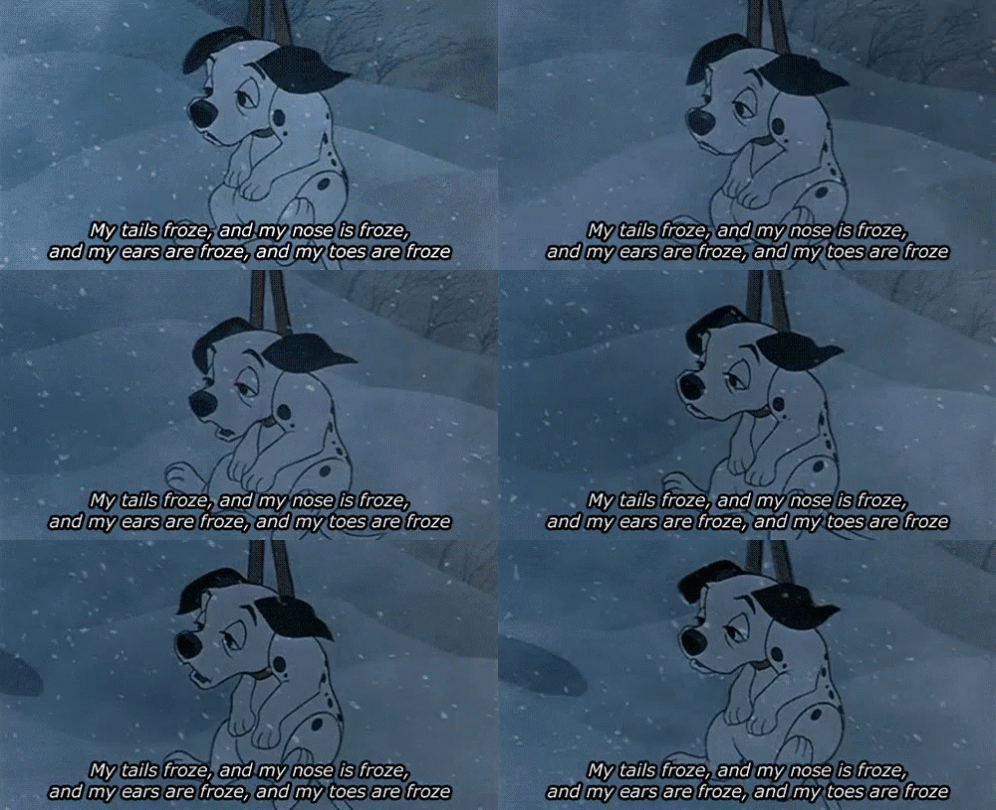
Dr. Chloe Josefson @chloejosefson.bsky.social · 27/03/2025Cold-water drowning can happen in minutes in the Arctic Sea: "Thermal conductivity of water is 20 to 25 times that of air, so a body will lose heat approximately three times faster in water than in air." (Rolf & Gallagher 2018) #2025MMMmedia.tenor.coma dalmatian dog is sitting in the snow with a quote from the movie 101 dalmatians .ALT: a dalmatian dog is sitting in the snow with a quote from the movie 101 dalmatians . 1302
Dr. Chloe Josefson @chloejosefson.bsky.social · 27/03/2025Narwhal's large, hollow horn is aimed at Zebra, who is treading water with greater and greater difficulty... until... Zebra sinks below the icy water's surface... forever #2025MMM 6344
Dr. Chloe Josefson @chloejosefson.bsky.social · 27/03/2025...Zebra grows sluggish as the blood vessels in his legs constrict to redirect blood towards core organs. Zebra's legs become tired as his muscles run out of available energy after shivering in hopes of producing body heat (thermogenesis) #2025MMM 3302
Dr. Chloe Josefson @chloejosefson.bsky.social · 27/03/2025Though many mammals exhibit some degree of the mammalian diving reflex (or response), it is much stronger in aquatic mammals like Narwhal than terrestrial species. This physiological reflex is triggered by submersion in cold water & likely helps preserve oxygen stores (Godek & Freeman 2022) #2025MMM 3293
Dr. Chloe Josefson @chloejosefson.bsky.social · 27/03/2025As Narwhal returns from the depths, he spots something strange moving at the surface above. Narwhal’s laterally-oriented, smaller optic nerve canals mean that he likely has reduced depth perception but a wider field of view (monocular vision) (Racicot et al. 2018) #2025MMM 3291
Dr. Chloe Josefson @chloejosefson.bsky.social · 27/03/2025Zebra’s legs “stride powerfully underwater” (Stone 2008) as he attempts to swim to land he assumes would be surely upstream… but where? #2025MMM 4282
Dr. Chloe Josefson @chloejosefson.bsky.social · 27/03/2025But the water is much colder than Zebra was expecting. MMMagic has transported this odd-toed ungulate to the open waters of Baffin Bay, where sea ice is reaching its maximum coverage this time of year (Harning et al. 2021). #2025MMM 3302
Dr. Chloe Josefson @chloejosefson.bsky.social · 27/03/2025In the grasslands of the Mountain Zebra National Park in S. Africa, Zebra has just finished grazing for grasses and is at a watering hole for his daily drink of water (Penzhorn 1988). He takes a few steps into the water. #2025MMM 1271
Dr. Chloe Josefson @chloejosefson.bsky.social · 27/03/2025Narwhal's fishy playmate makes a quick escape by rapidly swimming in the opposite direction (O'Corry-Crowe et al. 2025). Narwhal plunges deeper into the Bay. #2025MMM 1251
Dr. Chloe Josefson @chloejosefson.bsky.social · 27/03/2025The function of Narwhal’s tusk (actually, a long, spiraled tooth!) is unclear, but very recent work shows that they are used in prey capture and in “exploration and likely play” (O’Corry-Crowe et al. 2025). #2025MMM 2325
Dr. Chloe Josefson @chloejosefson.bsky.social · 27/03/2025TONIGHT, we find Narwhal in the North Water Polynya in the northern Baffin Bay region of the Arctic. Narwhal swims near the surface, his tusk closely pursuing a single Arctic char (Salvelinus alpinus). #2025MMM 3365