Sign in

Emilio Mármol Sánchez

@marmole6.bsky.social
506 followers 747 following 52 posts

Veterinarian & Researcher working on RNA, DNA and 3D genomics in ancient organisms at Globe Institute UCPH. emiliomarmol.academicwebsite.com

PostsRepliesMedia
Emilio Mármol Sánchez @marmole6.bsky.social · 24/09/2026
In our new #AaRC Blog entry from @aarc-community.bsky.social we interviewed Dr. Michael Campana about his new research where he described how old bones can trace the African lion decline throughout the 20th century. 🦁🦁 Click below to read the full story: animal-adna.org/blog/2026/09... #aDNA #Lion
animal-adna.org
Interview to our July AaRCTikTalks speaker Michael Campana · AaRC
020
Emilio Mármol Sánchez @marmole6.bsky.social · 15/09/2026
In our new #AaRC Blog entry from @aarc-community.bsky.social, we interviewed Molly Cassatt-Johnstone about her research project where she rediscovered the true life and ecology of the American "cheetah". Click below to read the full story: animal-adna.org/blog/2026/09... #aDNA #cheetah #ecology
animal-adna.org
Interview to our July AaRCTikTalks speaker Molly Cassatt-Johnstone · AaRC
051
Reposted by Emilio Mármol Sánchez
The Fromm Lab @frommlab.bsky.social · 02/07/2026
Had a bunch of fun presenting our work on ancient RNA #paleotranscriptomics with @lovedalen.bsky.social @marmole6.bsky.social @maridehasque.bsky.social and may more at #SMBE2026
0204
Emilio Mármol Sánchez @marmole6.bsky.social · 26/06/2026
Yesterday, I had the chance to share our last work on ancient mammoth #RNA in front of some of the world leading experts in paleogenetics, #aDNA and other ancient biomolecules, meeting together this week in the first International Conference in Paleogenetics #ICP2026 @palaeogenomics.bsky.social
0160
Reposted by Emilio Mármol Sánchez
The Fromm Lab @frommlab.bsky.social · 25/06/2026
#ICP2026 @marmole6.bsky.social presenting ancientRNA Talk number 3 beautifully summarizing the young field of paleotranscriptomics and showing off the cool 🦣Mammoth RNA paper we published earlier 💪🏻
0132
Reposted by Emilio Mármol Sánchez
The Fromm Lab @frommlab.bsky.social · 23/06/2026
#icp2026 Kicks off with exciting program ahead. It will also include some cool #ancientRNA talks by @marcfriedlander.bsky.social, our PhD student Vanessa and @marmole6.bsky.social
061
Emilio Mármol Sánchez @marmole6.bsky.social · 25/05/2026
🧬🌿🌱 genome.cshlp.org/content/earl...
genome.cshlp.org
030
Emilio Mármol Sánchez @marmole6.bsky.social · 20/05/2026
Discussing about artificial eggshels and giant extinct birds coming back to life ------------------------------ Discutiendo sobre cáscaras artificiales y aves gigantes extintas devueltas a la vida www.abc.es/ciencia/colo...
abc.es
La compañía que quiere resucitar un mamut anuncia los primeros polluelos nacidos de un huevo artificial
La estadounidense Colossal dice haber desarrollado una plataforma de incubación fuera de la cáscara biológica que permitiría devolver a la vida al moa gigante, un ave de Nueva Zelanda extinta hace 600...
010
Emilio Mármol Sánchez @marmole6.bsky.social · 04/05/2026
In our new #AaRC Blog entry from @aarc-community.bsky.social , we interviewed Dr. Anne Kathrine Runge about her research project where she traced prehistoric zoonoses through the bones of ancient animals. Click below to read the full story: animal-adna.org/blog/2026/05... #aDNA #pathogen #zoonosis
animal-adna.org
Interview to our February AaRCTikTalks speaker Anne Kathrine Runge · AaRC
063
Emilio Mármol Sánchez @marmole6.bsky.social · 01/05/2026
Kilobase-scale compartments enabled by CRUSH reveal regulatory programs across cell types, single-cells, and ancient mammoths www.biorxiv.org/content/10.6...
biorxiv.org
020
Emilio Mármol Sánchez @marmole6.bsky.social · 23/04/2026
New preprint out!!📜 We show that decades-old FFPE brain tissue archived in the unique Danish Brain Collection (up to 73 years old) can yield biologically informative genomes and transcriptomes. Read the full manuscript at: www.biorxiv.org/content/10.6... #RNA #DNA #FFPE #Brain
biorxiv.org
042
Emilio Mármol Sánchez @marmole6.bsky.social · 21/04/2026
New #AaRC Blog entry from @aarc-community.bsky.social where we interviewed Dr. Anna Nagel about her research project on estimating ancient DNA age using a multispecies coalescent model, presented in February 2026 #AaRCTikTalks. #aDNA animal-adna.org/blog/2026/04...
animal-adna.org
Interview to our February AaRCTikTalks speaker Anna Nagel · AaRC
021
Emilio Mármol Sánchez @marmole6.bsky.social · 01/04/2026
MicroRNA signatures of equine asthma endotypes in serum and bronchoalveolar lavage fluid www.biorxiv.org/content/10.6...
biorxiv.org
010
Emilio Mármol Sánchez @marmole6.bsky.social · 06/03/2026
www.nature.com/articles/s41...
nature.com
DICER cleavage fidelity is governed by 5′-end binding pockets - Nature
Cryo-electron microscopy and massively parallel assays shed light on the mechanism by which DICER, a key enzyme in the RNase III family, cleaves RNA at precise locations to produce small RNAs.
010
Emilio Mármol Sánchez @marmole6.bsky.social · 05/03/2026
I am looking for prospective Bachelor/MSc students willing to embark in the development of new methods for the extraction, processing, sequencing and analysis of historical and ancient RNA molecules from museum-preserved animal specimens. Read below and apply!! ucph.jobteaser.com/en/job-offer...
ucph.jobteaser.com
Ancient RNA: Uncovering the Lost Ark of paleogenetics | JobTeaser
The analysis of ancient DNA (aDNA) has gained considerable momentum over the past decade , allowing the study of extinct or extant genomes from organisms that lived up to 2.5 million years ago. This h...
152
Reposted by Emilio Mármol Sánchez
Audrey Lin, DPhil @undeaddandy.bsky.social · 24/02/2026
It's that time again... AaRCTikTalk this Friday!! Anne Runge will talk about microbial/pathogen DNA from prehistoric faunal remains🦠🦴🧬, & Anna Nagel will explore multispecies time calibrations! 🧬🕰️ Hurray! Don't miss it! 🕺 @aarc-community.bsky.social
0116
Emilio Mármol Sánchez @marmole6.bsky.social · 16/02/2026
Happening today!! Come to the Maersk Tower Copenhagen at 15:30 for a new session of CPH RNA Club. #RNA #Copenhagen
020
Emilio Mármol Sánchez @marmole6.bsky.social · 16/02/2026
New #AaRC Blog entry from @aarc-community.bsky.social where we interviewed Dr. @tatianafeuerborn.bsky.social about her research project on the genetic legacy of Greenland's sled dogs (Qimmit) she presented in January 2026 #AaRCTikTalks. #Greenland #Dog #aDNA www.animal-adna.org/blog/2026/01...
animal-adna.org
Interview to our January AaRCTikTalks speaker Tatiana Feuerborn · AaRC
0125
Emilio Mármol Sánchez @marmole6.bsky.social · 13/02/2026
academic.oup.com/mbe/article/...
academic.oup.com
Genomic comparisons and the adaptive basis of brain size plasticity and chromosomal instability in the Eurasian common shrew
Abstract. Sorex araneus, the Eurasian common shrew, has seasonal brain size plasticity (Dehnel's phenomenon) and many intraspecific chromosomal rearrangeme
031
Emilio Mármol Sánchez @marmole6.bsky.social · 13/02/2026
New year, new #AaRC blog!! Are you interested in ancient horse genomics? Then have a look at our new 2026 Blog entry from @aarc-community.bsky.social where we interviewed Arianna Weingarten about the research project she presented in January 2026 #AaRCTikTalks www.animal-adna.org/blog/2026/01...
animal-adna.org
Interview to our January AaRCTikTalks speaker Arianna Weingarten · AaRC
032
Emilio Mármol Sánchez @marmole6.bsky.social · 07/02/2026
I just got back a review for one of my stuck-in-revision papers so full of em dashes, like literally present in every other sentence, but also so politely hatefull in tone that it must have been written by some angry beta soviet mother version of all AIs joined together.
010
Emilio Mármol Sánchez @marmole6.bsky.social · 08/01/2026
Thanks to Sébastien Calvignac-Spencer (@scs22.bsky.social) and Carles Lalueza-Fox for their commentary on our work about ancient RNAs in the extinct wolly mammoth A trunkload of ancient RNA www.cell.com/cell/fulltex...
cell.com
A trunkload of ancient RNA
Ancient DNA has become a workhorse for evolutionary biologists. In contrast, ancient RNA studies have been rare and often methodologically controversial. Mármol-Sánchez et al. provide compelling evide...
071
Emilio Mármol Sánchez @marmole6.bsky.social · 28/11/2025
I have heard the same joke about my surname like thousand times during my life. Get a new one!
020
Emilio Mármol Sánchez @marmole6.bsky.social · 15/11/2025
Good read about mammoth ancient RNAs www.livescience.com/animals/mamm...
livescience.com
Mammoth RNA sequenced for the first time, marking a giant leap toward understanding prehistoric life
Scientists successfully sequence the RNA from woolly mammoths found in Siberia that lived up between 10,000 thousand and 50,000 years ago.
1122
Emilio Mármol Sánchez @marmole6.bsky.social · 14/11/2025
Read the whole paper and more information about my research and ongoing projects at: emiliomarmol.academicwebsite.com www.cell.com/cell/fulltex...
emiliomarmol.academicwebsite.com
Emilio Marmol Sanchez | Ancient RNA
Researcher exploring ancient RNA, epigenetics and 3D genomics in extinct and extant species. View my CV, highlights, and contact information.
072
Emilio Mármol Sánchez @marmole6.bsky.social · 14/11/2025
We sincerely thank our funders for trusting in our research ideas and for enabling us to carry out this challenging work. Their support helped us pushing forward the study of ancient #RNA molecules in extinct species. @vetenskapsradet.bsky.social @villumfonden.bsky.social @erc.europa.eu
130
Emilio Mármol Sánchez @marmole6.bsky.social · 14/11/2025
These are the oldest ancient #RNAs ever sequenced, obtained from the extinct woolly #mammoth 🦣🦣 Many thanks to all the people that contributed to make this groundbreaking work possible. @cpgsthlm.bsky.social @scilifelab.se @stockholm-uni.bsky.social @ucph.bsky.social @uitnorgesarktiske.bsky.social
141
Emilio Mármol Sánchez @marmole6.bsky.social · 14/11/2025
Intriguingly enough, some of these #RNAs indicated that Yuka might have died under quite stressful conditions. Indeed, claw marks in its skin could indicate that Yuka was attacked by cave lions before its death!! ☠️
media.tenor.com
a close up of a dog with a blue collar and tag
ALT: a close up of a dog with a blue collar and tag
120
Emilio Mármol Sánchez @marmole6.bsky.social · 14/11/2025
Interestingly, we discovered the expression of muscle-specific protein-coding and #microRNA genes. We were even able to detect two completely novel microRNAs solely based on #RNA data!
110
Emilio Mármol Sánchez @marmole6.bsky.social · 14/11/2025
Yuka was thought to be a female ♀️ mammoth, based on previous external examination. Surprisingly, we found evidence at both #RNA and #DNA levels revealing that Yuka was in fact a male! ♂️
110
Emilio Mármol Sánchez @marmole6.bsky.social · 14/11/2025
The ancient #RNA sequences from Yuka showed increased chemical damage, as expected for such old molecules.
110
Emilio Mármol Sánchez @marmole6.bsky.social · 14/11/2025
The best performing sample was mammoth 1, also known as #Yuka, a 5-year-old juvenile woolly mammoth that died nearly 40,000 years ago and that is one of the best preserved specimens ever found.
121
Emilio Mármol Sánchez @marmole6.bsky.social · 14/11/2025
Only 3 out of the 10 mammoths had #RNA and #DNA of good quality, and the ancient RNA molecules were strongly concentrated in exonic regions.
110
Emilio Mármol Sánchez @marmole6.bsky.social · 14/11/2025
We extracted both ancient #RNA and #DNA from soft tissues that have been preserved in the Siberian permafrost for thousands of years. Did we find any mammoth-like molecules? Yes ✅, both in the RNA and DNA fraction, but not for all the mammoths we analyzed.
110
Emilio Mármol Sánchez @marmole6.bsky.social · 14/11/2025
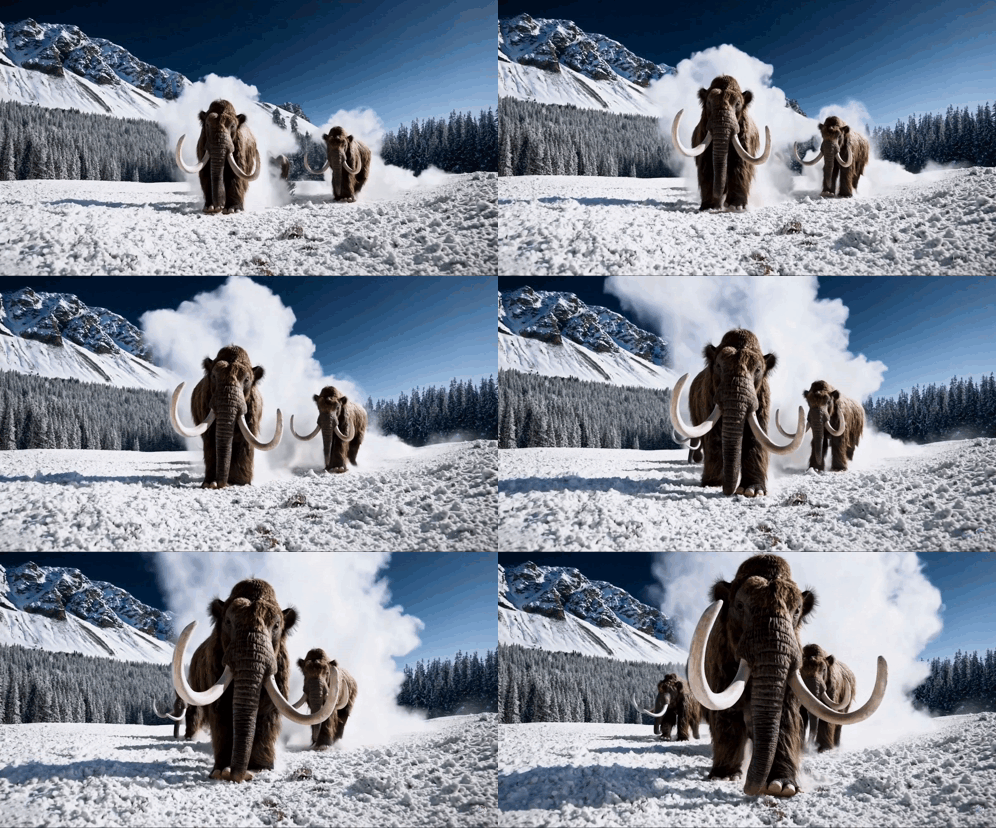
We sought to challenge this, and decided to double down the bet to look for ancient #RNA molecules in the extinct woolly mammoth. We analyzed 10 samples from #mammoths that lived between 10,000 and 50,000 years ago in the Northern region of Siberia during the last Ice Age🥶
media.tenor.com
two mammoths are walking through a snowy field in the mountains
ALT: two mammoths are walking through a snowy field in the mountains
120
Emilio Mármol Sánchez @marmole6.bsky.social · 14/11/2025
So far, isolating, sequencing, and analyzing #RNA molecules from old remains was considered such a difficult task full of past failures and only a handful of successes, that researchers seemed to have just lost hope.
media.tenor.com
a cartoon cat is crying while sitting on a wooden platform
ALT: a cartoon cat is crying while sitting on a wooden platform
110
Emilio Mármol Sánchez @marmole6.bsky.social · 14/11/2025
So why should we bother about #RNA? Contrary to #DNA: 📌RNA tells which genes are "turned on". 📌 We can detect tissue-specific gene expression and metabolic changes (stress, infections...) 📌Novel active genes can be found. 📌We can decipher regulatory mechanisms.
media.tenor.com
a cartoon of homer simpson holding his finger to his lips with the word interesting behind him
ALT: a cartoon of homer simpson holding his finger to his lips with the word interesting behind him
120
Emilio Mármol Sánchez @marmole6.bsky.social · 14/11/2025
During past years, research focused on ancient #DNA has gained a lot of interest, with dozens of papers being routinely published each year📃 But what about ancient #RNA? The common preconception is that these molecules, as opposed to DNA, do not last long after cell death.
media.tenor.com
a cartoon of a monkey laying on the ground with his arms outstretched
ALT: a cartoon of a monkey laying on the ground with his arms outstretched
130
Emilio Mármol Sánchez @marmole6.bsky.social · 14/11/2025
🦣🧬🦣🤯💥We are pleased to share our new paper about ancient RNA expression profiles from the Woolly Mammoth, now published in Cell @cellpress.bsky.social www.cell.com/cell/fulltex... If you want to know more, read the 🧵 below:
111142
Emilio Mármol Sánchez @marmole6.bsky.social · 06/11/2025
www.cell.com/cell/fulltex...
cell.com
Mapping chromatin structure at base-pair resolution unveils a unified model of cis-regulatory element interactions
Li et al. apply base-pair resolution Micro Capture-C ultra to map chromatin contacts between individual motifs within cis-regulatory elements and reveal a unified model of biophysically mediated enhan...
010
Emilio Mármol Sánchez @marmole6.bsky.social · 29/10/2025
academic.oup.com/nar/article/...
academic.oup.com
Functional microRNA targeting without seed pairing
Abstract. MicroRNAs (miRNAs) associate with Argonaute (AGO) proteins to serve as guides, directing binding to partially complementary sites in mRNAs, ultim
010
Emilio Mármol Sánchez @marmole6.bsky.social · 20/10/2025
www.science.org/content/arti...
science.org
On an Arctic archipelago, frozen soil may preserve a hidden history of viruses
Scientists are hunting for ancient RNA in Svalbard’s permafrost, hoping to shed light on the evolution of viral diseases
010
Emilio Mármol Sánchez @marmole6.bsky.social · 03/10/2025
Are you interested in microRNAs 🧬 and goats 🐐? We are!! Then have a look at our preprint on how microRNA mutations segregate worldwide 🌍 in goat populations and the potentially derived consequences of prolonged inbreeding and geographical isolation. www.biorxiv.org/content/10.1...
biorxiv.org
The variability of goat microRNA genes is strongly shaped by functional constraints
Background MicroRNAs (miRNAs) are a type of small non-coding RNAs involved in the post-transcriptional repression of target mRNA transcripts, and responsible for the fine-tuning of numerous molecular ...
041
Emilio Mármol Sánchez @marmole6.bsky.social · 02/10/2025
genomebiology.biomedcentral.com/articles/10....
genomebiology.biomedcentral.com
The rise of historical epigenomics and temporal analysis of gene regulation - Genome Biology
Complex diseases driven by gene-environment interactions impose a heavy burden on human and animal health. Addressing these challenges requires innovative research. The emerging field of historical epigenomics offers a promising opportunity to link genotypes with phenotypes using preserved biological material. New methods such as historical chromatin profiling in museum specimens provide valuable insights into vertebrate genome regulation. Building on successful work with formalin-fixed paraffin-embedded (FFPE) samples, we expect growing interest in using historical specimens for biomedical, evolutionary, and ecological research. Applied to historical collections, these tools can provide critical baselines for understanding modern diseases, environmental stressors, and human adaptation.
072
Reposted by Emilio Mármol Sánchez
Centre for Palaeogenetics @cpgsthlm.bsky.social · 02/09/2025
The world's oldest bacterial DNA found in a million-year-old mammoth! New results from researchers at #CpgSthlm published in Cell! Paper: www.cell.com/cell/abstrac...
37729
Emilio Mármol Sánchez @marmole6.bsky.social · 01/08/2025
Have a look at our new 2025 Blog entry from @aarc-community.bsky.social where we interviewed Dr. Pascale Lubbe (@plubbe.bsky.social) about the research project she presented in July 2025 #AaRCTikTalks www.animal-adna.org/blog/2025/08...
animal-adna.org
Interview to our July AaRCTikTalks speaker Pascale Lubbe · AaRC
083
Reposted by Emilio Mármol Sánchez
Nikolay Oskolkov @oskolkov.bsky.social · 18/07/2025
I am starting a computational lab at LIOS, Riga, Latvia, and going to recruit a few people. Please DM if you are interested in a postdoc or PhD position in my Metabolic Research Group within the TARGETWISE project. I can highly recommend Riga, it is a beautiful city with very good living conditions.
03630
Emilio Mármol Sánchez @marmole6.bsky.social · 19/05/2025
Have a look at our new 2025 Blog entry from @aarc-community.bsky.social where we interviewed PhD Fellow Lydia Hildebrand Furness about the research project she presented in March 2025 #AaRCTikTalks animal-adna.org/blog/2025/05... #aDNA #Dugong #conservation
animal-adna.org
Interview to our March AaRCTikTalks speaker Lydia Hildebrand Furness · AaRC
052
Emilio Mármol Sánchez @marmole6.bsky.social · 18/05/2025
Have a look at our new 2025 Blog entry from @AaRC_Community where we interviewed Dr. Alexander Salis and Dr. Anna Penna (@apenna.bsky.social‬) about the research project he presented in February 2025 #AaRCTikTalks. animal-adna.org/blog/2025/05... animal-adna.org/blog/2025/05... #aDNA #museomics
animal-adna.org
Interview to our February AaRCTikTalks speaker Alexander Salis · AaRC
063
Emilio Mármol Sánchez @marmole6.bsky.social · 12/04/2025
www.biorxiv.org/content/10.1...
biorxiv.org
On the ancestry and evolution of the extinct dire wolf
Dire wolves (Aenocyon dirus) are extinct predators of Pleistocene North America. Although phenotypically similar to living wolves (Canis lupus), dire wolves have yet to be placed confidently in the ca...
041