Sign in

davemomi.bsky.social

@davemomi.bsky.social
102 followers 129 following 16 posts

Computational cognitive neuroscientist 🧠 | Former pro 🏀 | Calisthenics athlete 💪 | @DJIGlobal Pilot 🚁 | Post-Doctoral Research Fellow @StanfordBrain

PostsRepliesMedia
davemomi.bsky.social @davemomi.bsky.social · 05/04/2025
11/11 Sincere thanks to our editors and reviewers at @naturecomms.bsky.social, and to all our collaborators at @camhnews.bsky.social, @stanfordbrain.bsky.social, @stanfordpntlab.bsky.social, @stanfordmedicine.bsky.social and @Università Milano who made this work possible!

media.tenor.com
a cartoon of patrick and spongebob with the words team work below them
ALT: a cartoon of patrick and spongebob with the words team work below them
020
davemomi.bsky.social @davemomi.bsky.social · 05/04/2025
10/11 These findings have exciting implications for brain stimulation therapies in psychiatry and neurology. Targeting high-order vs low-order networks might require completely different stimulation approaches!
120
davemomi.bsky.social @davemomi.bsky.social · 05/04/2025
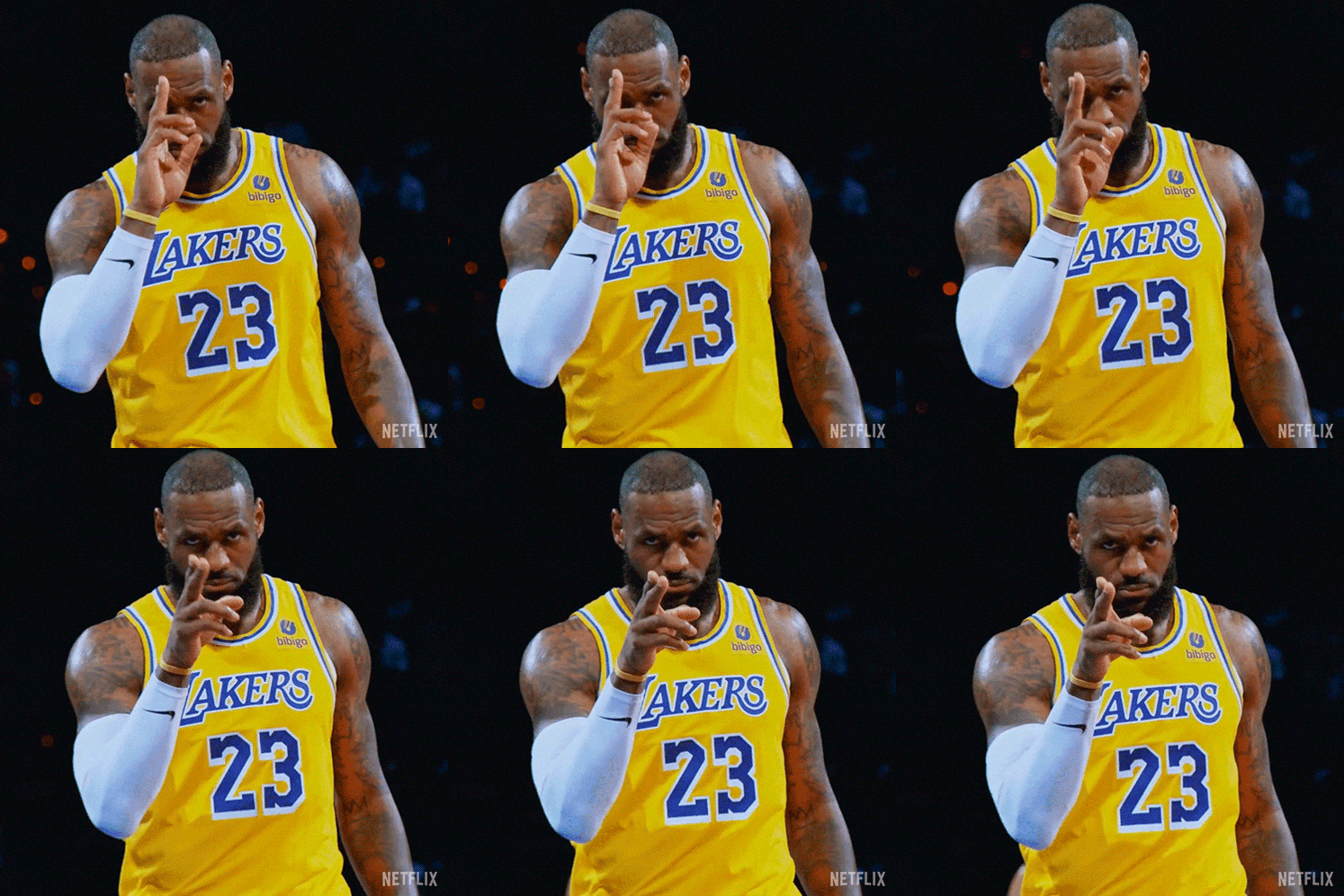
9/11 As @DanteSommoPoeta wrote: "The more perfect a thing is, the more it feels." In the brain, like basketball, star players like @Lebron James (cognitive networks) react dramatically to game changes while role players (sensory networks) maintain steadier, independent performance.
media.tenor.com
lebron james is wearing a yellow lakers jersey with the number 23
ALT: lebron james is wearing a yellow lakers jersey with the number 23
100
davemomi.bsky.social @davemomi.bsky.social · 05/04/2025
8/11 Meanwhile, low-order sensory networks were barely affected by removing these feedback connections! Their responses remained strong, suggesting they rely mostly on local processing rather than whole-brain feedback.
110
davemomi.bsky.social @davemomi.bsky.social · 05/04/2025
7/11 The results were striking: high-order networks NEED feedback from the rest of the brain to generate their full response. When we cut these feedback connections, their responses were significantly reduced.
120
davemomi.bsky.social @davemomi.bsky.social · 05/04/2025
6/11 But why? To understand the mechanism, we built computational models of each patient's brain based on their anatomical connections, and then performed "virtual dissections" - selectively removing connections between networks.
100
davemomi.bsky.social @davemomi.bsky.social · 05/04/2025
5/11 We discovered an "excitability gradient" across the brain! High-order cognitive networks (like the Default Mode Network) showed much stronger responses to stimulation than low-order sensory networks.
120
davemomi.bsky.social @davemomi.bsky.social · 05/04/2025
4/11 Based on our previous computational modeling work (elifesciences.org/articles/83232), we used rare data from 36 epilepsy patients, recording brain activity during 323 electrical stimulation sessions. This gave us a unique window into how stimulation activates different brain regions!
elifesciences.org
TMS-evoked responses are driven by recurrent large-scale network dynamics
Whole-brain computational modelling, incorporating novel ML-based parameter estimation techniques, reveals how transcranial magnetic stimulation-evoked brain responses are driven at earlier timepoints...
100
davemomi.bsky.social @davemomi.bsky.social · 05/04/2025
3/11 Building on @Daniel S. Margulies' seminal work on the "principal gradient" of brain organization (pnas.org/doi/10.1073/...), we asked how these different networks respond to direct electrical stimulation.
pnas.org
PNAS
Proceedings of the National Academy of Sciences (PNAS), a peer reviewed journal of the National Academy of Sciences (NAS) - an authoritative source of high-impact, original research that broadly spans...
110
davemomi.bsky.social @davemomi.bsky.social · 05/04/2025
2/11 The human brain has a fascinating organization: from simple sensory regions to complex cognitive networks. We wondered: do these different networks respond differently when stimulated? And does this follow the brain's known hierarchical organization? academic.oup.com/brain/articl...
academic.oup.com
From sensation to cognition.
Abstract. Sensory information undergoes extensive associative elaboration and attentional modulation as it becomes incorporated into the texture of cogniti
110
davemomi.bsky.social @davemomi.bsky.social · 05/04/2025
1/11 How does our brain's hierarchical organization impact its response to stimulation? We found striking differences between "high-order" networks (involved in complex cognition) vs "low-order" networks (handling sensory/motor functions) @naturecomms.bsky.social www.nature.com/articles/s41...
140
davemomi.bsky.social @davemomi.bsky.social · 09/03/2025
My school in Tanzania is running well! The Giona Basketball Academy just hosted a U12–U19 tournament last week—so much fun! Want to join me in Tanzania, explore the country, and make an impact at my school? DM me! #FreeEducation #SportsValue #Basketball #Tanzania
010
davemomi.bsky.social @davemomi.bsky.social · 24/02/2025
🚀 @GiovanniRabuffo is presenting our poster "Large-Scale Neural Dynamics as a Predictor of Stimulus Effects" at the 6th #BrainStimConf! 📍 Poster P2.064 Don't miss it—come discuss our latest findings on neural dynamics and stimulation effects! #BrainStimulation #Neuroscience
061
davemomi.bsky.social @davemomi.bsky.social · 19/02/2025
Excited to attend Brain Stimulation Conference! Presenting 3 talks and chairing the symposium on Computational and Mathematical Models of Brain Stimulation-Induced Synaptic Plasticity. Looking forward to great discussions and connecting with this amazing community! #BrainStimConf
020
davemomi.bsky.social @davemomi.bsky.social · 11/02/2025
Truly honored and grateful that our symposium Advancements in Brain Stimulation Modeling has been accepted for #OHBM2025 marking our third time being part of this incredible event. Heartfelt thanks to the @ohbmofficial.bsky.social community for this opportunity! #BrainStimulation #modelling
030
davemomi.bsky.social @davemomi.bsky.social · 29/01/2025
🎉 Thrilled to announce that our course on Neural Field Theory & Brain Networks has been accepted for #OHBM2025! Third year teaching computational neuroscience at OHBM. Can't wait to explore brain dynamics in Brisbane! @ohbmtrainees.bsky.social @drbreaky.bsky.social @johndgriffiths.bsky.social
0126